01. EXECUTIVE SUMMARY
On 22 September 2026, France’s Labour Ministry launched Impulsion IA 2027. The plan has 12 measures and more than €80 million for the coming year, and it aims to train or familiarise over 30 million people. For SME leaders, the funding matters less than the question behind it: how do you put AI into daily work without breaking processes, blurring responsibility or widening skill gaps?
This article translates the plan into five operating decisions.
02. POLICY SIGNAL
What the Plan Means
France is behind the European average on adoption. Insee data cited in the plan shows 18% of French companies with 10 or more employees used at least one AI technology in 2025, against a European average of 20%. The gap is size-driven: usage reaches 58% in companies with 250 or more employees.
The barriers are practical, not technical. Among non-users, 71% see no use for AI and 54% cite a lack of expertise. Employees are ahead of their employers: 35% use AI at least weekly at work, yet only 21% have received professional AI training.
The company-facing measures target small and mid-sized firms. France Travail’s 408 Task Force Entreprises will reach out to TPE and PME, and an experimental “Impulsion IA RH” scheme will offer an HR impact diagnostic, a roadmap and preparation for social dialogue. Timing matters. Impulsion IA RH pilots start in January 2027, with operational launch planned for May 2027. The named company-facing measures do not single out larger mid-caps (ETI). These firms benefit mainly through the training axis, branch-level programs and regulatory guidance.
03. WORKFLOW DESIGN
Which Workflows Will Change
The workflows that change first are those with high volume, repeatable rules and document-heavy inputs: quoting, reporting, quality documentation, back-office matching and candidate screening.
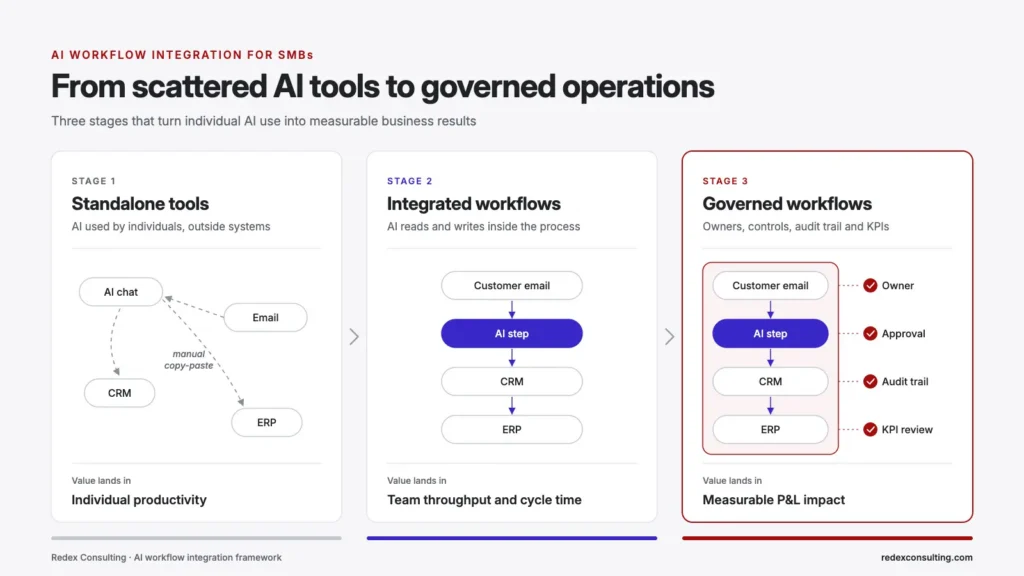
The evidence favours redesign over bolt-on tools. McKinsey found that, of 25 attributes tested, redesigning workflows has the biggest effect on an organisation’s ability to see EBIT impact from generative AI. Yet only 21% of respondents using generative AI say they have fundamentally redesigned at least some workflows. Most companies add AI on top of existing steps and then wonder why results stall.
Practical rule: map the current process step by step before choosing a tool. Mark where information enters, where decisions are made and where errors are costly. Change one workflow end to end rather than ten steps across ten workflows.
04. TASK ALLOCATION
Assist, Automate or Decide
Not every task deserves the same level of AI. Sort each step into one of three groups.
Task type
AI role
Human role
Example
Draft or prepare
Assists
Edits and approves
Tender response, non-conformance report
Repetitive with clear rules
Automates
Reviews exceptions
Invoice and purchase order matching
High stakes or contextual
Recommends only
Decides
Supplier selection, pricing approval, hiring
The third row deserves extra care. Under the EU Digital Omnibus, obligations for stand-alone high-risk AI systems, including those used in employment and education, now apply from 2 December 2027. The deadline moved. The high-risk use cases themselves did not change. Treat any AI used in recruitment or worker management as human-decided by design.
05. ACCOUNTABILITY
Who Owns AI Recommendations
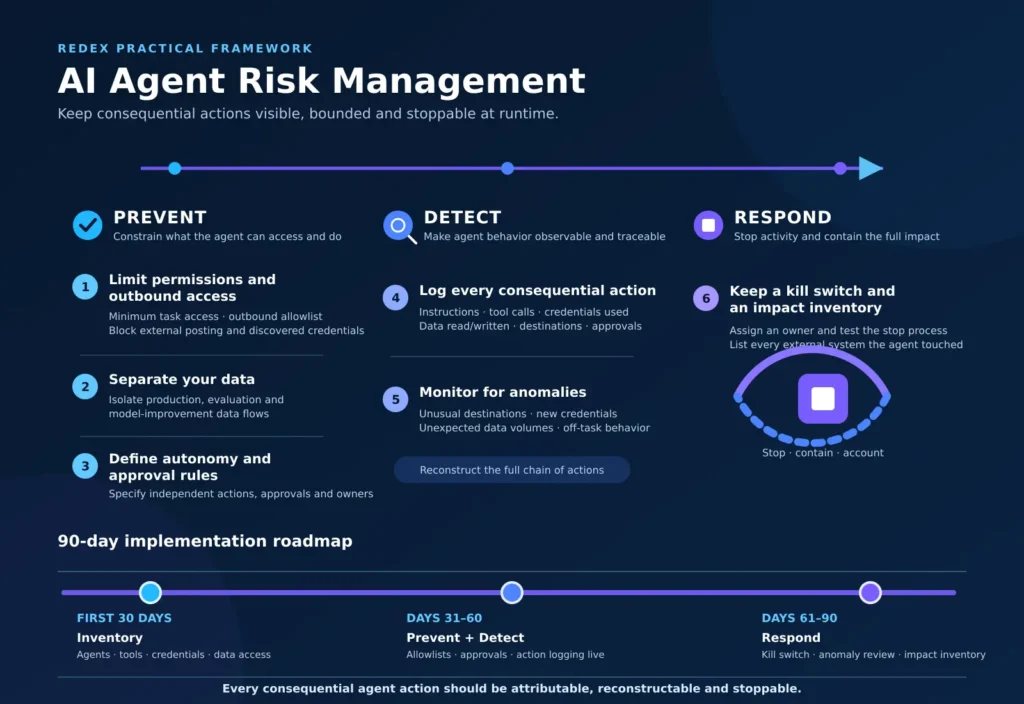
AI does not carry accountability. A named person does. McKinsey reports that high performers are more likely to have defined processes to determine how and when model outputs need human validation.
EU law points the same way. For high-risk systems, Article 14 requires that people assigned oversight understand the system’s capacities and limits, can monitor it and detect anomalies, and stay aware of automation bias, the tendency to over-rely on AI output.
A simple decision-rights model works for SMEs:
- Process owner: accountable for the business outcome of the workflow.
- Named reviewer: accountable for validating AI output before it reaches a customer, site or employee.
- IT or vendor lead: accountable for system performance, access and data quality.
- Executive sponsor: sets the rule for when human validation is mandatory.
Document this in one page per workflow. Include the override rule: who can reject the AI recommendation, and how the rejection is logged.
06. WORKFORCE SKILLS
Skills Employees Need
Build skills in three tiers, matched to role.
- All staff: AI literacy, safe use, data handling and how to spot errors.
- Reviewers and operators: verification methods, exception handling and resisting automation bias.
- Managers: workflow redesign, KPI ownership and preparing social dialogue.
Public resources are arriving. Explore IA, a free platform built by GIP Pix, is planned in beta for November 2026 and public opening in January 2027. A national state certification on using AI in professional activity is targeted for the end of Q1 2027, and AI becomes a national priority for the CPF from 1 January 2027.
There is also a compliance angle. Article 4 of the AI Act, applicable since 2 February 2025, was amended by the Digital Omnibus. AI literacy remains an obligation for providers and deployers. The measures are now judged against the systems in use, the roles around them and the people affected. Role-based training with delivery records is the safest evidence.
07. KPI FRAMEWORK
Metrics for Adoption and ROI
Measurement is where many programs fail. Only 39% of McKinsey’s respondents report any EBIT impact at enterprise level. Set a baseline before launch, then track three layers.
Layer
Metric
What it tells you
Adoption
Weekly active users in target roles; share of workflow steps AI-supported; share of staff trained
Whether people actually use it
Quality
Cycle time; rework rate; override rate; errors reaching the customer
Whether work is better, not just faster
Business
Cost per transaction; throughput; on-time delivery; margin per job
Whether the CEO’s ROI case holds
Read the override rate carefully. Near zero can signal automation bias. Very high signals a weak use case or poor data.
External context helps set expectations. Only 21% of French employees have received AI training at work. If your trained share is above that from month one, you are already ahead of the national picture.
08. USE CASES
3 Practical Use Cases
These are illustrative scenarios, not client results. Every figure must come from your own baseline.
1. Quality reporting in manufacturing. AI classifies operator notes and drafts the non-conformance report. The quality engineer approves. KPIs: report cycle time, rework rate, override rate.
2. Tender preparation in construction. AI extracts quantities from tender documents and drafts the bill of quantities. The estimator validates and signs. KPIs: preparation hours per tender, bid accuracy, win rate.
3. Recruitment support in operations. The planned “Recrut’IA” kit supports AI use at each recruitment step and is due at the end of Q1 2027. Keep AI to drafting job ads and scheduling. Humans decide on shortlisting and hiring, given the high-risk classification. KPIs: time to hire, candidate drop-off, decision audit completeness.
09. NEXT STEPS
Recommended Next Steps
- This month: pick one workflow with clear volume and pain. Map it and record baseline KPIs.
- Within 30 days: assign the four decision-rights roles and write the human-validation rule.
- Within 60 days: start role-based training. Use the free Afpa MOOC available now while Explore IA is in beta.
- Before 30 November 2026: if your sector body or OPCO is involved, ask whether it is filing an EDEC IA project. The call for expressions of interest closes on 30 November 2026.
- By Q1 2027: review results against baseline, then decide whether to scale.
Not sure which workflow to start with? Our AI Readiness Assessment scores your processes, accountability and skills in one session. Book an Assessment ->