01. EXECUTIVE SUMMARY
Your people already use AI. Your business does not.
AI workflow integration is now the gap that separates SMBs that talk about AI from those that profit from it. On 28 September 2026, France Num published its barometer of 9,000 French TPE/PME: AI use rose 14 percentage points in a single year. 4 in 10 small businesses now use an AI solution, and among PME the figure reaches 53%.
That changes the question for every CEO and COO. When half your peers use AI, using it is no longer an advantage. The next stage of digital transformation is not adoption. It is making the AI your teams already use work inside the way the business actually operates.
02. THE PROBLEM
AI Use Ends Where the Copy-Paste Begins
In most SMBs, AI arrived from the bottom up. A sales rep drafts quotes in ChatGPT. An engineer summarises supplier specs in Copilot. A plant manager writes shift reports in Gemini. Each saves time, and none of it shows up in the operating numbers.
The reason is the handoff. The AI output still has to be retyped into the CRM, pasted into the ERP, or emailed to the next team. The gain stays with the individual, while the business keeps the delay, the rework and the errors between steps.
A simple test tells you where you stand: if a person must carry the AI output to the next system before the business can use it, the workflow is not integrated.
03. THE RISK
Standalone AI Carries Cost Without Return
Staying at individual use is not neutral. It creates 3 costs that compound as adoption grows.
- Invisible data exposure. When staff use personal accounts, customer names, pricing and supplier terms leave the business with no record of where they went.
- Inconsistent output. Ten people prompting ten different ways produce ten versions of a quote, a contract summary or a report. Quality depends on who did the work that day.
- No measurable return. Leadership cannot connect AI spend to cycle time, error rates or margin, so the next budget conversation stalls.
The longer this lasts, the harder it becomes to unwind. Habits form around personal tools, and governance arrives later as a restriction rather than a design choice.
04. THE FRAMEWORK
3 Stages of AI Workflow Integration
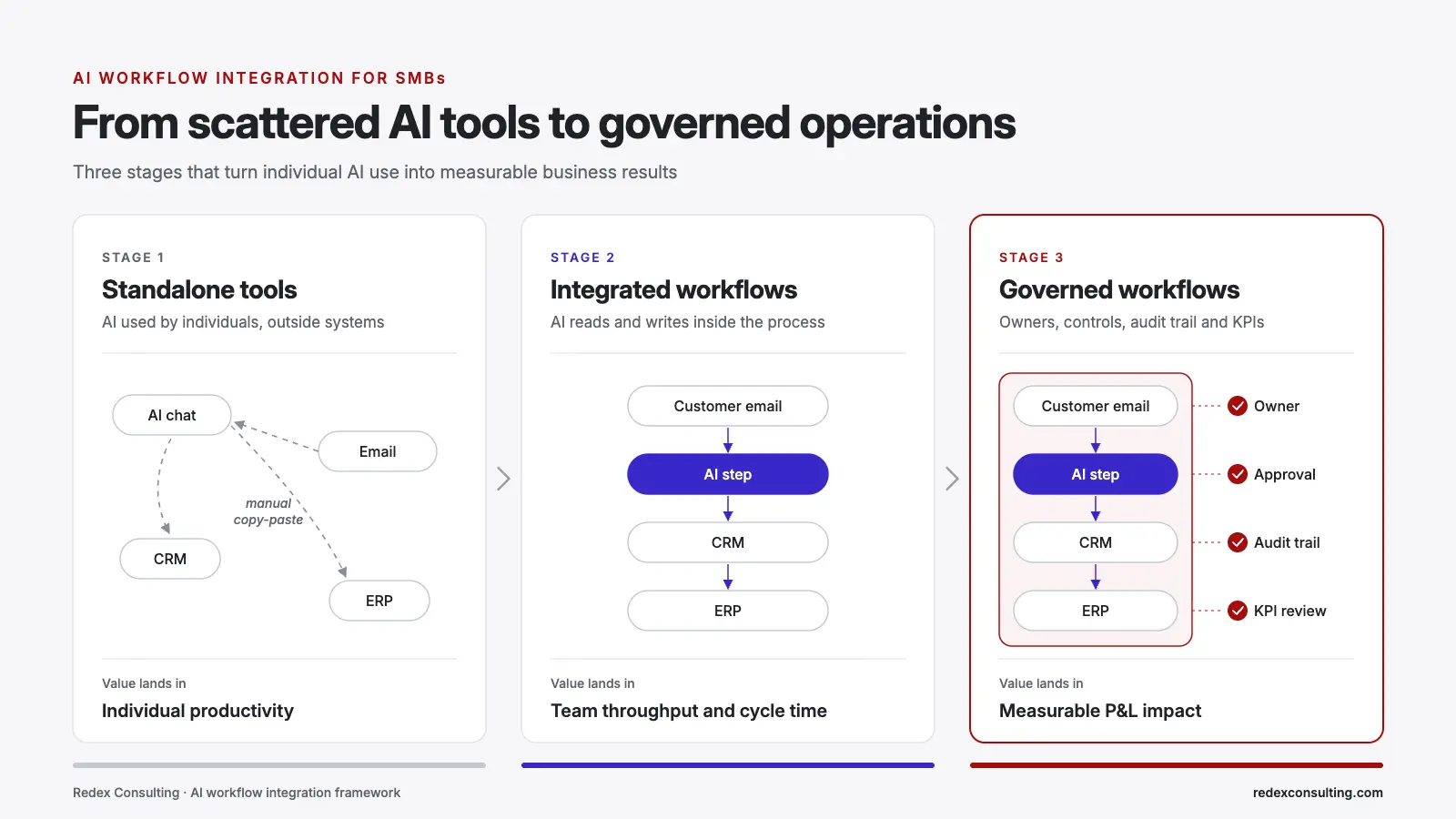
Moving from AI use to AI operations happens in 3 stages. Most SMBs sit at Stage 1 and believe they are at Stage 2.
–
What it looks like
Where value lands
Leadership question
Stage 1: Standalone tools
Staff use AI tools on their own initiative
Individual productivity
Who is using what?
Stage 2: Integrated workflows
AI reads from and writes to CRM, ERP and documents inside a defined process
Team throughput and cycle time
Which handoffs can AI remove?
Stage 3: Governed workflows
Integrated workflows run with owners, controls, logs and KPIs
Measurable P&L impact, repeatable across sites
Can we prove it is safe and paying back?
Stage 1 is where adoption lives. It is useful, cheap and fast, but it scales people, not processes.
Stage 2 is where AI workflow integration starts. AI steps are triggered by real events, such as a customer email or a supplier invoice, and their output lands directly in the system of record. The risk at this stage is automating a broken process faster, so process design comes before tooling.
Stage 3 is where advantage is defended. Each workflow has a named owner, human approval where the stakes are high, an audit trail, and a monthly KPI review. For businesses selling into Europe, this is also where GDPR and EU AI Act obligations are built in rather than bolted on.
Maturity is rarely uniform. Sales may sit at Stage 1 while finance runs a Stage 2 invoice flow that nobody governs.
05. THE METHOD
How to Integrate the AI You Already Use: 5 Questions
Integration does not start with a new platform. It starts with five questions, answered in order.
1. Where is AI already being used?
Map every use case by team, tool, account type and the data it touches. Shadow AI on personal accounts is usually the largest share.
2. Where is work still handed off manually?
Walk three to five core workflows end to end and log each point where a person carries output to the next step. Waiting time between teams is often larger than working time.
3. Which systems need connecting?
List the email, document, CRM and ERP systems each workflow depends on, and how open they are to integration.
4. Which controls are required?
Scale controls to risk: light checks for internal summaries, mandatory approval and audit trails for anything that touches prices, customers or financial records.
5. Which workflow goes first?
Score candidates on business value, feasibility and risk. The first workflow must prove return within 90 days.
The answer to the fifth question is often a revenue or cash workflow, such as quote-to-order or supplier invoice processing, running on systems that already expose APIs.
06. WORK WITH US
The AI Workflow Integration Assessment
Redex Consulting runs this method as a 4 to 6 week assessment for SMBs and mid-market firms. You receive an AI usage map, a manual handoff map, a systems integration plan, the controls each workflow needs, and a business case for the first workflow to integrate, with a 90-day plan to take it from Stage 1 to Stage 3.
Best for: CEOs and COOs of 50 to 500 person construction, manufacturing and energy firms whose teams already use AI but see no change in operating results.
FAQ
Questions Leaders Ask About AI Workflow Integration
What is AI workflow integration?
It is the step where AI stops being a personal tool and becomes part of a business process. AI reads from and writes to systems such as CRM and ERP, so its output is used without a person copying it between tools.
Do we need new AI tools to integrate AI into our workflows?
Usually not. Most SMBs can start with the AI licences and business systems they already pay for, connected through native connectors or middleware.
How long does it take to see a return?
A well-chosen first workflow should show measurable results within 90 days. Choosing a workflow with high value and high feasibility matters more than the technology.
How do we keep AI use safe and compliant?
Scale controls to risk: approved tools, data classification, human approval for high-stakes output, access rights and audit trails. Firms selling into the EU should map these controls to GDPR and the EU AI Act.
Which workflow should we integrate first?
Start with a workflow that has many manual handoffs, costly errors and systems that already expose APIs. Quote-to-order and supplier invoice processing are common first choices.