
01. EXECUTIVE SUMMARY
The $30 Billion Opportunity in DXP for Manufacturing
Digital experience platform (DXP) for manufacturing has become the fastest-growing technology category in industrial digital transformation. The global DXP market reached $12.4 billion in 2023 and is projected to exceed $30 billion by 2030, according to Grand View Research. Yet most manufacturers are still making platform decisions based on vendor marketing rather than operational requirements.
The stakes are significant. A Deloitte survey found that 93% of industrial manufacturing companies are already experimenting with or implementing digital customer experience initiatives. On average, these companies are deploying four use cases simultaneously. The question is no longer whether to invest in a digital experience platform for manufacturing, but which platform architecture will deliver the fastest return.
This guide provides a structured, vendor-neutral framework for evaluating DXP platforms against manufacturing-specific requirements. It covers seven selection criteria, six leading platforms, three architecture approaches, and five proven use cases drawn from real implementation experience.
$30B+
Global DXP market by 2030
93%
Manufacturers implementing DCX initiatives
4
Average use cases deployed simultaneously
Using AI/ML and IoT for customer experience
02. Foundation
What Is a Digital Experience Platform (DXP)?
A DXP is an integrated set of technologies that enables organizations to create, manage, deliver, and optimize digital experiences across every customer touchpoint. Unlike a traditional content management system (CMS), a DXP combines content management with commerce, personalization, analytics, and integration capabilities in a unified architecture.
For manufacturers, this distinction matters. A CMS can publish product pages. A digital experience platform for manufacturing can connect those product pages to real-time inventory data, personalize pricing for each dealer account, trigger automated reorder workflows, and feed equipment performance data back into the customer portal.
Capability
Traditional CMS
DXP
Content Management
Core strength
Core strength + headless delivery
B2B Commerce
Requires separate platform
Integrated or composable
Personalization
Basic (page-level)
Advanced (role, account, behavior-based)
Analytics
Page views, basic metrics
Journey analytics, attribution, A/B testing
Integration
Limited API support
API-first, pre-built connectors
IoT Data
Not supported
Real-time data ingestion and visualization
Multi-channel
Web only
Web, mobile, kiosk, IoT, partner portals
Typical Cost
$10K-$100K/year
$100K-$1M+/year
RedEx Point of View
The CMS vs DXP decision is not about technology sophistication. It is about business model complexity. If your digital channels simply publish content, a CMS is sufficient. If your digital channels need to transact, personalize, and integrate with operational systems, you need a DXP. Most manufacturers we work with have outgrown their CMS within 18 months of launching their first dealer portal.
03. Business Drivers
Why Manufacturers Are Investing in DXP
6 business drivers are accelerating DXP for manufacturing adoption across this sector. Each driver represents a measurable gap between current capabilities and market expectations.
01
B2B Buyer Expectations
Industrial buyers now expect consumer-grade digital purchasing experiences. 73% of B2B buyers prefer to order online rather than through sales representatives.
02
Dealer Channel Pressure
Dealers demand self-service tools for inventory, pricing, and order management. Manufacturers without digital dealer portals are losing channel partners to competitors who offer them.
03
After-Sales Revenue
Service and spare parts represent 20-30% of manufacturing revenue. Digital service portals increase parts attach rates by 35% and reduce support costs by 45%.
04
Global Operations
Multi-region manufacturers need consistent brand experiences across languages, currencies, and regulatory environments. Manual localization does not scale.
05
IoT Monetization
Connected products generate data that customers will pay for. Equipment performance dashboards, predictive alerts, and usage-based pricing all require a DXP delivery layer.
06
Competitive Differentiation
When products are commoditized, the digital experience becomes the differentiator. Manufacturers with superior digital touchpoints command 12-18% price premiums.
"An enhanced digital customer experience is now considered table stakes according to industrial manufacturing and construction companies."
Deloitte, Digital Customer Experience in Industrial Manufacturing, 2024
04. Selection Framework
7 Critical Criteria for Evaluating a DXP for Manufacturing
These 7 criteria are drawn from 14+ DXP implementations across manufacturing, construction, and energy sectors. Each criterion includes evaluation questions and red flags to watch for during vendor selection.
Integration Architecture
Manufacturing environments run on complex technology stacks. Your ERP (SAP, Oracle, Microsoft Dynamics), PLM, MES, and CRM systems must connect seamlessly with the DXP. Evaluate the platform’s native connectors, API capabilities, and middleware support.
Key Evaluation Questions
- Does the platform offer pre-built connectors for your ERP system?
- Can it support real-time data synchronization with shop floor systems?
- How does it handle data transformation between OT and IT systems?
- What middleware or integration platform (iPaaS) is required?
Red Flag
Platforms that require custom development for every integration point will drive implementation costs 3-5x higher than projected.
B2B Commerce Capabilities
Industrial commerce is fundamentally different from B2C. Your platform must support complex pricing (contract pricing, volume discounts, customer-specific catalogs), configure-price-quote workflows, and multi-step approval processes that are standard in manufacturing procurement.
Key Evaluation Questions
- Can it handle customer-specific pricing and product catalogs?
- Does it support configure-price-quote (CPQ) for complex products?
- Can it manage multi-step purchase approval workflows?
- How does it handle bulk ordering and reorder functionality?
Red Flag
Platforms designed primarily for B2C retail will require extensive customization to support manufacturing procurement workflows.
Content & Asset Management
Manufacturers manage thousands of SKUs, each with technical specifications, CAD files, compliance documents, safety data sheets, and marketing content. The DXP must handle structured product data alongside unstructured content across multiple languages and regions.
Key Evaluation Questions
- Can it manage both structured product data and unstructured content?
- Does it support digital asset management for CAD files and technical drawings?
- How does it handle multi-language content for global operations?
- Can it enforce compliance workflows for regulated content?
Red Flag
Platforms without native DAM and PIM integration will create content silos that defeat the purpose of a unified digital experience.
Personalization & Segmentation
Manufacturing audiences are diverse. Dealers, distributors, end customers, service technicians, and procurement teams all need different views of the same product data. The DXP must deliver role-based experiences without maintaining separate portals for each audience.
Key Evaluation Questions
- Can it deliver role-based content and navigation for different user types?
- Does it support account-based personalization for enterprise customers?
- How does it handle permission-based access to technical documentation?
- Can it personalize product recommendations based on purchase history?
Red Flag
Building separate portals for each audience segment multiplies maintenance costs and creates inconsistent brand experiences.
Scalability & Performance
Manufacturing catalogs can contain 50,000+ SKUs with complex product relationships. The platform must handle large product databases, high-volume API calls from IoT devices, and traffic spikes during trade shows or product launches without performance degradation.
Key Evaluation Questions
- How does the platform perform with 50,000+ SKUs and complex product hierarchies?
- Can it handle concurrent API calls from thousands of connected devices?
- What is the platform's uptime SLA and disaster recovery capability?
- Does it support edge caching for global manufacturing operations?
Red Flag
Platforms that slow down significantly above 10,000 products will become a bottleneck as your digital catalog grows.
Total Cost of Ownership
Manufacturing environments run on complex technology stacks. Your ERP (SAP, Oracle, Microsoft Dynamics), PLM, MES, and CRM systems must connect seamlessly with the DXP. Evaluate the platform’s native connectors, API capabilities, and middleware support.
Key Evaluation Questions
- What is the 5-year total cost including licensing, implementation, and maintenance?
- How many specialized developers are required to maintain the platform?
- What is the typical implementation timeline for manufacturing use cases?
- Are there hidden costs for API calls, storage, or user seats?
Red Flag
Vendors that quote only licensing costs are obscuring the true investment. Always demand a full TCO breakdown before signing.
Composability & Future-Readiness
Manufacturing environments run on complex technology stacks. Your ERP (SAP, Oracle, Microsoft Dynamics), PLM, MES, and CRM systems must connect seamlessly with the DXP. Evaluate the platform’s native connectors, API capabilities, and middleware support.
Key Evaluation Questions
- Is the platform built on a composable, API-first architecture?
- Can individual components be replaced without full re-platforming?
- Does it support headless content delivery for emerging channels?
- How does the vendor's roadmap align with MACH principles?
Red Flag
Monolithic platforms that lock you into a single vendor's ecosystem will limit your ability to adopt best-of-breed solutions as the market evolves.
05. DXP Architecture
6 Leading DXP Platforms for Manufacturing
This comparison reflects platform capabilities as of Q1 2026. Redex maintains vendor-neutral relationships with all platforms listed. Rankings are based on manufacturing-specific fit, not general market position.
Platform
Type
Core Strength
Mfg Fit
Pricing
Composable
Best For
Sitecore
Suite DXP
Enterprise personalization, content management
Strong
$$$$$
Hybrid (XM Cloud)
Large manufacturers with complex personalization needs
Adobe Experience Cloud
Suite DXP
Analytics, marketing automation, asset management
Strong
$$$$$
Hybrid
Manufacturers with large marketing teams and Adobe ecosystem
Optimizely
Suite DXP
Experimentation, A/B testing, content management
Moderate
$$$$$
Hybrid
Data-driven manufacturers focused on conversion optimization
Liferay
Suite DXP
B2B portals, commerce, self-service
Moderate
$$$
Modular
Mid-market manufacturers needing dealer/ customer portals
Acquia
Open DXP
Drupal-based flexibility, open source foundation
Moderate
$$$
Native
Manufacturers with in-house development teams
Contentful
Headless CMS
API-first content delivery, developer experience
Growing
$$
Native
Manufacturers building composable stacks from scratch
RedEx Point of View
Platform selection should start with use cases, not vendor demos. Define your top three manufacturing use cases (dealer portal, B2B commerce, service portal), map the integration requirements to your existing tech stack, and then evaluate platforms against those specific needs. The best platform is the one that fits your operational reality, not the one with the most impressive feature list.
06. Architecture Decision
Monolithic vs Composable vs Hybrid: Which Architecture Fits?
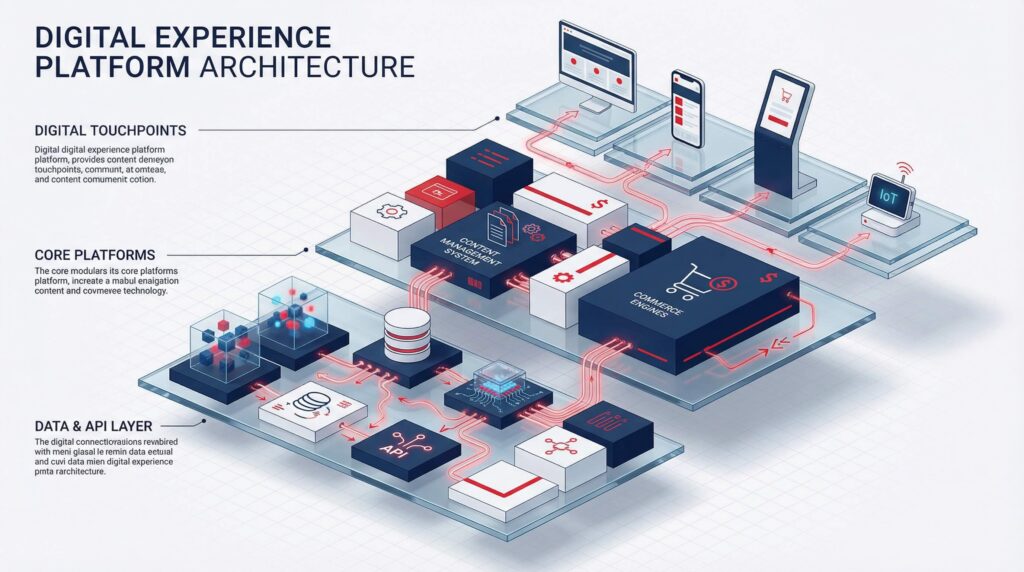
The architecture decision is as important as the platform decision. Each approach carries different trade-offs in flexibility, complexity, cost, and time-to-value.
Monolithic DXP
All-in-one suite from a single vendor. Content management, commerce, personalization, and analytics are tightly integrated.
Advantages
- Single vendor accountability
- Pre-integrated components
- Faster initial deployment
- Unified support and training
Trade-offs
- Vendor lock-in risk
- Slower innovation cycles
- Higher licensing costs
- Difficult to swap individual components
Best for:
Manufacturers with limited IT resources who need a turnkey solution and can commit to a single vendor ecosystem.
Examples:
Sitecore XP, Adobe Experience Manager (traditional)
Composable DXP
Best-of-breed components connected through APIs and a central orchestration layer. Each component can be independently selected, deployed, and replaced.
Advantages
- Best-of-breed flexibility
- Faster innovation adoption
- Lower long-term TCO
- No single vendor lock-in
Trade-offs
- Higher integration complexity
- Requires skilled development team
- Multiple vendor relationships
- Longer initial setup
Best for:
Manufacturers with strong IT teams who want maximum flexibility and plan to evolve their digital stack over time.
Examples:
Contentful + commercetools + Algolia + Segment
Recommended for Most Manufacturers
Hybrid DXP
A core platform with composable extensions. The vendor provides essential capabilities while allowing third-party integrations for specialized functions.
Advantages
- Balanced flexibility and simplicity
- Core vendor support with extensibility
- Gradual modernization path
- Lower risk than full composable
Trade-offs
- Partial vendor dependency
- Some integration overhead
- May outgrow hybrid model
- Variable component quality
Best for:
Most mid-market manufacturers. Provides stability with room to grow and modernize incrementally.
Examples:
Sitecore XM Cloud, Optimizely, Liferay DXP, Adobe Experience Manager (cloud)
07. Proven Use Cases
5 High-Impact DXP Use Cases for Manufacturers
These 5 use cases represent the highest-ROI applications of a digital experience platform for manufacturing. Each is drawn from real implementation experience across industrial sectors.
Dealer & Distributor Portals
Dealer & Distributor Portals
Problem
Dealers rely on phone calls and emails to check inventory, place orders, and access product specifications. This creates delays, order errors, and inconsistent pricing across channels.
Solution
A DXP-powered dealer portal centralizes product catalogs, real-time inventory, pricing rules, and order management into a single self-service interface. Dealers can configure products, check availability, and place orders without contacting sales teams.
Outcome
- 68% reduction in order processing time
- 42% fewer order errors
- 3.2x increase in dealer self-service adoption
B2B Digital Commerce
B2B Digital Commerce
Problem
Industrial buyers expect the same digital purchasing experience they get as consumers. Most manufacturers still rely on PDF catalogs, manual quoting, and fax-based ordering.
Solution
A composable DXP integrates product information management (PIM), configure-price-quote (CPQ) engines, and payment processing into a unified B2B commerce experience. Buyers can search, configure, price, and order complex industrial products online.
Outcome
- $2.4M average annual revenue from digital channel
- 55% faster quote-to-order cycle
- 31% increase in average order value
After-Sales Service Portals
After-Sales Service Portals
Problem
Customers struggle to find warranty information, order spare parts, or schedule service appointments. Support teams spend 60% of their time answering repetitive questions that could be self-served.
Solution
A DXP-based service portal provides customers with warranty lookup, spare parts ordering, service scheduling, and knowledge base access. Integration with IoT sensors enables proactive service alerts based on equipment condition data.
Outcome
- 45% reduction in support ticket volume
- 72% customer self-service resolution rate
- 28% improvement in customer satisfaction scores
Product Information Management
Product Information Management
Problem
Product data lives in spreadsheets, ERP systems, and individual team members' laptops. Inconsistent specifications across channels lead to returns, warranty claims, and lost customer trust.
Solution
A DXP with integrated PIM capabilities creates a single source of truth for all product data. Technical specifications, CAD drawings, compliance documents, and marketing content flow automatically to every digital touchpoint.
Outcome
- 89% reduction in product data errors
- 4x faster time-to-market for new products
- 35% decrease in product returns due to specification errors
IoT Data Visualization
IoT Data Visualization
Problem
Connected equipment generates massive volumes of sensor data, but this data remains trapped in operational technology (OT) systems. Customers cannot access performance insights about their purchased equipment.
Solution
A DXP integrates with IoT platforms to deliver real-time equipment performance dashboards to customers. This transforms the manufacturer from a product seller into a service partner, creating recurring revenue opportunities through data-driven maintenance contracts.
Outcome
- $1.8M average annual recurring revenue from data services
- 23% increase in customer retention
- 4.5x improvement in equipment uptime visibility
08. Implementation Guide
4-Phase DXP Implementation Roadmap
A successful DXP implementation for manufacturing typically spans 12-18 months from vendor selection to full production deployment. This roadmap breaks the journey into 4 manageable phases.
Phase 1: Discovery & Platform Selection
- Month 1-3
- $75K-$150K
- Audit current digital touchpoints and integration landscape
- Define top 3 use cases with measurable success criteria
- Evaluate 3-4 shortlisted platforms against selection criteria
- Build proof-of-concept with top 2 platforms
- Select platform and negotiate licensing terms
Deliverables:
Platform selection report, integration architecture blueprint, 5-year TCO model
Phase 2: Foundation & First Use Case
- Month 4-8
- $200K-$400K
- Deploy platform infrastructure and development environments
- Build core integrations (ERP, PIM, CRM)
- Implement first use case (typically dealer portal or product catalog)
- Establish content governance and workflow processes
- Train internal team on platform administration
Deliverables:
Production-ready first use case, integration layer, content governance playbook
Phase 3: Expansion & Optimization
- Month 9-15
- $150K-$350K
- Launch second and third use cases (commerce, service portal)
- Implement personalization rules for different audience segments
- Integrate analytics and establish KPI dashboards
- Optimize performance for large product catalogs
- Roll out to additional regions or business units
Deliverables
Multi-use-case production environment, personalization engine, analytics dashboards
Phase 4: Scale & Continuous Improvement (Ongoing)
- On-going
- $100K-$200K/year
- Add IoT data integration and customer-facing dashboards
- Implement AI-powered search and product recommendations
- Expand to mobile and kiosk channels
- Continuous A/B testing and conversion optimization
- Evaluate composable component upgrades
Deliverables:
Omnichannel digital experience, AI-enhanced features, continuous optimization program
09. ROI Analysis
Building the Business Case for Manufacturing DXP
DXP investments in manufacturing typically achieve positive ROI within 18-24 months. The returns come from 5 measurable value streams.
Value Stream
Conservative
Moderate
Aggressive
Digital commerce revenue (new channel)
$500K/yr
$1.5M/yr
$3M+/yr
Support cost reduction (self-service)
$120K/yr
$280K/yr
$450K/yr
Order processing efficiency
$80K/yr
$180K/yr
$320K/yr
Dealer/partner retention improvement
$200K/yr
$500K/yr
$900K/yr
Data services revenue (IoT)
$150K/yr
25-35% of COGS
$1.2M/yr
RedEx Point of View
The most commonly underestimated value stream is dealer retention. When a manufacturer loses a dealer to a competitor with better digital tools, the revenue impact is 10-50x the cost of the DXP investment. We recommend framing the business case around competitive risk, not just operational efficiency.
10. Implementation Guide
5 DXP Implementation Pitfalls and How to Avoid Them
These 5 failure patterns appear in over 60% of manufacturing DXP implementations. Each is preventable with the right approach.
Selecting Platform Before Defining Use Cases
Teams evaluate platforms based on feature lists and vendor demos rather than specific manufacturing requirements. This leads to expensive platforms that are over-engineered for actual needs, or under-powered platforms that require costly customization.
Redex Countermeasure
Define your top 3 use cases with measurable success criteria before engaging any vendor. Build a requirements matrix weighted by business impact, then evaluate platforms against that matrix.
Underestimating Integration Complexity
Manufacturing environments have deeply embedded ERP, PLM, MES, and CRM systems. Integration with these systems typically consumes 40-60% of total implementation budget, but is often estimated at 15-20%.
Redex Countermeasure
Conduct a thorough integration audit before platform selection. Map every data flow between the DXP and existing systems. Budget 50% of implementation costs for integration work.
Launching Without Content Governance
Teams focus on platform configuration and ignore content strategy. The result is a technically capable platform with inconsistent, outdated, or missing content that undermines the digital experience.
Redex Countermeasure
Establish content ownership, review workflows, and quality standards before launch. Assign product managers as content owners for their product lines. Automate content freshness alerts.
Ignoring Change Management
Dealers, distributors, and internal teams resist new digital tools when they are deployed without training, communication, or incentive alignment. Adoption rates below 30% are common.
Redex Countermeasure
Start change management 3 months before launch. Identify champion users in each dealer segment. Provide hands-on training, not just documentation. Tie dealer incentives to portal adoption.
Over-Customizing the Platform
Teams build custom features instead of adapting business processes to platform capabilities. This creates technical debt, slows upgrades, and increases maintenance costs by 3-5x.
Redex Countermeasure
Adopt a 'configure before customize' principle. For every custom feature request, evaluate whether a process change or platform configuration can achieve 80% of the requirement at 20% of the cost.
Transform Your Manufacturing Operations
Start Your DXP Assessment
Redex provides vendor-neutral DXP advisory for manufacturers. Our assessment covers your current digital maturity, use case prioritization, platform shortlisting, and implementation roadmap. No vendor commitments required.
What the Assessment Covers
- Current digital maturity audit across all customer touchpoints
- Use case prioritization based on business impact and feasibility
- Platform shortlist with manufacturing-specific evaluation criteria
- Integration architecture blueprint for your tech stack
- 5-year TCO model and ROI projection
- Implementation roadmap with phased milestones
FAQs
DXP Selection Questions from Manufacturing Leaders
What is the typical timeline for a manufacturing DXP implementation?
A full DXP implementation for manufacturing typically spans 12-18 months from vendor selection to production deployment of the first three use cases. The first use case (usually a dealer portal or product catalog) can go live within 5-6 months. Subsequent use cases like B2B commerce and service portals add 3-4 months each. The timeline depends heavily on integration complexity with existing ERP and PLM systems.
Should we choose a monolithic or composable DXP architecture?
For most mid-market manufacturers, a hybrid approach offers the best balance. Start with a core platform that provides content management, basic commerce, and portal capabilities out of the box. Then extend with best-of-breed components (search, PIM, analytics) as your digital maturity grows. Full composable architectures require strong internal development teams and are better suited for large enterprises with dedicated platform engineering resources.
How does a DXP differ from our existing CMS?
A CMS manages and publishes content. A digital experience platform combines content management with commerce, personalization, analytics, and integration capabilities. For manufacturers, the key difference is integration depth. A DXP can connect to your ERP for real-time inventory, your PIM for product data, and your IoT platform for equipment performance data. A CMS cannot do this without significant custom development.
What is the ROI timeline for a manufacturing DXP investment?
Most manufacturing DXP implementations achieve positive ROI within 18-24 months. The fastest returns come from support cost reduction (self-service portals reduce ticket volume by 40-50%) and order processing efficiency (digital ordering cuts processing costs by 60-70%). Digital commerce revenue typically ramps over 12-18 months as dealers and customers adopt the new channel.
How do we evaluate DXP platforms for manufacturing-specific needs?
Start with your use cases, not vendor feature lists. Define your top 3 manufacturing use cases with measurable success criteria. Then evaluate platforms against seven criteria: integration architecture, B2B commerce capabilities, content and asset management, personalization, scalability, total cost of ownership, and composability.
Can we implement a DXP without replacing our existing ERP system?
Yes. A well-architected DXP sits alongside your ERP, not in place of it. The DXP handles customer-facing digital experiences while the ERP continues to manage back-office operations. Integration between the two systems is achieved through APIs and middleware. The key is ensuring your chosen DXP has pre-built connectors or a robust API framework for your specific ERP platform (SAP, Oracle, Microsoft Dynamics).
Continue Your Manufacturing Modernization Journey