01. EXECUTIVE SUMMARY
Why Digital Transformation Manufacturing Demands a Systems Approach
Digital transformation manufacturing represents the convergence of operational technology, information technology, and customer experience into a unified business system. For mid-size manufacturers with 50 to 500 employees, this convergence is not a theoretical exercise. It is the difference between growing margins and watching them erode.
The numbers tell a clear story. Global spending on digital transformation manufacturing initiatives will exceed $816 billion in 2025 according to IDC. The Industry 4.0 market is growing at 24% annually. Yet McKinsey research reveals that most manufacturers remain trapped in “pilot purgatory,” unable to scale successful experiments into enterprise-wide capabilities. The gap between leaders and laggards is widening every quarter.
The root cause is not technology. It is architecture. Most digital transformation manufacturing programs fail because they treat each initiative as an isolated project: a DXP here, an IoT platform there, an AI pilot somewhere else. Without a systems-level approach that connects these investments into a coherent operating model, every dollar spent creates another silo.
35%
Average ROI
$816B
Global DX Spend 2025
70%
Stuck in Pilot Phase
Market CAGR
"Companies at the front of the pack are capturing benefits across the entire manufacturing value chain. It is not uncommon to see 30 to 50 percent reductions in machine downtime, 10 to 30 percent increases in throughput, and 15 to 30 percent improvements in labor productivity."
McKinsey, Industry 4.0: Capturing the True Value
RedEx Point of View
At Redex, we have guided dozens of manufacturing SMBs through digital transformation manufacturing programs. The pattern is consistent: organizations that start with architecture and business outcomes outperform those that start with technology selection by 3 to 5x on ROI metrics. This article presents the 8 strategies that separate successful transformations from expensive experiments.
02. Assessment Framework
The Redex Digital Transformation Maturity Model
Before investing in any technology, you need an honest assessment of where your organization stands today. The Redex Digital Transformation Maturity Model provides a structured framework for evaluating your current capabilities across four levels. Each level in the digital transformation manufacturing journey builds on the previous one, and skipping levels creates technical debt that compounds over time.
Phase 1
Disconected
Siloed systems with manual data transfer between departments. Static website, basic ERP, no customer portal. Digital transformation manufacturing efforts have not yet begun in a structured way.
- Manual order entry from phone/fax
- Spreadsheet-based planning
- No real-time production visibility
- Static product catalog
Phase 2
ConNected
Core systems integrated through basic APIs. ERP connected to CRM. Initial IoT sensors on critical equipment. Core digital initiatives are underway with foundational data flows established.
- ERP-CRM integration live
- Basic IoT monitoring
- Simple B2B portal
- Centralized data warehouse
Phase 3
Intelligent
AI and analytics driving operational decisions. Predictive maintenance active. DXP delivering personalized customer experiences. Integrated digital systems are generating measurable ROI across multiple functions.
- Predictive maintenance active
- AI-powered demand forecasting
- Personalized B2B portal
- Digital twin pilots
Phase 4
AutonomouS
Self-optimizing operations with minimal human intervention. AI copilots guiding every role. Composable architecture enabling rapid innovation. The fully integrated digital ecosystem has become a continuous competitive advantage.
- Self-optimizing production
- AI copilots for all roles
- Composable MACH stack
- Autonomous supply chain
Where Most SMBs Stand
Based on Redex assessments across 40+ manufacturing clients, 55% of SMBs operate at Level 1 (Disconnected), 30% at Level 2 (Connected), 12% at Level 3 (Intelligent), and only 3% at Level 4 (Autonomous). The good news: moving from Level 1 to Level 2 typically delivers the highest percentage ROI because it eliminates the most wasteful manual processes.
03. Strategic Playbook
8 Essential Digital Transformation Manufacturing Strategies
Each strategy in this playbook follows a consistent structure: the business problem it solves, the solution architecture, and the measurable outcomes you can expect. These are not theoretical frameworks. They are implementation blueprints drawn from real SMB engagements.
Digital Experience Platform (DXP) Integration
The problem
Most manufacturing SMBs rely on static websites and PDF catalogs. Buyers expect self-service portals with real-time pricing, inventory visibility, and personalized product recommendations. Without a DXP, you lose deals to competitors who offer better digital experiences.
AI Solution
Deploy a composable DXP that connects your product catalog, ERP inventory data, and customer accounts into a single B2B portal. Enable self-service ordering, real-time quoting, and personalized content delivery based on buyer role and purchase history.
Outcome
Manufacturers implementing DXP-driven B2B portals report 40% faster order processing, 25% increase in average order value through cross-sell recommendations, and 60% reduction in customer service calls for order status inquiries.
- 60% fewer support calls
- 25% higher AOV
- 40% faster order processing
MACH Architecture Adoption
The problem
Legacy monolithic ERP and CMS systems create rigid technology stacks that cannot adapt to changing business requirements. Every integration requires custom development. Every upgrade risks breaking existing workflows.
The Solution
Adopt MACH principles: Microservices for modular functionality, API-first for seamless integration, Cloud-native for scalability, and Headless for flexible front-end delivery. This composable approach lets you swap individual components without disrupting the entire stack.
Outcome
MACH-based manufacturers achieve 3x faster time-to-market for new digital capabilities, 50% lower integration costs, and the flexibility to add new channels without rebuilding core systems.
- 3x faster time-to-market
- 50% lower integration costs
CRM and CDP Data Unification
The problem
Customer data lives in silos across your ERP, CRM, email platform, and sales spreadsheets. Your sales team cannot see a complete picture of buyer behavior. Marketing sends generic messages because they lack behavioral segmentation.
The Solution
Implement a Customer Data Platform (CDP) that unifies data from all touchpoints into a single customer profile. Connect your CRM, ERP order history, website behavior, and support tickets to create a 360-degree view of every account.
Outcome
Unified customer data enables 35% improvement in lead-to-close conversion rates, 28% increase in customer retention through proactive engagement, and 45% more accurate demand forecasting by correlating buying signals with order patterns.
- 35% better conversion
- 28% higher retention
- 45% forecast accuracy
IoT and Industry 4.0 Integration
The problem
Production data stays trapped on the factory floor. Management makes decisions based on yesterday's reports. Quality issues are detected after the fact. Equipment failures cause unplanned downtime that disrupts delivery schedules.
The Solution
Connect IoT sensors across your production line to a centralized data platform. Feed real-time machine performance, quality metrics, and environmental data into AI models that predict failures, optimize scheduling, and trigger automated alerts.
Outcome
IoT-connected manufacturers achieve 30 to 50% reduction in unplanned downtime, 15 to 30% improvement in labor productivity, and 85% more accurate production forecasting according to McKinsey research on Industry 4.0 implementations.
- 30-50% less downtime
- 15-30% productivity gain
Digital Twin Deployment
The problem
Process optimization relies on trial and error on the live production line. Testing new configurations means risking quality, wasting materials, and losing production time. You cannot simulate changes before committing resources.
The Solution
Build digital twins of your critical production processes, equipment, and supply chain flows. Use simulation models to test changes virtually before implementing them on the factory floor. Connect twins to live IoT data for continuous calibration.
Outcome
Digital twin adopters report 20 to 30% reduction in process development time, 15% improvement in overall equipment effectiveness (OEE), and the ability to test dozens of optimization scenarios without any production disruption.
- 20-30% faster development
- 15% OEE improvement
- Zero-risk testing
AI Copilot for Operations
The problem
Operators spend 30 to 40% of their time searching for information: looking up procedures, checking specifications, reviewing historical data. Knowledge lives in the heads of senior workers who are approaching retirement.
The Solution
Deploy AI copilots that provide real-time guidance to operators, maintenance technicians, and quality inspectors. These systems combine large language models with your proprietary data to deliver contextual answers, step-by-step procedures, and predictive recommendations.
Outcome
AI copilot implementations deliver 25 to 40% reduction in operator decision time, 60% faster onboarding for new hires, and 35% fewer procedural errors through real-time guidance and automated knowledge capture.
- 25-40% faster decisions
- 60% faster onboarding
- 35% fewer errors
AI-Powered Supply Chain Intelligence
The problem
Supply chain disruptions cost manufacturers 6 to 10% of annual revenue. Manual demand forecasting produces 30 to 50% error rates. Excess inventory ties up working capital while stockouts lose customer orders.
The Solution
Implement AI-driven demand sensing that combines historical orders, market signals, weather data, and economic indicators. Automate inventory optimization with dynamic safety stock calculations. Use supplier risk scoring to identify vulnerabilities before they cause disruptions.
Outcome
AI-optimized supply chains deliver 20 to 35% reduction in inventory carrying costs, 15 to 25% improvement in forecast accuracy, and 40% faster response to demand fluctuations through automated reorder triggers.
- 20-35% lower inventory costs
- 15-25% better forecasts
Workforce Digital Enablement
The problem
The manufacturing skills gap is widening. 2.1 million positions will go unfilled by 2030 according to Deloitte research. Existing workers need new digital skills but traditional classroom training disrupts production schedules.
The Solution
Deploy a digital learning ecosystem that combines AI-powered skills assessment, immersive VR/AR training modules, and microlearning delivered through mobile devices on the factory floor. Use competency mapping to identify skill gaps and personalize learning paths.
Outcome
Digital workforce programs deliver 45% faster time-to-competency for new hires, 30% reduction in training costs through self-paced digital modules, and 25% improvement in employee retention by creating visible career progression pathways.
- 45% faster competency
- 30% lower training costs
- 25% better retention
04. DXP Architecture
The Role of DXP in Digital Transformation Manufacturing
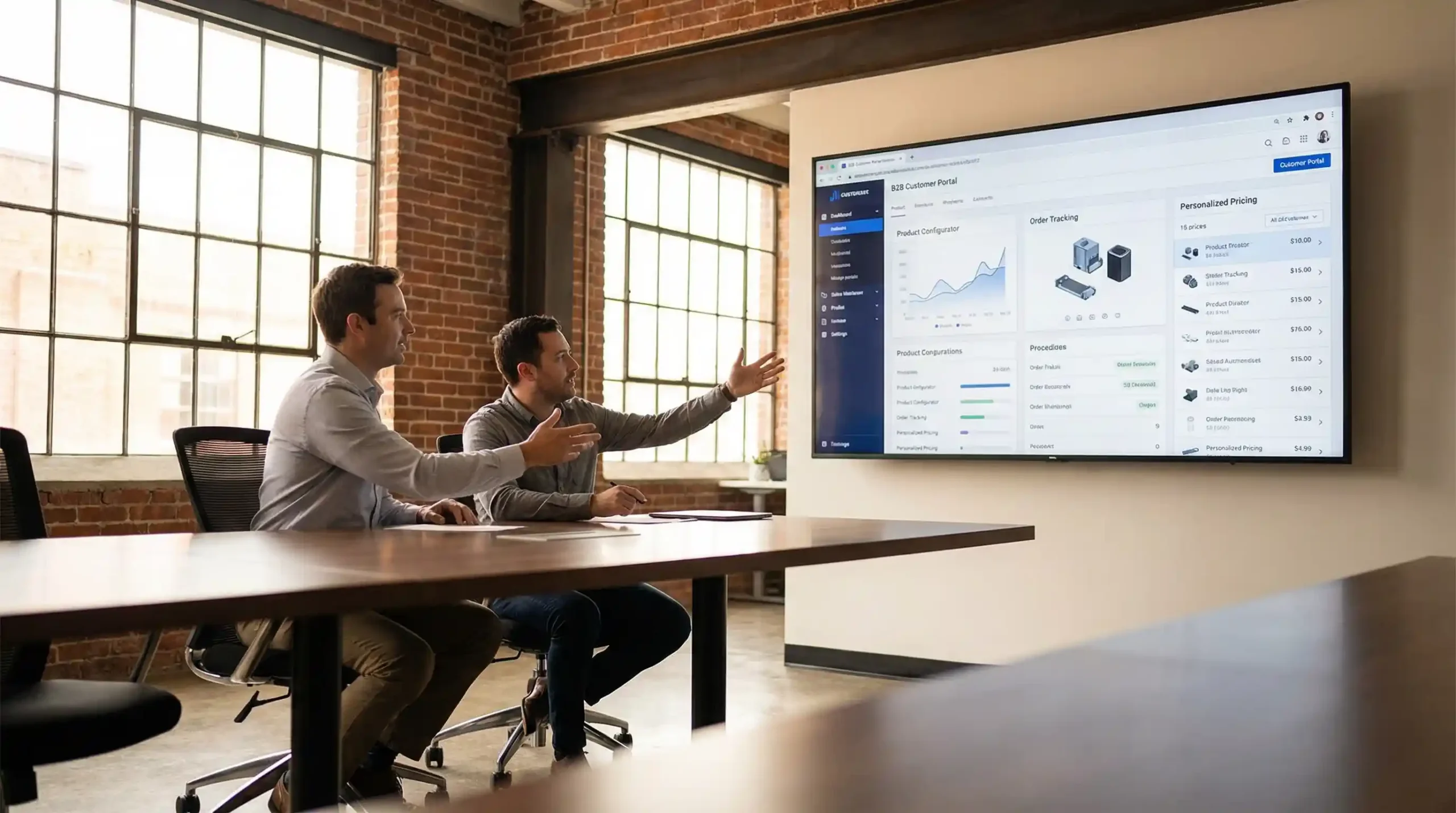
A Digital Experience Platform sits at the intersection of your operational systems and your customer-facing channels. For manufacturers pursuing this transformation, the DXP serves as the orchestration layer that connects ERP inventory data, CRM customer profiles, and product information management (PIM) into a unified digital experience. This is not about building a better website. It is about creating a revenue-generating digital channel that operates 24/7.
The composable DXP approach is particularly relevant for manufacturing SMBs because it avoids the all-or-nothing commitment of monolithic platforms. You can start with a headless CMS for product content, add a B2B commerce layer for self-service ordering, and integrate a personalization engine as your customer data matures. Each component connects through APIs, which means you can upgrade or replace individual pieces without disrupting the entire system. Learn more about how DXP architecture transforms B2B experiences in our comprehensive pillar guide.
RedEx Point of View
We see a consistent pattern across our manufacturing clients: the DXP investment pays for itself within 8 to 12 months through reduced order processing costs alone. When you add revenue uplift from cross-sell recommendations and 24/7 self-service ordering, the ROI accelerates dramatically. The key is starting with your highest-volume product categories and expanding from there.
05. Architecture Principles
Composable Architecture: The Foundation of Scalable Manufacturing Transformation
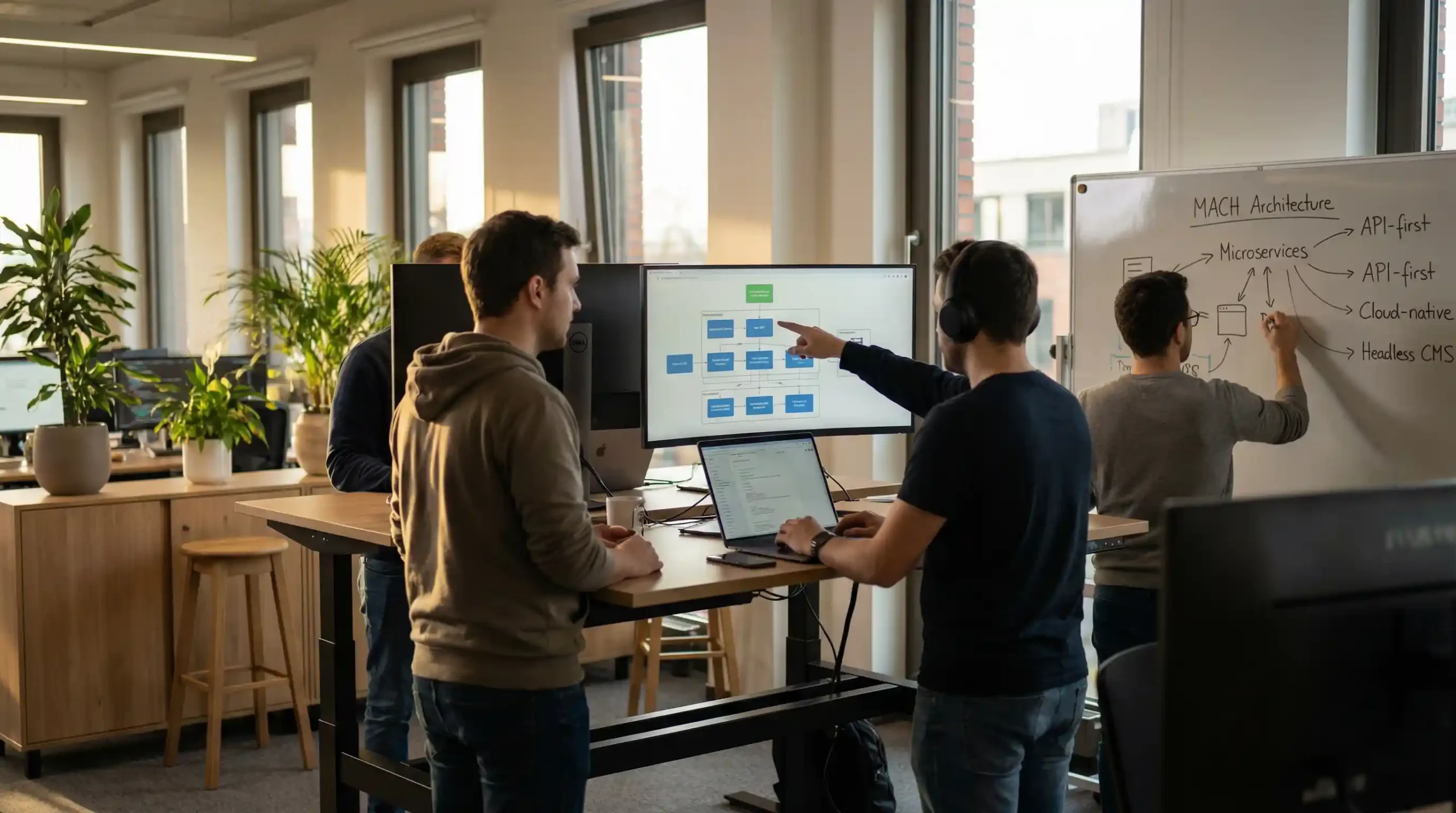
The MACH architecture framework (Microservices, API-first, Cloud-native, Headless) has emerged as the preferred approach for manufacturing modernization because it solves the fundamental scaling problem. Traditional monolithic systems force you to upgrade everything at once. MACH lets you evolve individual components independently, which means your IoT platform can advance to the latest version without touching your DXP, and your commerce engine can add new payment methods without modifying your ERP integration.
For manufacturing SMBs, composable architecture delivers three critical advantages. First, it reduces vendor lock-in by ensuring every component communicates through standardized APIs. Second, it enables incremental investment because you can add capabilities one at a time rather than committing to a massive upfront platform purchase. Third, it future-proofs your technology stack because new innovations (AI copilots, digital twins, AR interfaces) can be plugged into the existing architecture without rebuilding the foundation. Explore how custom platform engineering enables composable manufacturing systems.
MACH Principle
Manufacturing Application
SMB Benefit
Microservices
Independent services for ordering, inventory, quoting, quality
Update one function without breaking others
API-First
ERP, MES, CRM, IoT all connected through REST/GraphQL APIs
Seamless data flow between all systems
Cloud-Native
Azure, AWS, or GCP hosting with auto-scaling
Pay only for what you use, scale on demand
Headless
One backend serving B2B portal, mobile app, IoT dashboard
Add new channels without rebuilding backend
06. Technology Selection
Vendor Landscape for Manufacturing Modernization
Selecting the right technology stack is one of the most consequential decisions in any manufacturing modernization program. The table below compares options across six critical categories, segmented by company size. Redex recommendations prioritize cost-effectiveness, integration flexibility, and time-to-value for manufacturing SMBs.
Category
Enterprise
Mid-Market
SMB
DXP/CMS
Adobe Experience Manager, Sitecore XP
Contentful, Strapi
Webflow, WordPress
ERP Integration
SAP S/4HANA, Oracle Cloud
Microsoft Dynamics 365, Infor
Odoo, NetSuite
CRM / CDP
D365, Salesforce CDP, Adobe RT-CDP
HubSpot, Segment, D365
HubSpot Starter, Zoho CRM
IoT Platform
PTC ThingWorx, Siemens MindSphere
Azure IoT Hub, AWS IoT Core
Losant, Ubidots
AI / ML
Palantir, C3.ai
Azure ML, AWS SageMaker
Google Vertex AI, OpenAI API
Commerce
SAP Commerce, Salesforce B2B
BigCommerce B2B, Shopify Plus
Shopify, WooCommerce
Build vs. Buy Decision Framework
For this type of transformation, Redex recommends an 80/20 approach: buy commercial platforms for 80% of capabilities (DXP, CRM, IoT, commerce) and build custom integrations for the 20% that creates competitive differentiation (proprietary algorithms, unique workflow automation, industry-specific data models). This approach minimizes development risk while preserving your operational advantage.
07. Risk Mitigation
Why Most Manufacturing Modernization Programs Fail
McKinsey research on Industry 4.0 identifies five systemic failure patterns that prevent manufacturers from scaling digital initiatives. Based on our experience with 40+ manufacturing SMBs, we have distilled these into four actionable patterns with specific Redex countermeasures.
Technology-First Thinking
Buying platforms before defining business outcomes. A $200K DXP investment delivers zero ROI if you have not mapped customer journeys or defined success metrics first.
Redex Countermeasure
Start with the Redex Digital Transformation Maturity Model assessment. Map current state, define target state, then select technology that bridges the gap.
Siloed Implementation
IT department drives the transformation in isolation. Operations, sales, and finance are not involved. The result: systems that technically work but nobody uses.
Redex Countermeasure
Our cross-functional discovery workshops bring operations, sales, IT, and finance together. Every technology decision is validated against real workflow requirements.
Successful pilots at one site never scale across the network. McKinsey reports that most manufacturers remain stuck in pilot purgatory, unable to replicate local wins.
Redex Countermeasure
The Redex 4-phase roadmap builds scaling mechanisms into Phase 1. Every pilot includes documentation, training, and change management for network-wide deployment.
Data Foundation Neglect
Deploying AI and analytics on top of dirty, fragmented data. Predictive models produce unreliable outputs. Customer segmentation fails because CRM data is incomplete.
Redex Countermeasure
Phase 1 of every Redex engagement includes a data quality audit. We establish master data governance before deploying any analytics or AI capabilities.
08. Performance Metrics
KPI Benchmarks for Manufacturing Modernization
Every manufacturing modernization investment should be measured against clear KPI benchmarks. The table below presents realistic targets based on Redex client data across manufacturing SMBs with $10M to $200M annual revenue.

Metric
Before DX
After DX (12 mo)
Improvement
Operations
Unplanned Downtime
8-12% of capacity
3-5% of capacity
50-60% reduction
Operations
Labor Productivity
Baseline
+15 to 30%
15-30% gain
Customer
Order Processing Time
2-5 business days
Same day
80% faster
Customer
Self-Service Adoption
0-10%
40-60%
4-6x increase
Financial
Inventory Carrying Cost
25-35% of COGS
15-22% of COGS
20-35% reduction
Financial
Forecast Accuracy
50-65%
80-90%
30-45% improvement
Revenue
Average Order Value
Baseline
+15 to 25%
Cross-sell uplift
Revenue
Customer Retention
70-80%
88-95%
15-25% improvement
Worked ROI Example: $30M Precision Manufacturer
Investment (18 months):
- Phase 1 (Foundation): $85,000
- Phase 2 (Intelligence): $165,000
- Phase 3 (Optimization): $120,000
- Total: $370,000
Annual Returns (Year 1)
- Downtime reduction: $180,000
- Self-service order savings: $95,000
- Inventory optimization: $210,000
- Revenue uplift (AOV + retention): $340,000
- Year 1 Return: $825,000 (223% ROI)
09. Roadmap
4-Phase Manufacturing Modernization Roadmap
Successful manufacturing modernization follows a phased approach that builds capabilities incrementally while delivering measurable ROI at each stage. The Redex 4-phase roadmap ensures every investment is validated before scaling.
Phase 1: Foundation
- Month 1-4
- $50K-$150K
- Data quality assessment and master data governance plan
- Target architecture blueprint (MACH-aligned)
- ERP-CRM integration with unified customer view
- Basic B2B portal with product catalog and order tracking
- IoT sensor deployment on 3-5 critical machines
Focus Area
Data audit, architecture design, core integrations
Target Outcome
Quick wins: 20-30% reduction in manual data entry, 15% faster order processing
Phase 2: Intelligence
- Month 5-10
- $100K-$200K
- Predictive maintenance models on connected equipment
- AI-powered demand forecasting integrated with ERP
- DXP personalization engine for B2B portal
- Customer Data Platform (CDP) unifying all touchpoints
- Digital twin pilot for highest-value production line
Focus Area
AI deployment, DXP personalization, predictive capabilities
Target Outcome
30-40% downtime reduction, 25% higher AOV, 35% better forecasts
Phase 3: Optimization
- Month 11-16
- $80K-$200K
- AI copilot deployment for operators and maintenance
- Supply chain risk scoring and automated reordering
- VR/AR training modules for critical procedures
- Advanced analytics dashboards for C-suite
- Automated quality inspection with computer vision
Focus Area
AI copilots, supply chain intelligence, workforce enablement
Target Outcome
Compounding returns: 25-40% faster operator decisions, 20-35% lower inventory costs
Phase 4: Scale
- Month 17-24
- $60K-$150K
- Playbooks and templates for multi-site rollout
- Continuous improvement feedback loops with AI
- Innovation pipeline for emerging technologies
- Partner and supplier portal integration
- Full composable architecture with MACH compliance
Focus Area
Network-wide deployment, continuous improvement, innovation
Target Outcome
Sustainable advantage: 35%+ overall ROI, competitive differentiation through digital maturity
This phased approach ensures that each investment generates measurable returns before committing to the next stage. Explore our frameworks for detailed methodology documentation, or read how digital twin technology and AI copilots accelerate manufacturing transformation.
Transform Your Operations
Stop Running Disconnected Pilots. Start Building a Digital Manufacturing System.
Manufacturing modernization succeeds when technology serves strategy. Redex helps manufacturing SMBs design and implement composable digital architectures that connect operations, customers, and data into a unified competitive advantage.
FAQs
What is digital transformation manufacturing and why does it matter for SMBs?
Digital transformation manufacturing is the systematic integration of digital technologies across all aspects of manufacturing operations, from factory floor production to customer-facing experiences. For SMBs with 50 to 500 employees, it matters because competitors who digitize first capture market share through faster delivery, lower costs, and better customer experiences. The average ROI for well-executed programs is 35% within the first 18 months.
How much does digital transformation manufacturing cost for a mid-size manufacturer?
Phase 1 (Foundation) typically costs $50,000 to $150,000 over 3 to 4 months, covering data audit, architecture design, and initial integrations. Phase 2 (Intelligence) adds $100,000 to $250,000 for AI, IoT, and DXP deployment. Total 18-month investment ranges from $200,000 to $500,000 depending on scope. The key is phased investment with measurable ROI gates at each stage.
What is the difference between a DXP and a traditional CMS for manufacturers?
A traditional CMS manages website content. A Digital Experience Platform (DXP) orchestrates the entire customer journey across multiple channels: B2B portals, mobile apps, IoT dashboards, and partner integrations. For manufacturers, a DXP connects product data from your ERP, pricing from your CRM, and inventory from your MES into a unified customer experience that drives self-service ordering and reduces sales cycle time.
Should we build custom solutions or buy commercial platforms?
For most manufacturing SMBs, the answer is composable: buy best-of-breed platforms for core capabilities (DXP, CRM, IoT) and build custom integrations that connect them to your specific workflows. MACH architecture enables this approach by ensuring every component communicates through APIs. Redex recommends starting with commercial platforms and customizing only where your processes create genuine competitive differentiation.
How long does a digital transformation manufacturing program take to show ROI?
Phase 1 quick wins (ERP-CRM integration, basic IoT monitoring, B2B portal) typically show measurable ROI within 3 to 6 months. AI-powered capabilities (predictive maintenance, demand forecasting, personalization) require 6 to 12 months to train models and validate results. Full maturity from Level 1 to Level 3 typically takes 18 to 24 months with disciplined execution.
Continue Your Manufacturing Modernization Journey