01. EXECUTIVE SUMMARY
The Value of AI Construction Safety: Why Construction Needs AI Now
In 2024, the United States celebrated the lives of 1,041 workers who returned home safely compared to the previous year, as workplace fatalities decreased to 1,034. While every life is a priority, the industry is now striving for a future where every single person remains protected. By addressing the primary safety pillars (fall prevention, object awareness, electrical security, and equipment clearance) firms can protect the 60% of the workforce most frequently exposed to these risks. Ensuring the well-being of every team member also preserves the health of those involved in minor incidents and near-misses.
Investing in AI construction safety is a definitive strategy for financial strength. While a typical injury carries a direct cost of $42,000, maintaining a secure environment preserves 3 to 5 times that amount in total value by ensuring high productivity, steady schedules, stable insurance premiums, and regulatory excellence. For a mid-sized general contractor with $30–50M in annual revenue, a robust AI construction safety program can protect $200,000–$500,000 in annual earnings.
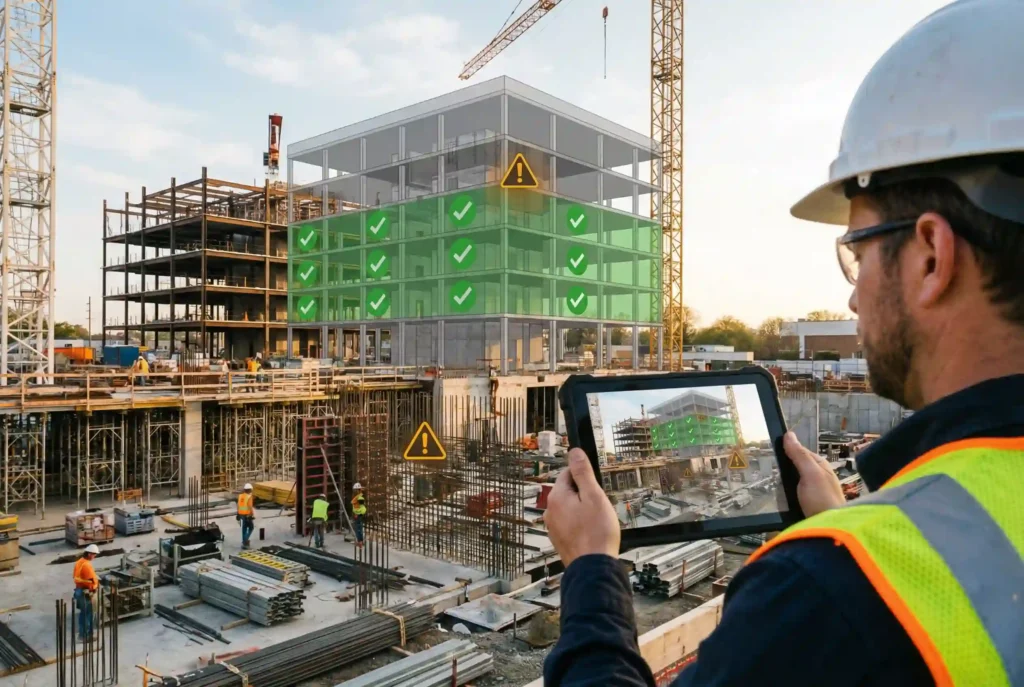
Modern industry leaders recognize that safety is a proactive journey. While physical walkthroughs provide a snapshot of site activity, AI construction safety scales oversight to encompass the entire project, transforming management into a constant, supportive presence.
1,034
Worker fatalities (2024)
$42K
Avg. direct cost per injury
60%
Deaths from Fatal Four
Incident reduction with AI
Industry Data
According to Deloitte’s 2026 Engineering and Construction Industry Outlook, the adoption of safety-focused computer vision technologies is transforming site safety, with many hazards now identified in seconds rather than hours. The report highlights that real-time safety analytics are becoming increasingly important, especially for firms competing for large federally funded projects where safety records directly impact pre-qualification.
02. Definition
What AI Construction Safety Actually Means
AI construction safety is not a single product. It is an ecosystem of interconnected workplace safety technologies. By combining computer vision cameras, IoT wearable sensors, and predictive analytics, firms create a continuous, intelligent safety oversight across every active site.
The shift to AI-powered construction safety management represents a positive evolution in how firms approach risk. Traditional methods are often periodic and subjective. In contrast, AI construction safety is continuous, objective, and predictive, monitoring every zone simultaneously, measuring compliance quantitatively, and identifying opportunities for safety improvements before they are needed.
Why This Matters for Construction SMBs
For construction SMBs (50–500 employees), AI construction safety matters because it directly impacts 3 critical business outcomes:
Insurance Efficiency: Your Experience Modification Rate (EMR) determines your premiums; AI keeps this rate favorable.
Project Eligibility: Project owners and GCs prioritize firms with strong, tech-backed safety records for pre-qualification.
Workforce Retention: Skilled workers choose employers who invest in the best AI in construction tools to protect their well-being.
This connects directly to the broader AI in construction transformation. Safety is often the first domain where construction firms deploy AI because the ROI is immediate, measurable, and tied to outcomes that every stakeholder from the CEO to the field worker cares about.
The construction firms achieving the best safety outcomes are not the ones with the most safety managers. They are the ones where every camera, sensor, and data point feeds a single intelligence layer that never sleeps, never gets distracted, and never misses a shift.
Redex field observation, 2025
03. The Approach
Construction Safety Intelligence Model
Most firms that attempt AI construction safety adoption fail because they buy point solutions without a system-level architecture. A camera here, a wearable there, a dashboard that nobody checks. The Redex Construction Safety Intelligence Model provides a 4-layer framework that ensures every technology investment connects to measurable safety outcomes.
RedEx Construction Safety Intelligence Model
Data Collection Layer
Layer 01
- Computer vision cameras at high-risk zones (crane areas, edges, excavations)
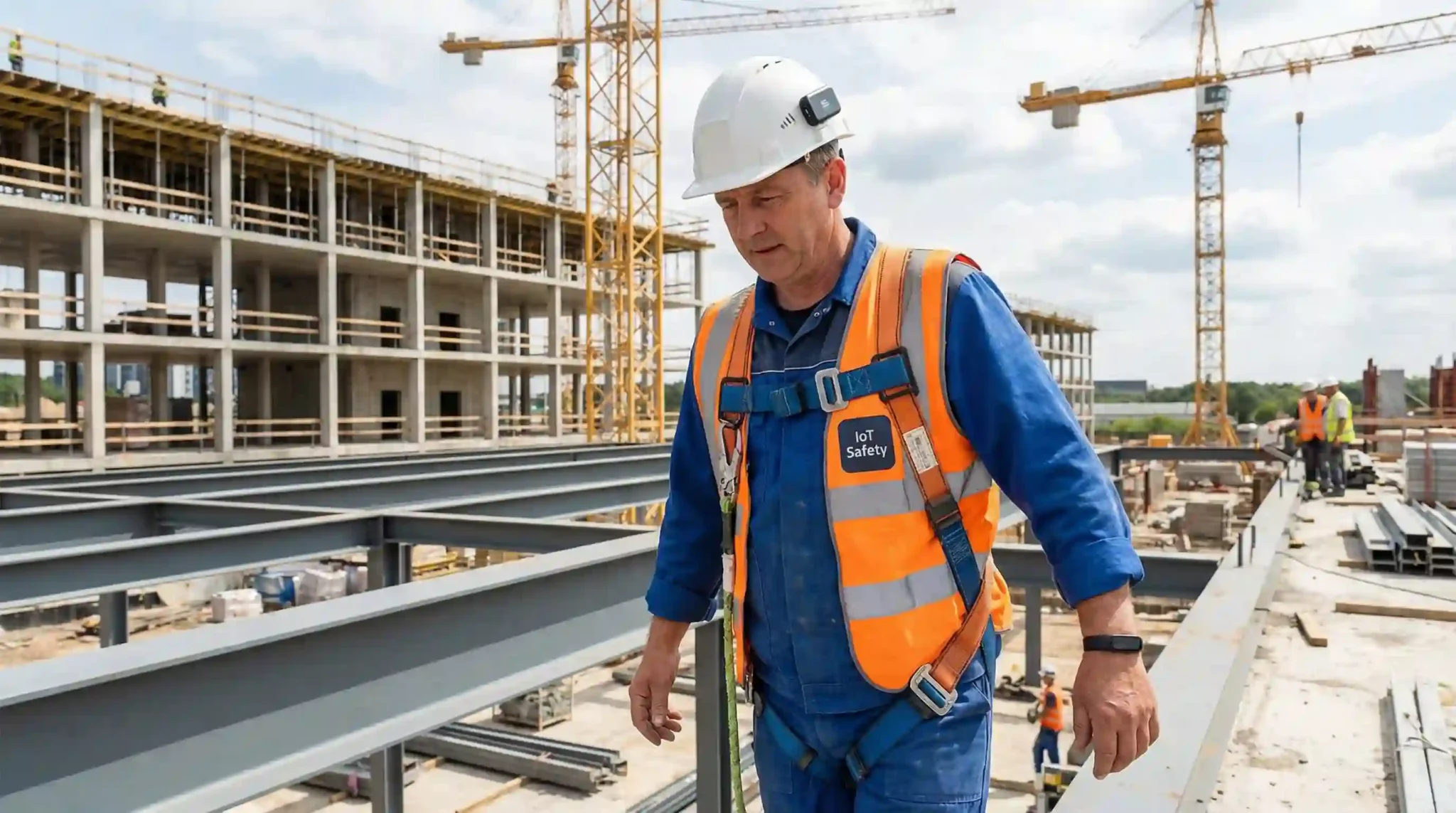
- IoT wearable sensors (smart hard hats, proximity badges, biometric wristbands)
- Digital inspection inputs (mobile app checklists, photo documentation)
- Drone survey data (aerial imagery, thermal scans, progress photos)
- Environmental sensors (air quality, noise, temperature, humidity)
AI Processing Layer
Layer 02
- Computer vision models: PPE detection, behavior recognition, zone monitoring
- Predictive analytics: risk scoring, incident pattern recognition, weather integration
- NLP engines: incident report analysis, OSHA regulation mapping, toolbox talk generation
- Anomaly detection: equipment sensor deviations, biometric alerts, environmental thresholds
Real-Time Response Layer
Layer 03
- Instant alerts: supervisor notifications, worker wearable vibrations, audio warnings
- Automated zone restrictions: virtual geofencing, equipment lockouts
- Emergency response coordination: fall detection, location tracking, first responder dispatch
- Daily safety scorecards: zone compliance, trade performance, shift comparisons
Continuous Learning Layer
Layer 04
- Model retraining on company-specific incident data for improved accuracy
- Cross-project benchmarking: compare safety performance across sites and teams
- Safety culture metrics: leading indicator trends, training effectiveness, engagement scores
- Insurance and compliance optimization: EMR tracking, audit preparation, carrier reporting
Redex Point of View
The most common mistake construction SMBs make is starting at Layer 2 (buying AI software) without establishing Layer 1 (reliable data collection). We consistently see firms invest in predictive analytics platforms that produce unreliable outputs because the underlying data (inconsistent incident reporting, no camera infrastructure, no wearable deployment) is insufficient. The Redex model ensures each layer is solid before advancing to the next.
For a detailed look at all Redex proprietary methodologies, visit our Frameworks page.
04. AI Use Cases
High-Impact AI Safety Use Cases for Construction SMBs
These are production-ready AI safety workflows that construction SMBs deploy today to reduce incidents, lower insurance costs, and win more projects. Each use case maps directly to a layer of the Construction Safety Intelligence Model.
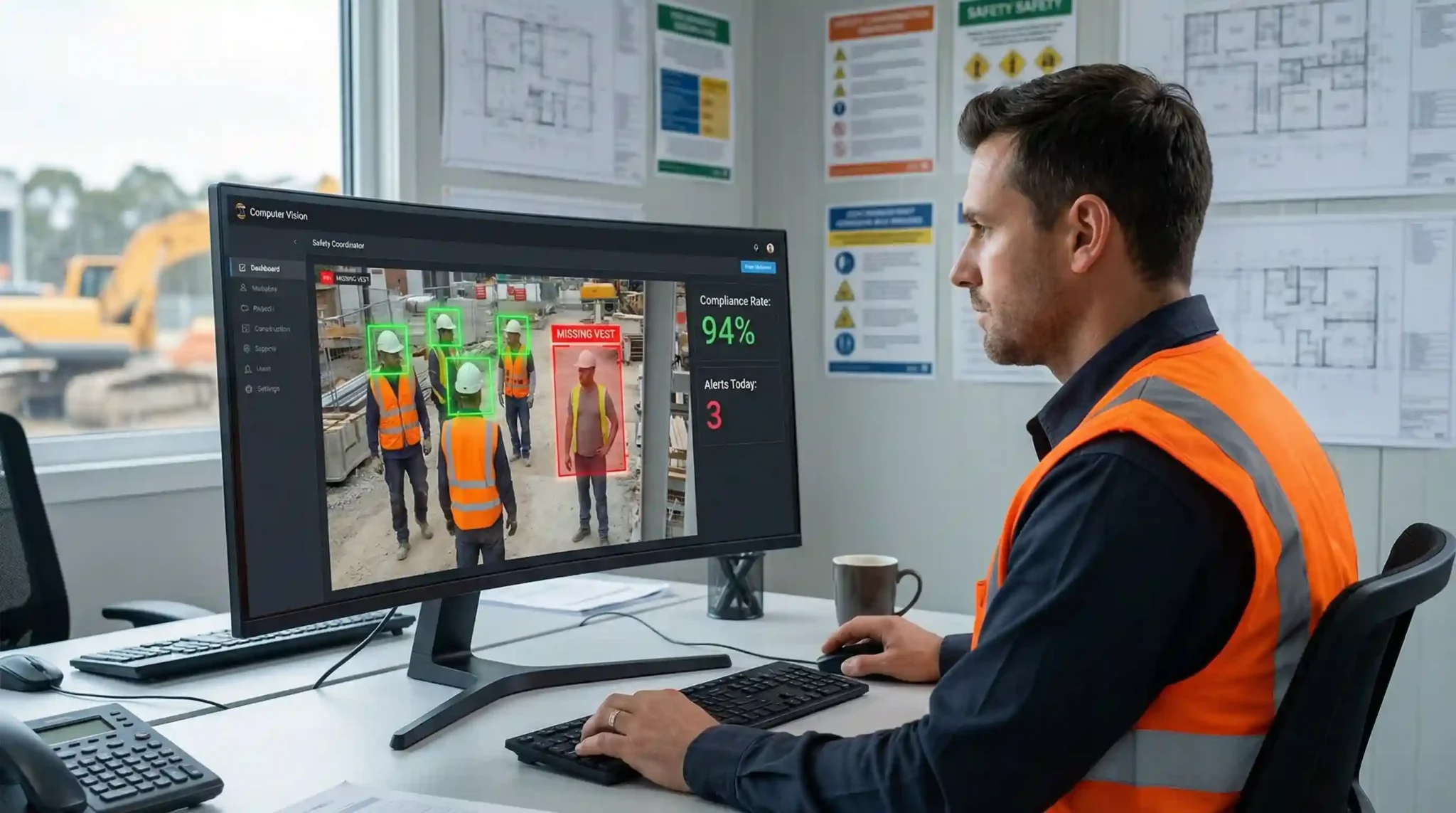
Computer Vision PPE Monitoring
AI-powered cameras that detect PPE violations, unsafe behaviors, and hazard zone breaches in real time reducing recordable incidents by 40–60%.
94% detection accuracy
Automated PPE Compliance Detection
AI cameras continuously scan the site for workers missing hard hats, safety vests, harnesses, or eye protection. Unlike periodic manual inspections, computer vision monitors every worker, every second. A mid-sized GC running 3 active sites typically catches 15–25 violations per day that manual inspections miss entirely.
85% reduction in zone violations
Exclusion Zone Monitoring
AI defines virtual boundaries around active crane zones, excavation edges, and high-voltage areas. When a worker enters a restricted zone without authorization, the system triggers immediate audio alerts and supervisor notifications. For a $15M commercial project, this prevents an average of 3–5 potential struck-by incidents per month.
50% fewer near-miss incidents
Unsafe Behavior Recognition
Beyond PPE detection, advanced computer vision identifies risky behaviors: workers standing under suspended loads, improper ladder usage, or operating equipment without seatbelts. The AI learns from thousands of labeled safety incidents to distinguish normal activity from high-risk behavior patterns.
Daily compliance reports in 10 minutes
Real-Time Safety Scorecards
AI aggregates all camera observations into automated daily safety scorecards by zone, trade, and shift. What takes a safety manager 2–3 hours of manual observation and documentation is generated automatically, freeing them to focus on high-risk interventions.
IoT Wearables and Environmental Sensors
Smart hard hats, vests, and wristbands that monitor worker health, proximity to hazards, and environmental conditions providing early warnings before incidents occur.
70% reduction in struck-by near-misses
Proximity Alert Systems
Ultra-wideband (UWB) sensors in hard hats and equipment detect when workers are within dangerous proximity of heavy machinery, moving vehicles, or active crane loads. The system triggers vibration alerts in the worker's wearable and audible warnings on the equipment. For a busy site with 50+ workers, this prevents 8–12 potential contact incidents monthly.
45% fewer heat-related incidents
Fatigue and Heat Stress Monitoring
Biometric sensors in smart wristbands track heart rate variability, skin temperature, and movement patterns to detect early signs of fatigue or heat stress. When a worker's biometrics indicate risk, the system alerts the foreman to rotate them to lighter duties or mandate a rest break before the worker collapses.
Response time reduced from 8 min to 90 sec
Fall Detection and Emergency Response
Accelerometers and gyroscopes in smart hard hats detect sudden impacts and falls. When a fall is detected, the system immediately alerts emergency responders with the worker's exact GPS location, floor level, and the nature of the impact - critical information that saves lives in the first minutes after an incident.
Continuous air quality and noise tracking
Environmental Hazard Monitoring
IoT sensors distributed across the site monitor air quality (dust, VOCs, carbon monoxide), noise levels, temperature, and humidity in real time. When conditions exceed OSHA thresholds, the system automatically alerts affected workers and supervisors. For demolition and renovation projects, this is critical for silica dust compliance.
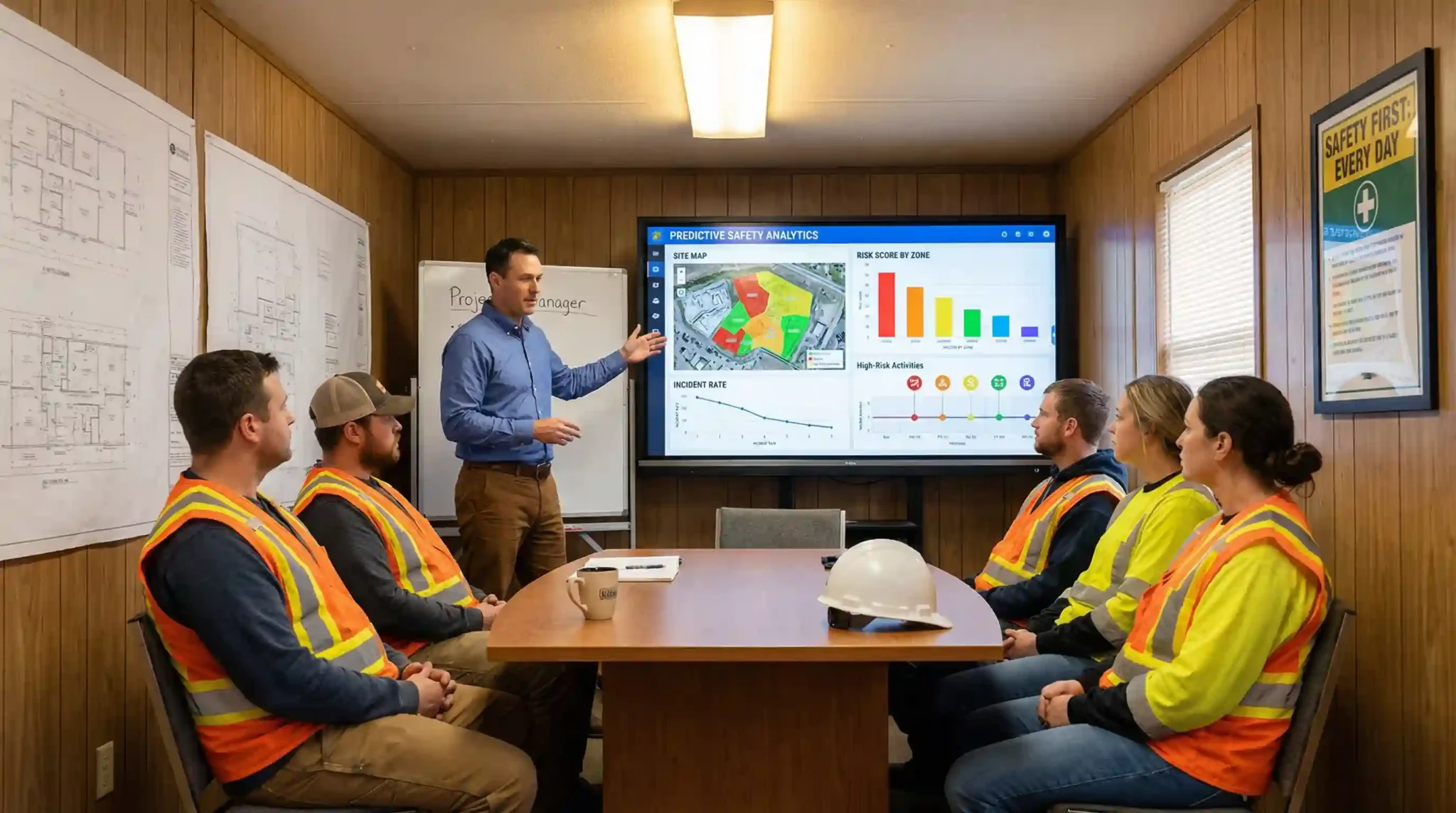
Predictive Safety Analytics
Machine learning models that analyze historical incident data, weather, schedules, and site conditions to predict where and when the next safety incident is most likely to occur.
2–3 weeks advance warning on high-risk periods
Daily Risk Scoring by Zone and Activity
AI assigns a risk score (1–100) to every planned activity based on historical incident patterns, weather forecasts, crew experience levels, and task complexity. A concrete pour scheduled during high winds with a new crew scores differently than the same pour in calm conditions with experienced workers. Safety managers use these scores to allocate resources where they matter most.
Identify root causes 60% faster
Incident Pattern Recognition
AI analyzes years of incident reports, near-miss data, and OSHA citations to identify non-obvious patterns such as the correlation between Monday morning shifts and fall incidents, or the link between subcontractor onboarding weeks and electrical violations. These insights drive targeted interventions that address root causes, not symptoms.
40% fewer weather-related incidents
Weather-Integrated Safety Planning
AI combines 10-day weather forecasts with the construction schedule to flag high-risk combinations: steel erection during predicted wind gusts, roofing work before rain, or concrete pours during temperature drops. The system recommends schedule adjustments 48–72 hours in advance, giving project managers time to re-sequence work.
Shift from lagging to leading metrics
Leading Indicator Dashboards
Instead of measuring safety by incidents that already happened (TRIR, DART), AI tracks leading indicators, near-miss frequency, PPE compliance trends, training completion rates, and inspection scores, to predict future performance. Construction firms using leading indicator dashboards report 30–50% improvement in safety outcomes within 12 months.
Automated Safety Compliance and Documentation
AI that automates OSHA documentation, toolbox talks, inspection reports, and audit preparation reducing compliance paperwork by 60–70% while improving accuracy.
70% reduction in documentation time
Automated Inspection Reports
AI generates inspection reports from camera observations, sensor data, and mobile app inputs. A safety manager walks the site with a tablet, takes photos, and the AI auto-populates the report with location, violation type, severity, corrective action, and responsible party. What takes 45 minutes manually is completed in 10 minutes.
95% audit readiness at all times
OSHA Compliance Tracking
AI continuously monitors compliance against OSHA 1926 standards: fall protection, scaffolding, electrical, excavation, and hazard communication. The system maintains a real-time compliance dashboard and automatically flags gaps before they become citations. For a firm with $500K+ in annual OSHA exposure, this is direct cost avoidance.
Task-specific safety briefings in 2 minutes
Digital Toolbox Talk Generation
AI generates customized toolbox talks based on the day's planned activities, weather conditions, and recent incident trends. Instead of generic safety topics, workers receive briefings specific to their tasks, fall protection for steel erectors, silica exposure for concrete cutters, trench safety for excavation crews.
Root cause analysis 50% faster
Incident Investigation Assistance
When an incident occurs, AI pulls together all relevant data (camera footage, sensor readings, weather conditions, worker training records, and equipment maintenance logs) into a structured investigation package. The AI suggests probable contributing factors based on similar historical incidents, accelerating the investigation process.
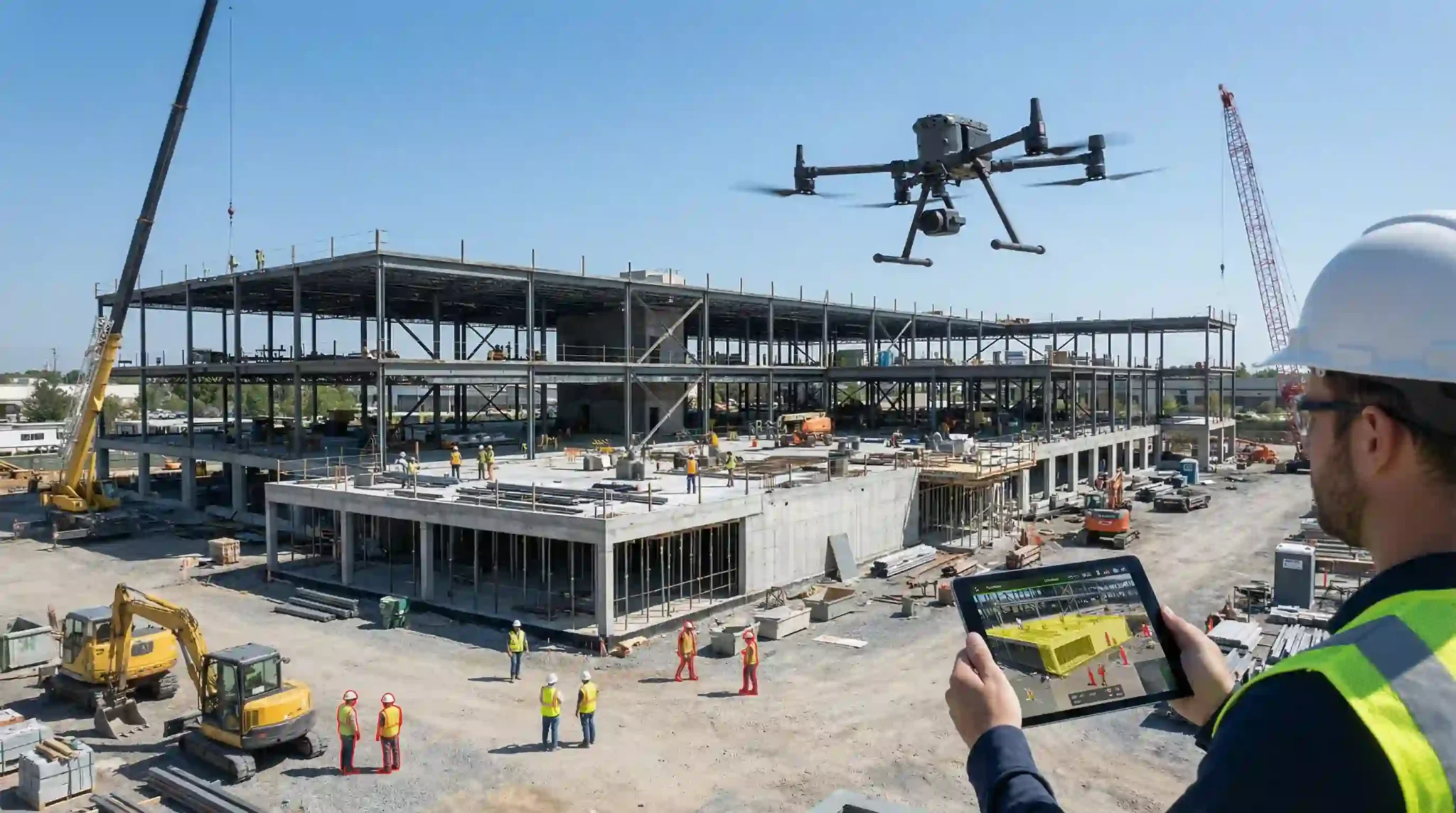
Drone-Based Site Safety Surveillance
Autonomous drone inspections that survey large sites, identify hazards from aerial perspectives, and create safety heat maps covering areas that are dangerous or impractical for human inspectors.
Cover 10x more area than manual inspections
Automated Perimeter and Height Inspections
Drones equipped with AI cameras conduct daily flyovers of the entire site, inspecting scaffolding connections, guardrail integrity, netting placement, and perimeter fencing from angles that are dangerous for human inspectors. A 200,000 sq ft site that takes a safety team 4 hours to inspect manually is surveyed in 30 minutes by drone.
Identify safety plan deviations in real time
Progress vs. Safety Plan Comparison
AI compares drone imagery against the BIM-based safety plan to identify deviations: missing guardrails where the plan requires them, unauthorized material storage in fire lanes, or incomplete barricading around excavations. This connects directly to the AI-BIM integration capabilities we outline in our companion article.
Detect overheating equipment 24–48 hours before failure
Thermal Imaging for Electrical and Fire Hazards
Drones with thermal cameras identify overheating electrical panels, transformers, and equipment that are invisible to the naked eye. Early detection of thermal anomalies prevents electrical fires and equipment failures that can cause injuries and project delays.
Visual risk mapping updated daily
Site Safety Heat Maps
AI aggregates drone observations into color-coded safety heat maps showing high-risk zones (red), moderate-risk areas (yellow), and compliant zones (green). These maps are displayed in the site office and shared digitally with all supervisors, creating a shared visual language for safety across the project team.
05. Tech Stack
The AI Construction Safety Technology Stack
Selecting the right technology stack depends on your firm’s size, project types, and current safety maturity. The table below maps key technology categories to SMB-appropriate solutions with realistic cost ranges.
Technology Category
SMB-Appropriate Solutions
Monthly Cost Range
Implementation Time
Computer Vision
Smartvid.io, Everguard.ai, OpenSpace
$500–$2,000+/ site/ month
1–2 weeks
IoT Wearables
Spot-r (Triax), Guardhat, Kenzen
$20–$50/ user/ month + hardware ($100–300/device)
1-2 weeks
Predictive Analytics
Newmetrix, Salus, Procore Safety
$500–$2,500/ company/ month
2–4 weeks
Compliance Automation
SafetyCulture (iAuditor), HammerTech
$100–$500/ company/ month
1 week
Drone Inspection
DroneDeploy, Skydio, Propeller Aero
$300–$1,000/ site/ month
1–2 weeks
Integrated Platform
Procore + AI modules, Autodesk Construction Cloud
$1,000–$10,000+/ year (SMB → enterprise huge variance)
4–12 weeks
The key principle is interoperability. Avoid vendor lock-in by choosing platforms with open APIs that can share data across your safety ecosystem. The firms that get the most value from AI safety are those that connect their camera data, wearable alerts, and predictive models into a single intelligence layer, not those that run 5 disconnected dashboards. This is where our Agentic AI consulting services help construction firms design integrated safety architectures.
06. Pitfalls
Why Most AI Construction Safety Initiatives Underperform
Across construction AI implementations, four recurring failure patterns tend to undermine safety technology investments. Understanding these patterns before you deploy is the difference between a 40% incident reduction and an expensive shelf-ware purchase.
Alert Fatigue from Uncalibrated Systems
The most common failure. Firms deploy computer vision cameras with default sensitivity settings, generating 50–100 false alerts per day. Within two weeks, supervisors start ignoring all alerts including the real ones. The fix: spend the first 2 weeks calibrating detection thresholds on your specific site conditions before going live.
Data Silos Between Safety and Operations
Safety data lives in one system, project schedules in another, and weather data in a third. Without integration, predictive analytics cannot correlate the factors that actually drive incidents. The fix: require API connectivity as a procurement criterion and invest in a data integration layer before buying analytics tools.
Deploying Technology Without Culture Change
AI cameras and wearables are perceived as surveillance tools rather than safety tools. Workers resist adoption, supervisors see it as overhead, and the technology becomes a compliance checkbox rather than a safety improvement driver. The fix: involve field workers in the selection process, share safety data transparently, and celebrate improvements publicly.
Buying Enterprise Solutions for SMB Problems
A 200-person GC does not need the same AI safety platform as a $5B ENR Top 10 contractor. Enterprise solutions come with enterprise complexity, enterprise pricing, and enterprise implementation timelines. The fix: start with point solutions that solve your top 2–3 safety challenges, then integrate as you scale.
07. KPIs & ROI
KPI and ROI Benchmarks for AI Construction Safety Investment
AI safety investments should be measured against both leading indicators (predictive of future performance) and lagging indicators (measuring past outcomes). The table below provides realistic benchmarks for construction SMBs deploying AI safety over a 12-month period.
Metric
Metric
Baseline (Pre-AI)
Target (12 Months)
Total Recordable Incident Rate (TRIR)
Lagging
Industry avg: 2.5
Target: 1.2–1.8
Days Away, Restricted, Transfer (DART)
Lagging
Industry avg: 1.4
Target: 0.7–1.0
Experience Modification Rate (EMR)
Lagging
1.0 (industry avg)
Target: 0.75–0.85
PPE Compliance Rate
Leading
70–80% (manual obs.)
Target: 92–98% (AI-verified)
Near-Miss Reporting Rate
Leading
2–5 per month
Target: 15–30 per month
Safety Inspection Completion
Leading
60–75% on schedule
Target: 95–100% automated
Time to Incident Response
Leading
8–15 minutes
Target: 60–90 seconds
Workers’ Comp Premium Savings
Financial
Baseline premium
10–25% reduction (Year 2)
Redex Point of View
The single most impactful metric for construction SMBs is EMR reduction. A 0.15-point improvement in your Experience Modification Rate translates directly to 10–15% lower workers’ compensation premiums. For a firm paying $300,000/year in workers’ comp, that is $30,000–$45,000 in annual savings often enough to fund the entire AI safety program. We help clients build the documentation trail that connects AI safety improvements to EMR reduction for their insurance carrier conversations.
08. Roadmap
4-Phase Implementation Roadmap for Construction SMBs
AI safety deployment is not a one-time purchase — it is a capability that matures over time. This roadmap is designed for construction SMBs running 2–8 active projects simultaneously, with safety teams of 1–5 people. Each phase builds on the previous one and delivers standalone value.
For a broader perspective on AI implementation planning, see our AI-BIM Integration article, which covers a parallel maturity model for construction technology adoption.
Phase 1: Safety Assessment and Quick Wins
Baseline your current safety performance and deploy high-impact, low-cost tools
- Month 1-2
- $3,000–$8,000 setup + $150–$400/mo tools
- Audit current safety metrics: TRIR, DART, EMR, near-miss reporting rates
- Review OSHA citation history and identify recurring violation patterns
- Deploy basic computer vision on 1–2 cameras at highest-risk zones (crane areas, edges)
- Implement digital daily inspection checklists via mobile app
- Establish baseline PPE compliance rate through 2-week manual observation
- Set up automated weather-schedule integration for the next 3 projects
Phase 2: Pilot Deployment
Expand AI safety tools across one full project and measure impact
- Month 3-5
- $8,000–$20,000 setup + $400–$800/mo tools
- Deploy computer vision across all high-risk zones on the pilot project (6–10 cameras)
- Issue IoT wearables to 20–30 workers for proximity alerts and biometric monitoring
- Implement predictive risk scoring using historical incident data + weather integration
- Automate weekly safety reports and toolbox talk generation
- Train safety managers and foremen on AI dashboard interpretation
- Measure: PPE compliance rate, near-miss reporting, incident rate vs. baseline
Phase 3: Multi-Site Scaling
Roll out proven AI safety tools across all active projects
- Month 6-9
- $15,000–$40,000 setup + $800–$2,000/mo tools
- Standardize AI safety stack across all active projects (cameras, wearables, analytics)
- Deploy drone inspection program for sites over 100,000 sq ft
- Integrate AI safety data with BIM models for spatial risk analysis
- Implement automated OSHA compliance tracking and audit preparation
- Connect safety analytics to insurance carrier for EMR improvement documentation
- Establish company-wide safety intelligence dashboard for executive visibility
Phase 4: Continuous Intelligence
Build a self-improving safety system that learns from every project
- Month 10-12
- $2,000–$5,000/mo ongoing (all projects)
- Retrain AI models on company-specific incident data for higher prediction accuracy
- Implement cross-project safety benchmarking and best practice sharing
- Deploy advanced behavioral analytics for proactive culture measurement
- Integrate safety performance into project bidding and pre-qualification processes
- Automate insurance renewal documentation with AI-generated safety performance reports
- Establish safety innovation pipeline: evaluate and pilot emerging technologies quarterly
For firms at the beginning of their AI journey, our research on AI’s impact on employee expertise provides important context on how AI augments, rather than replaces, your safety team’s capabilities. The goal is not to eliminate safety managers. It is to give them 10x the visibility and 100x the data to make better decisions.
Build Your AI Operating Model
Stop Reacting to Incidents. Start Preventing Them.
Every construction fatality is a failure of awareness: someone did not see the risk, or saw it too late. AI does not eliminate risk. It eliminates the gaps in awareness that allow risk to become injury. If your safety program still depends primarily on manual inspections and reactive reporting, you are operating with 5–10% visibility of actual site conditions.
Frequently Asked Questions
How much does AI construction safety technology cost for a mid-sized GC?
For a general contractor running 3–5 active projects with 100–300 workers, expect $15,000–$40,000 in first-year setup costs and $1,500–$4,000/month in ongoing tool subscriptions. The ROI typically materializes within 6–9 months through reduced incident costs, lower insurance premiums, and improved project pre-qualification rates. Most firms see 3–5x return on their AI safety investment within the first 18 months.
Will workers resist AI safety monitoring as surveillance?
This is the most common concern and the most manageable one. The key is positioning AI as a tool that protects workers, not monitors them. Firms that involve workers in the selection process, share safety data transparently (showing improvements, not individual violations), and use AI alerts to prevent injuries rather than assign blame see adoption rates above 80% within 3 months. The workers who resist most initially often become the strongest advocates once they see the technology prevent a real incident.
Do we need to upgrade our site infrastructure for AI safety tools?
Most AI safety tools are designed for construction site conditions: rugged cameras, cellular-connected sensors, and cloud-based analytics that work without site Wi-Fi. You will need reliable cellular coverage (4G/5G) and power for camera locations. For sites in remote areas, solar-powered camera units with cellular backhaul are available from most vendors. The infrastructure investment is typically $2,000–$5,000 per site for cameras and networking.
How does AI safety performance affect our insurance premiums?
Your Experience Modification Rate (EMR) is the primary driver of workers’ compensation premiums. AI safety tools help reduce your EMR by preventing recordable incidents and improving your TRIR and DART rates. A 0.15-point EMR improvement typically reduces premiums by 10–15%. Additionally, some insurance carriers now offer premium discounts (5–10%) for firms that demonstrate AI-powered safety programs. We help clients document their AI safety investments in a format that insurance carriers recognize.
Can we start with just one AI safety technology, or do we need the full stack?
Start with one. Computer vision for PPE monitoring is the most common entry point because it delivers the fastest, most visible ROI, you will see compliance improvements within the first week. Once you have proven value with one technology, expand to wearables for high-risk activities, then add predictive analytics as you accumulate 6–12 months of data. The Redex Construction Safety Intelligence Model is designed for phased adoption, not big-bang deployment.