$15.8B
Global DXP market size in 2026 projected to reach $30B+ by 2030
70%
Of enterprises will adopt composable DXP technologies by 2026
446%
3-year ROI from well-implemented DXP with sub-6-month payback
70%
Of digital transformation projects fail to achieve their stated goals
Foundation
What Is a Digital Experience Platform?
A digital experience platform (DXP) is an integrated set of technologies that enables organizations to manage and deliver content across channels, orchestrate personalized customer journeys, integrate data from CRM, analytics, and backend systems, and scale globally with governance and localization.
Unlike a traditional CMS that focuses on publishing web pages, a DXP serves as an experience orchestration layer connecting content, data, personalization, and commerce into a unified platform that delivers consistent experiences across every touchpoint.
The DXP market has grown to $15.8 billion in 2026, driven by enterprises recognizing that fragmented CMS ecosystems cannot deliver the connected, personalized experiences that modern customers expect.
"By 2026, 70% of enterprises will adopt composable DXP technologies moving from monolithic suites to best-of-breed architectures that deliver faster time-to-market and lower total cost of ownership."
— Gartner, 2025
Key Distinction
DXP vs CMS vs Headless CMS: What's the Difference?
Traditional CMS
Content Publishing
FOCUS
Web content creation and publishing
STRENGTH
Simple, proven, widely adopted
LIMITATION
Siloed, web-only, limited personalization
EXAMPLES
WordPress, Drupal (standalone)
Sufficient for simple websites and blogs
Headless CMS
API-Driven Content
FOCUS
Decoupled content delivery via APIs
STRENGTH
Flexibility, multi-channel delivery
LIMITATION
Lacks orchestration, personalization, analytics
EXAMPLES
Contentful, Strapi, Sanity
A component of DXP, not a replacement
Digital Experience Platform
Experience Orchestration
FOCUS
End-to-end customer experience management
STRENGTH
Content + data + personalization + integration
LIMITATION
Higher complexity, longer implementation
EXAMPLES
Adobe AEM, Sitecore, Acquia, Optimizely
Required for enterprise-scale digital experiences
Key insight
A headless CMS is a component of a DXP, not a replacement. Many organizations start with a headless CMS for content flexibility, then realize they need the orchestration, personalization, and integration capabilities that only a full DXP provides. The modern approach is a composable DXP assembling best-of-breed components (including headless CMS) into an integrated experience platform.
Assessment
When Do You Need a DXP?
Not every organization needs a full DXP. A traditional CMS or headless CMS may be sufficient for simpler requirements. However, you likely need a DXP if your digital experience challenges match these patterns:
Multi-region or multi-brand operations
You operate across multiple countries, languages, or brands and need centralized governance with local flexibility.
Slow or inconsistent content workflows
Content takes days or weeks to publish. Different teams use different tools. Brand consistency is a constant battle.
Personalization at scale
You need to deliver different experiences to different audience segments based on behavior, role, geography, or intent.
Disconnected technology stack
Your CMS, CRM, analytics, and commerce systems don't talk to each other. Data lives in silos. Customer view is fragmented.
Warning Signs You've Outgrown Your CMS
If you recognize three or more of these, it’s time to evaluate a DXP:
- Duplicate content published across regions with no single source of truth
- Manual publishing processes that require developer involvement
- Low conversion rates despite healthy traffic. Visitors aren't finding relevant content
- Marketing team can't launch campaigns without IT support
- Customer data scattered across 5+ disconnected systems
- Content updates take 2+ weeks from creation to publication
Business Impact
How a DXP Drives Measurable Business Outcomes
“Organizations implementing a well-architected DXP achieved 446% return on investment over three years, with payback in under 6 months driven by faster content operations, improved conversion, and reduced operational overhead.”
— Forrester TEI Study, October 2025
01
Revenue & Growth
Increase in lead generation
+20–35%
Improvement in conversion rates
+15–25%
Higher customer lifetime value
+10–20%
02
Operational Efficiency
Reduction in content production time
-50%
Lower operational cost per page
-30–40%
Faster time-to-market for campaigns
3x
03
Performance & Scale
Platform availability SLA
99.95%
Page load time improvement
-40–60%
Scalable to 50+ regional sites
Global
Architecture
DXP Architecture: How It Actually Works
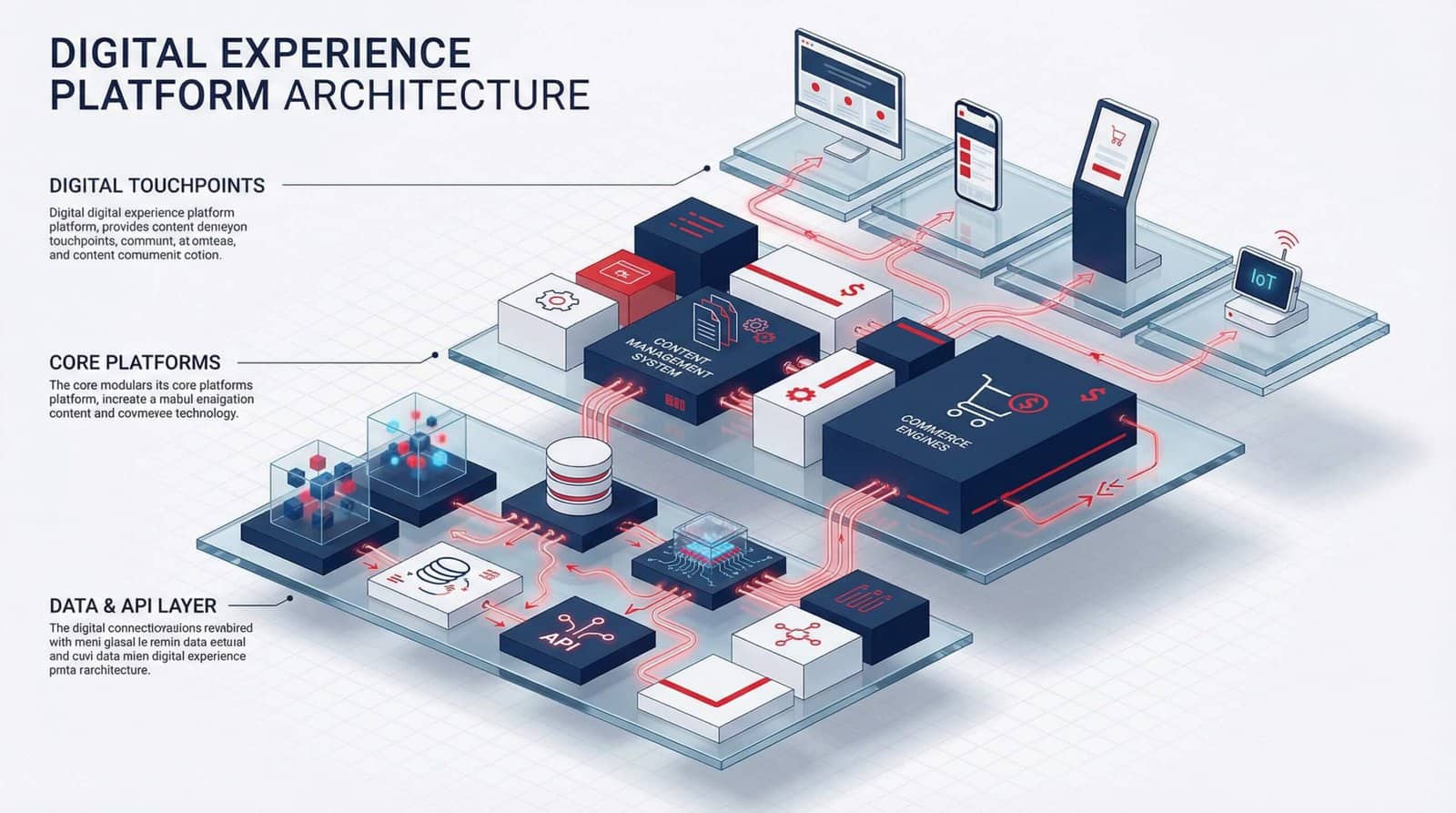
A modern DXP is built on five interconnected layers, each responsible for a distinct capability. Understanding this architecture is essential for making informed platform decisions and designing integrations that scale.
Layer 1
Experience Layer
Web, mobile, apps, portals, kiosks, IoT devices
Layer 2
Content Layer
DXP / Headless CMS / hybrid CMS for omnichannel delivery
Layer 3
Data Layer
Customer data, analytics, behavior tracking, CDP
Layer 4
Integration Layer
APIs connecting CRM, ERP, marketing tools, commerce
Layer 5
Intelligence Layer
Personalization, AI, automation, experimentation
Platform Comparison
Adobe vs Sitecore vs Acquia: Which DXP Is Right for You?
There is no universal “best” DXP platform. The right choice depends on your organization’s size, complexity, integration requirements, budget, and strategic priorities. Here’s how the three leading platforms compare across the dimensions that matter most.
Our DXP Platform Selection case study demonstrates how we run a structured evaluation process with weighted scoring across 40+ criteria to ensure objective, data-driven platform decisions.
Adobe Experience Manager
- AEM as a Cloud Service
- Premium Pricing
Key strengths
- Strongest enterprise integration, part of Adobe Experience Cloud
- 8x Gartner Magic Quadrant Leader (consecutive)
- Best-in-class asset management and content workflows
- Deep analytics integration with Adobe Analytics
Best for
Large-scale global organizations with complex content operations and existing Adobe ecosystem investments
Analyst Recognition
Gartner Leader 2025, Forrester Leader Q4 2025
Sitecore
- Composable (XM Cloud = headless-first)
- Mid-to-High Pricing
Key strengths
- Industry-leading personalization capabilities
- Flexible architecture. XM Cloud is fully headless
- Strong composable DXP strategy
- Robust multi-language and multi-site management
Best for
Mid-to-large enterprises prioritizing personalization at scale and flexible architecture
Analyst Recognition
Gartner Leader 2025, Forrester Leader Q4 2025
Acquia (Drupal)
- Open-source + Cloud (headless-capable)
- Cost-Efficient Pricing
Key strengths
- Open-source flexibility. Drupal core with enterprise cloud
- Cost-efficient compared to proprietary platforms
- Strong developer community and extensibility
- Full control over code and architecture
Best for
Organizations wanting control, flexibility, and lower licensing costs without vendor lock-in
Analyst Recognition
Gartner Challenger 2025
Platform Selection Depends On:
Organization Size
Enterprise vs. mid-market requirements
Complexity
Multi-region, multi-brand, multi-language
Integration Needs
CRM, ERP, commerce, analytics ecosystem
Budget & TCO
Licensing, implementation, 3–5 year horizon
The Reality Check
Common DXP Implementation Challenges
The 70% failure rate in digital transformation projects applies equally to DXP implementations. Understanding the most common pitfalls and designing your approach to avoid them is the difference between a platform that transforms your business and one that becomes expensive shelfware.
Over-engineered architecture
Building for every possible future scenario instead of today's requirements. The result: 18-month implementations that deliver features nobody uses.
Lack of governance across regions
No clear content ownership, approval workflows, or brand guidelines. Regional teams create their own processes, leading to inconsistency and duplication.
Poor integration with existing systems
Underestimating the complexity of connecting CRM, ERP, and marketing automation. Integration often consumes 40–60% of total implementation effort.
Content migration complexity
Treating migration as a lift-and-shift instead of an opportunity to restructure. Legacy content formats, broken links, and missing metadata create ongoing technical debt.
Low adoption (underutilized features)
Deploying a powerful platform without investing in training, change management, or process redesign. Teams revert to old workflows within months.
The Redex Approach:
Strategy Before Software
We design every DXP engagement around time-to-value. Our methodology ensures that the platform delivers measurable business outcomes from the first sprint, not just after a 12-month implementation.
- Start with business outcomes, not feature lists
- Design composable, avoid monolithic lock-in
- Phase the rollout to deliver value in 90-day increments
- Invest 30% of budget in training and change management
- Establish governance before go-live, not after
- Measure content velocity and conversion, not just uptime
Implementation Approach
The Redex DXP Implementation Methodology
Our 5-step approach balances thoroughness with speed delivering measurable value within the first 90 days while building toward the full enterprise DXP vision.
01
Business & Content Audit
Understand your current state
Timeline: 2–3 weeks
Comprehensive analysis of your current CMS landscape, content workflows, integration points, and stakeholder requirements. We map every content type, publishing workflow, and digital touchpoint to establish a clear baseline.
Key Actions
- Current CMS and technology inventory
- Content audit and taxonomy analysis
- Stakeholder interviews and requirements gathering
- Integration landscape mapping
02
Architecture Design
Design your composable DXP
Timeline: 2–4 weeks
Define the target architecture based on your specific requirements: composable vs. monolithic, headless vs. hybrid, cloud-native vs. on-premise. We design for flexibility, scalability, and time-to-value.
Key Actions
- Composable DXP architecture blueprint
- Integration mapping and API strategy
- Data flow and personalization design
- Security and governance framework
03
Platform Selection
Choose the right platform
Timeline: 3–4 weeks
Structured evaluation of DXP platforms against your requirements: Adobe vs. Sitecore vs. Acquia and alternatives. We run a weighted scoring model across 40+ criteria to ensure objective, data-driven selection.
Key Actions
- Weighted scoring across 40+ criteria
- Vendor demonstrations and POC evaluation
- TCO analysis over 3–5 year horizon
- Reference checks with similar implementations
04
Implementation & Migration
Build and migrate with precision
Timeline: 12–24 weeks
Phased rollout that prioritizes quick wins while building toward the full vision. Content migration is handled systematically & automated where possible, manually curated where quality demands it.
Key Actions
- Sprint-based implementation with bi-weekly demos
- Automated content migration with quality gates
- Integration development and testing
- Performance optimization and load testing
05
Governance & Optimization
Sustain and improve
Timeline: Ongoing
Establish content governance workflows, editorial guidelines, and performance monitoring. Continuous optimization based on analytics, A/B testing, and user feedback ensures the platform delivers increasing value over time.
Key Actions
- Content governance framework and workflows
- Editorial guidelines and training
- Performance monitoring and alerting
- Quarterly optimization reviews
Industry Applications
DXP Use Cases by Industry
Manufacturing
- Product catalogs with rich technical specifications and configurators
- Distributor and dealer portals with role-based content access
- Multi-language product documentation and compliance materials
- Self-service customer portals for orders, invoices, and support
Energy & Utilities
- Multi-region content governance across 50+ country sites
- Regulatory communication and compliance documentation
- Investor relations portals with automated reporting
- Employee intranets with safety and training content
Construction
- Automate repetitive documentation, reporting, and compliance checks.
- Automated quality checks, data consistency validation, and accurate estimates.
- Predictive scheduling, resource optimization, and constraint resolution.
Featured Research
DXP in action: manufacturing digital transformation
How leading manufacturers are using DXP architecture, MACH composability, and Industry 4.0 integration to build connected digital experiences across the factory floor and beyond.

- PREMIUM Guide
Key takeaways
Your Enterprise DXP Strategy Checklist
01
A DXP is an experience orchestration layer, not just a CMS. If you only need content publishing, a traditional or headless CMS may suffice. If you need personalization, integration, and multi-channel delivery, you need a DXP.
02
Headless CMS is a component of DXP, not a replacement. The modern approach is composable, assembling best-of-breed components into an integrated platform.
03
Platform selection should be data-driven. Adobe, Sitecore, and Acquia each excel in different contexts. Run a structured evaluation against your specific requirements, not industry hype.
04
Most DXP failures are organizational, not technical. Invest 30% of your budget in governance, training, and change management, not just technology.
05
Design composable, not monolithic. Each architecture layer should be independently upgradeable. Avoid vendor lock-in by choosing platforms with strong API and integration capabilities.
06
Measure content velocity and conversion, not just uptime. A DXP that delivers 99.99% availability but takes 3 weeks to publish content is failing its purpose.
Book a DXP Strategy Workshop
Ready to Move From Fragmented CMS to Integrated DXP?
Whether you’re evaluating your first DXP, migrating from a legacy CMS, or optimizing an existing platform, we start every engagement with a clear-eyed assessment of your current state, target architecture, and the fastest path to measurable value.
FAQs
Common Questions
What is a digital experience platform (DXP)?
A DXP is an integrated set of technologies that enables organizations to manage and deliver content across channels, orchestrate personalized customer journeys, integrate data from CRM, analytics, and backend systems, and scale globally with governance and localization. Unlike a traditional CMS, a DXP is an experience orchestration layer.
Is a DXP the same as a CMS?
No. A CMS is one component of a DXP. A traditional CMS focuses on content publishing for a single channel (typically web). A DXP extends this with customer data integration, personalization engines, multi-channel delivery, analytics, and integration layers that connect to your entire technology ecosystem.
What is a difference between a headless CMS and a DXP?
A headless CMS provides API-driven content delivery with great flexibility, but it lacks the orchestration capabilities of a full DXP: personalization, customer data management, experimentation, and cross-channel journey management. Think of a headless CMS as a powerful component that can be part of a composable DXP architecture.
How long does a DXP implementation take?
Typically 6–12 months depending on scope, complexity, and the number of integrations. A phased approach, starting with core content management and adding personalization, commerce, and advanced features in subsequent phases, delivers faster time-to-value. Our implementations typically show measurable results within the first 3 months.
Which DXP platform is best (Adobe, Sitecore, Acquia)?
There is no universal ‘best’. The right platform depends on your organization’s size, complexity, integration requirements, budget, and strategic priorities. Adobe excels in enterprise-scale global operations, Sitecore leads in personalization, and Acquia offers open-source flexibility at lower cost. We recommend a structured evaluation process against your specific requirements.
What does a DXP cost?
DXP costs vary significantly based on platform, scale, and implementation complexity. Enterprise platforms like Adobe AEM typically start at $200K+/year in licensing alone, while Acquia/Drupal can start at $50K–$100K/year. Implementation costs range from $150K to $2M+ depending on scope. The key metric is total cost of ownership (TCO) over 3–5 years, including licensing, implementation, training, and ongoing operations.
For the latest analyst evaluations, see the Gartner Peer Insights for DXP and the Forrester Wave: Digital Experience Platforms.