01. EXECUTIVE SUMMARY
Construction technology has become remarkably capable. Modern platforms manage drawings, BIM models, takeoffs, estimates, bids, project documents, coordination, field execution and increasingly, AI-assisted decision support. Autodesk Forma is a good example of how far the market has evolved: what was once a collection of separate tools is becoming a connected industry cloud spanning planning, design, construction and operations.
For construction businesses, that is good news. The question is no longer whether capable software exists. A harder question is emerging: why does work still get stuck when the software is already there.
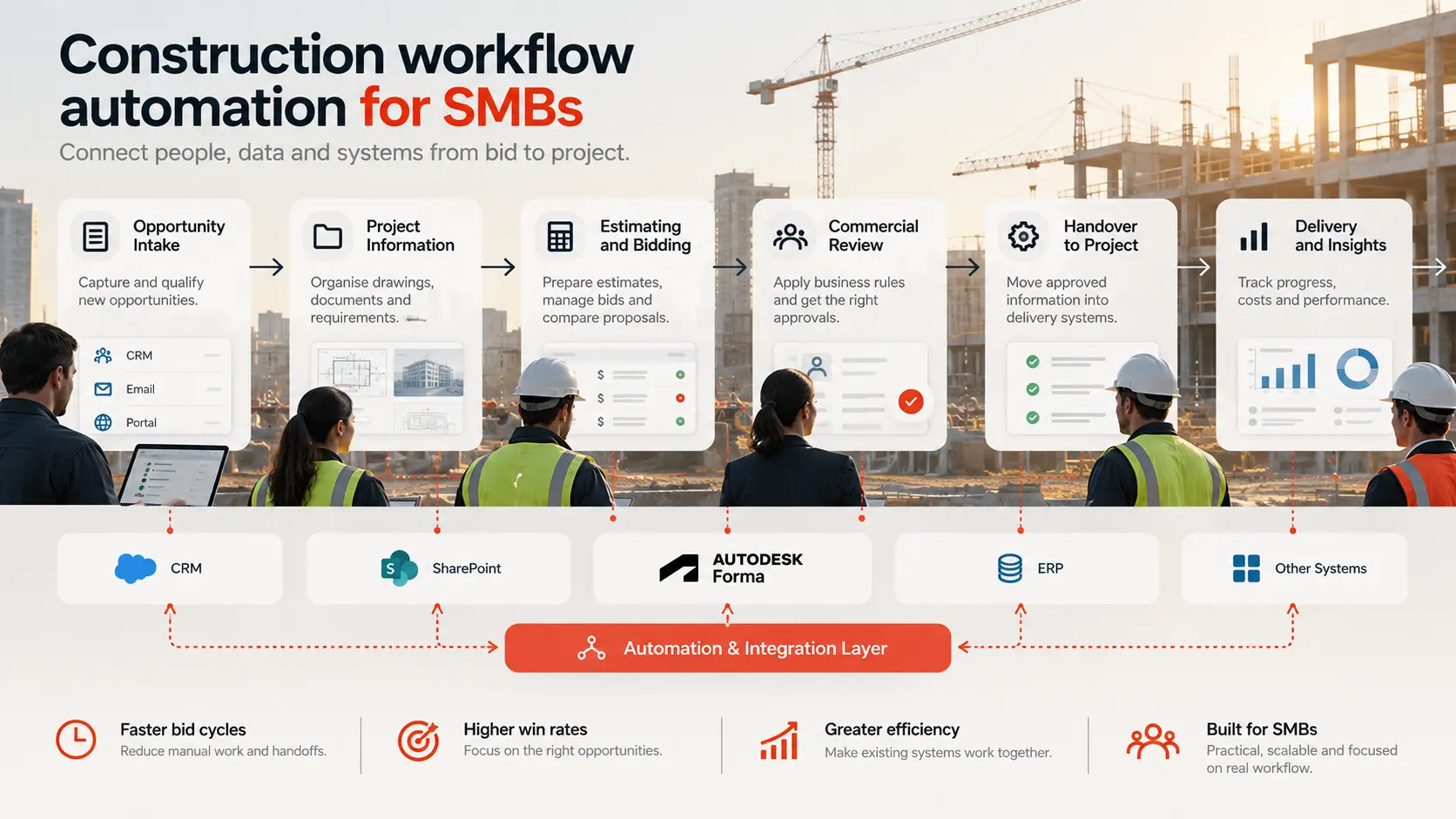
For many contractors and growing construction firms, the problem is not the absence of technology. It is what happens between the systems they already use. An opportunity lands in the CRM or an inbox. Drawings sit in a project folder. Estimators work across spreadsheets and specialist tools. Commercial assumptions get discussed by email. Management approves the bid somewhere else. Once the project is won, the same information has to move again into an ERP or project-management system.
Every individual system may be doing its job. The workflow as a whole may still be broken.
02. Industry Shift
Construction Software Has Matured. Has Your Workflow?
Digital transformation in construction has often been framed as a software-selection problem: which BIM platform, which estimating tool, which construction-management system. Those questions still matter, but leading platforms now cover far more of the project lifecycle than they used to.
Autodesk Forma, for example, now connects planning, design, preconstruction, construction and operations within a broader industry cloud, with preconstruction capabilities that include takeoff, estimating, bid management and subcontractor qualification.
That changes the transformation conversation. If a capable platform already provides the functionality a business needs, building another version of it rarely makes sense. The more useful question becomes: where does the operating workflow still fail despite those capabilities.
Sometimes the answer is configuration. Sometimes it is adoption. Sometimes two systems simply need to exchange information. Sometimes a repetitive step can be automated. And sometimes the company has a distinctive process or decision rule that genuinely requires a custom capability. Knowing the difference matters.
03. The Real Gap
Working Systems, Broken Workflow
Consider a typical bid-to-project process. A contractor may already have a CRM, an Autodesk environment, an ERP, document storage and several specialist applications. Yet an estimator still spends part of the morning searching for the latest drawings. Sales manually forwards project information. Someone re-enters quantities into another system. Approval depends on an email thread. Once the project is awarded, the same information is typed into yet another application.
Nothing is necessarily wrong with any individual product. The friction sits in the handoffs.
This is where digital initiatives quietly become expensive: a workflow problem gets interpreted as a platform problem, so the business goes looking for another major application. But another application can simply create another boundary.
Before adding technology, construction leaders should map how work actually moves from one decision to the next. Where does information enter the process. Where is it enriched. Who needs to make a judgement call. Which system owns which record. Where is data copied by hand. Which exceptions need human review.
Those questions point to a different technology strategy than “which platform should we buy next.”
04. Decision Framework
Configure. Integrate. Build.
This leads to a simple operating principle: configure when the existing platform can solve the problem, integrate when the capability exists but the workflow is disconnected, and build only when the missing capability reflects a genuinely distinctive business requirement.
This distinction matters most for smaller and mid-sized construction businesses. A company rarely needs to transform its entire technology landscape to improve one commercially important process.
Suppose the immediate problem is bidding. The business may want to qualify opportunities consistently, connect the relevant drawings and project information, bring the right estimating inputs together, introduce a clear approval gate, and hand approved information into the project or ERP environment. That does not automatically mean replacing existing systems. It may require a focused workflow layer around them.
The smallest useful intervention might be an integration, an automated intake process, a lightweight portal that connects existing data, AI applied to document classification, or a custom application where company-specific rules justify one. The architecture follows the problem, not the other way around.
05. Right-Sized Transformation
You Don't Need to Buy the Whole Stack
Enterprise construction platforms solve broad categories of problems because they serve broad markets. A growing construction company usually has a narrower immediate need: one estimating team, one bid type, one product family, one geography, one approval process.
That creates a real alternative to the traditional transformation programme. Instead of asking which platform to roll out across the company, the business can ask which workflow is costing the most time, capacity or commercial opportunity today. That workflow can then be bounded and measured.
For example: qualify the opportunity, gather the required project information, connect drawings and estimating inputs, make assumptions visible, route the bid to the right reviewer, transfer approved information downstream. Solve that workflow first. Measure whether bid cycle time falls, whether estimators handle more opportunities, whether data quality improves, whether commercial review happens earlier. Then decide whether to expand.
This sequencing reduces the temptation to over-engineer a solution before the organisation has evidence the change creates value. Redex’s Custom Digital Platforms work follows exactly this configure-integrate-build logic.
06. Autodesk Customers
The Opportunity Sits Around Autodesk
The same principle applies to companies already invested in Autodesk. Autodesk may be the right environment for project data, preconstruction, BIM coordination or construction execution. The remaining problem can sit before, after or between those activities.
A commercial opportunity might begin in Dynamics or Salesforce. Project documents might arrive through email or SharePoint. The estimator may work in Autodesk Forma. Pricing might come from an ERP or internal database. Management may need margin, customer and pipeline information that lives outside the construction platform. Once a bid is won, approved information may need to create or update records in finance, ERP and project-management systems.
The real workflow looks less like a single product and more like a chain: CRM, qualification, project data, estimating, commercial review, approval, ERP, project delivery. Autodesk can be an important part of that chain without needing to become every system in the business. This is where integration and workflow orchestration create value: not replacing a platform that already works, but making it operate coherently within the wider business.
07. AI Discipline
AI Should Remove Friction
AI creates another temptation to rebuild capabilities that already exist. Construction platforms are already incorporating AI into planning, risk management and project information. Adding a separate AI application simply because AI is available often creates more complexity, not less.
A better question: what company-specific work remains difficult even after the platform’s own capabilities are considered. AI may be useful to classify an incoming request, extract information from documents before a bid is created, compare an opportunity against historical projects, or flag missing information ahead of commercial review. But those capabilities should connect to the workflow the company already operates, and they should preserve human judgement wherever commercial, technical or contractual decisions require it.
The objective is not to insert AI into every step. It is to remove repetitive work so experienced people spend more time evaluating scope, cost, risk, margin and trade-offs.
08. The Honest Call
Sometimes the Right Answer Is No New Software
There is an uncomfortable but useful conclusion here: a technology partner should sometimes recommend that nothing new be built.
If the existing platform already contains an appropriate capability, the right intervention may be configuration or adoption. If two applications simply need to exchange information reliably, integration may be enough. If the process itself is unclear, software should probably wait until ownership and decision rules are defined.
Custom development becomes valuable when the remaining gap is genuinely specific to how the business creates value. That might include proprietary qualification logic, unusual estimating inputs, customer-specific approval rules, or a workflow that spans several systems in a way standard software cannot easily support. Custom should be the answer to a demonstrated gap, not the starting assumption.
This is not a fringe concern. McKinsey’s analysis of the construction and building technology sector points to high fragmentation and slow technology adoption as central drivers of the industry’s weak recovery and value creation. Fixing the workflow between systems, not just the systems themselves, is where much of that lost value sits.
09. Next Steps
Start Where the Work Gets Stuck
The construction technology market will keep consolidating workflows into more capable platforms. That is not a threat to focused digital transformation. It makes focus more important.
The opportunity is no longer to digitise activities that software vendors have already digitised well. It is to find where a company’s actual operating model still breaks across people, systems and decisions. For one contractor, that may be opportunity qualification. For another, it may be the connection between BIM data and estimating. For an Autodesk customer, it may be the handoff between Forma and the CRM or ERP. For a smaller firm, it may be a single high-value workflow that does not justify a broad technology transformation at all.
Recommended next step: map your bid-to-project workflow before evaluating any new platform. Identify where information crosses system boundaries, where it is copied by hand, and where a decision waits on a person rather than a process. That map, not a vendor shortlist, should drive the next investment.
At Redex, we approach construction transformation from the workflow outward: we map where work slows down, identify what your existing technology can already solve, connect the systems that should work together, and build dedicated capability only where the business case justifies it. See how this applies to bid and award processes on our Construction Bid Management page, browse related construction case studies, or explore our Construction & Manufacturing industry page for the full picture.