01. EXECUTIVE SUMMARY
Autodesk Forma Is Becoming More Connected. What Does That Mean for Construction Teams?
Autodesk Forma is moving well beyond its origins in early stage design. At Autodesk University 2026, Autodesk announced another wave of capabilities across AI, data management, preconstruction and project execution. The direction is increasingly clear: Autodesk wants Forma to connect more of the architecture, engineering and construction lifecycle within one cloud environment, while reducing the manual handoffs that still separate design, bidding and delivery.
Among the latest developments are AI agents for bid review, smarter document access controls, expanded bidding workflows, workflow automation and stronger connections between project schedules and models. For construction teams, these are meaningful improvements, but they also raise a useful strategic question. As platforms such as Autodesk Forma become more capable, where should construction companies rely on the platform, and where do they still need integration, automation or custom workflows around it? That distinction matters, particularly for small and mid sized construction businesses that already have multiple systems in place.
02. FORMA EVOLVES
Autodesk Forma is becoming an end-to-end construction environment
Autodesk has been steadily expanding the scope of Autodesk Forma. Earlier in 2026, Autodesk Construction Cloud became part of the Forma industry cloud, bringing products for document management, preconstruction, construction management and model coordination under the broader Forma environment. The announcements at Autodesk University 2026 continue that direction.
Rather than treating planning, bidding, coordination and construction as isolated software categories, Autodesk is increasingly connecting them through shared project data and workflows. For customers, that can reduce one of construction technology’s persistent problems: information being recreated every time a project moves from one stage to another. Autodesk’s latest updates concentrate on three areas: artificial intelligence, structured project data and integrated workflows.
03. AI IN ACTION
Autodesk Forma is introducing more task-specific AI
One of the most notable announcements is the Bid Proposal Agent, currently in beta. Reviewing subcontractor proposals can require estimators to manually interpret scope, identify what has been included or excluded, and structure information before bids can be meaningfully compared. Autodesk is applying agentic AI to this task so teams can spend less time reviewing and re-entering information manually.
This represents an important shift in how AI is entering construction software. Instead of providing a generic chatbot next to an existing application, AI is increasingly being embedded into specific operational tasks. For construction companies evaluating AI, this should influence the build versus buy discussion: if Autodesk Forma already provides an effective capability inside the workflow where teams work, recreating the same feature independently may add complexity without creating meaningful differentiation.
The more valuable question is what happens around that capability. Where does the proposal originate? What information is required before it reaches the estimator? What company-specific qualification or commercial rules apply, and where does the approved decision need to go next? Those surrounding steps are often where workflow fragmentation remains.
04. SMARTER DATA
Forma Data Management is becoming more context-aware
Autodesk also announced Smart Controls for Forma Data Management. Construction document access is often managed through folder structures, and when a document reaches another approval stage, teams may move or duplicate it into another folder with different permissions. Smart Controls instead allows access rules to respond to metadata such as approval status: the file does not necessarily need to move, since its status determines who should be able to access it.
This may appear to be a document management enhancement, but it reflects a broader transformation occurring across construction technology. Data is becoming less dependent on where a document physically sits and more dependent on what that information represents, and that creates a stronger foundation for automation. When project information contains consistent metadata, systems can make better decisions about routing, access, reporting and downstream processes.
For construction businesses considering AI or workflow automation, the lesson is significant: automation quality depends heavily on the structure and reliability of the underlying data. A workflow cannot become truly intelligent if people still need to interpret inconsistent folders, filenames and spreadsheets before every decision.
05. CONNECTED BIDDING
Autodesk Forma is extending the preconstruction workflow
Autodesk is also expanding access to Forma Bid, bringing established BuildingConnected bidding workflows further into the Forma preconstruction environment. Teams can create bid packages, invite subcontractors, evaluate bids and work with shared project information within a more connected process. Autodesk has also outlined deeper connections between bidding and estimating: estimate line items are expected to connect with bid packages, helping teams compare subcontractor pricing with estimated costs and identify potential scope gaps, and awarded bids can then connect downstream toward project execution and cost management.
This direction is particularly relevant to construction companies evaluating their own construction bid management workflow. The goal should not automatically be to create another bidding platform. If Autodesk Forma already addresses the standard functionality a company requires, using those capabilities is usually more sensible than rebuilding them.
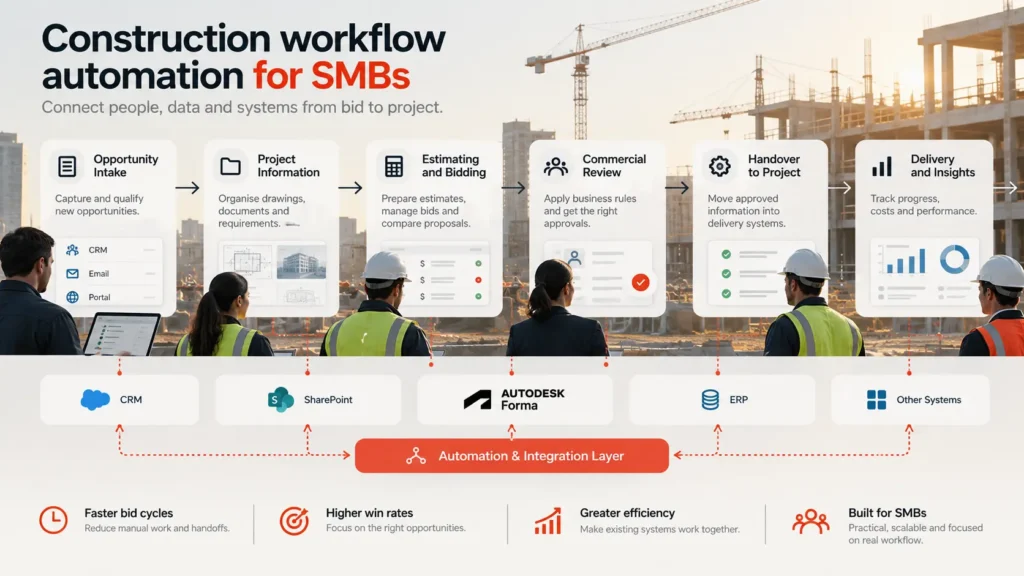
But construction bidding rarely exists entirely within one application. An opportunity may arrive through a CRM or email, project requirements may be stored in SharePoint, commercial qualification may depend on information from finance, pricing may come from an ERP or proprietary database, and management approval may involve rules that are specific to the business. The platform can therefore be capable while the end-to-end workflow remains fragmented.
06. WORKFLOW AUTOMATION
Workflow Studio moves Forma toward orchestration
Another important Autodesk Forma development is Workflow Studio, currently in beta. Workflow Studio allows teams to define what should happen after specific project events. Autodesk gives the example of a pre-installation inspection: if the inspection fails, an issue can automatically be routed to the superintendent, and if it passes, the next checklist can be created and assigned.
This begins to move construction platforms beyond storing project information toward actively coordinating what happens next. That is valuable because some of the largest productivity losses in construction do not come from difficult technical calculations. They come from small administrative transitions repeated hundreds or thousands of times: someone receives information, someone checks it, someone sends it elsewhere, someone creates the next task, someone updates another system. Automation can remove much of this coordination work.
But there is an important boundary. Workflow Studio can orchestrate processes within the Autodesk environment, while a construction company’s operating workflow may extend much further. CRM, ERP, finance, customer portals, procurement systems, internal databases and other platforms may all participate in the same business process, and that is where architecture becomes more important than simply selecting another feature.
07. BEYOND FORMA
What happens outside Autodesk Forma still matters
Consider a construction company using Autodesk Forma effectively for preconstruction and project delivery. Its actual commercial workflow might still look something like this:
CRM → Opportunity qualification → Project documents → Autodesk Forma → Estimate → Commercial approval → ERP → Project execution → Reporting
Autodesk Forma can play a central role without needing to become every system within that architecture. The challenge becomes ensuring that information moves correctly between each stage. This is where RedEx sees a different type of construction technology problem: the question is not how do we replace Autodesk Forma, but how do we make Autodesk Forma, our existing systems, business rules and people operate as one workflow.
For some companies, the answer may simply be better configuration or adoption. For others, an integration may remove duplicated data entry between Autodesk and another business system, and some may benefit from automation around opportunity intake, qualification or approvals. Where a workflow genuinely reflects proprietary knowledge or competitive advantage, a focused custom application may be justified.
08. BUILD SELECTIVELY
More capable platforms should mean less unnecessary custom software
The expansion of Autodesk Forma should actually make the case for selective custom development stronger, not weaker. Construction companies should not build software merely because their current process is inconvenient. The first question should be whether an existing platform already solves the problem.
At RedEx, we approach that decision through three paths: use what works, connect what is fragmented, build only what is missing. If an Autodesk Forma capability solves the requirement, use it. If the capability exists but information is trapped between systems, integrate them. If the company operates a genuinely distinctive workflow that standard software cannot support effectively, then consider a focused custom platform or orchestration layer.
This is particularly relevant to smaller construction companies. A business may not require every capability available across an enterprise construction technology stack. It may instead have one commercially important workflow that creates disproportionate friction, such as bid qualification, estimating handoffs or project setup, and rather than beginning with a company-wide transformation, RedEx can start with that bounded workflow, assess the existing systems and determine the smallest useful intervention.
Our AI Strategy Consulting approach follows the same principle: assess the workflow, data, integration requirements and operating constraints before deciding whether the answer should involve an existing product, integration, automation or custom development.
09. REDEX POSITIONING
RedEx works around the workflow, not against the platform
Autodesk Forma is becoming a broader and increasingly connected construction industry environment. That makes it an important part of the technology architecture for many contractors, architects, engineers and owners. RedEx does not need to compete with that architecture. Our role is different.
We help construction businesses identify where work still slows down across their existing systems and determine the most practical way to remove that friction. For a company already using Autodesk Forma, that might mean connecting Forma with CRM, ERP, document repositories or proprietary data. For a smaller construction business, it might mean solving one high-value bid-to-project workflow without deploying an unnecessarily broad technology stack. For another organisation, the problem may be AI readiness, inconsistent project data or a process that has never been properly defined before automation. The solution depends on the workflow.
Our Custom Digital Platforms capability is therefore not based on replacing standard platforms wherever possible. It is designed for the situations where integration, automation or company-specific functionality remains missing after existing technology has been considered.
10. START HERE
Autodesk Forma is expanding. Your technology strategy should become more focused.
The latest Autodesk Forma announcements show where construction technology is heading. AI is moving into individual tasks, project data is becoming more structured, bidding and estimating are becoming increasingly connected to construction, and workflow automation is moving directly into the platforms teams already use.
For construction leaders, the response should not be to add technology at the same pace vendors add features. It should be to become more deliberate about where technology creates value. Start by identifying where work gets stuck, then ask whether Autodesk Forma or another existing platform already solves it. If it does, use the capability. If the process breaks between systems, connect them. If an important workflow is genuinely unique to the business, build only the piece that is missing.
That is the approach behind RedEx’s Bid-to-Project Acceleration work: improve qualification, project information, estimating, commercial review and downstream handoffs around the technology the organisation already has. As construction platforms become more powerful, the advantage will increasingly come not from owning more software, but from making the right systems work together.