01. EXECUTIVE SUMMARY
Construction Lead Management: The Decisions That Turn Interest Into A Bid
Construction lead management is not a matter of collecting more names. It is the operating discipline that helps commercial, technical and estimating teams decide what to pursue, what to clarify and who owns the next response. In a complex project sale, the first enquiry may include a drawing, a location, a partial specification, a tight deadline or simply a request to talk. The value lies in turning that incomplete signal into a visible decision.
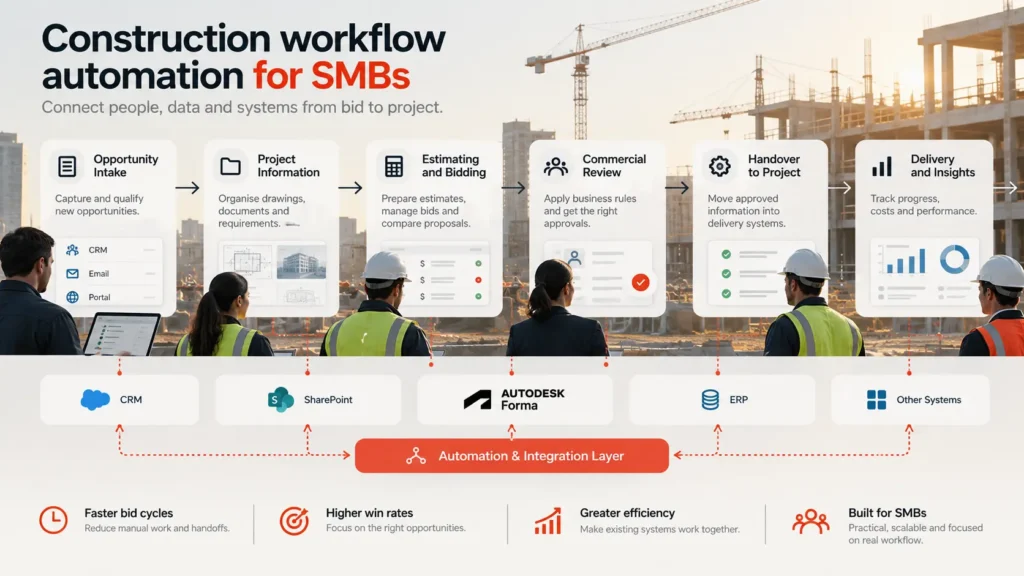
That is why construction lead management should connect qualification, document context, estimating and hand-off. It should not sit as an isolated form, inbox or CRM stage. This page explains the decisions, information and workflow controls that make a lead-to-project process useful. It is written for construction and industrial teams that want fewer avoidable hand-offs and a clearer path from enquiry to bid.
02. Foundation
Why Construction Lead Management Matters?

Construction lead management matters because a project enquiry is not yet an opportunity. It is a request for attention. Before a team commits estimation time or promises a meeting, it needs to know whether the project is a fit, whether the request is complete enough to progress and whether an accountable person can respond. When those decisions are unclear, people compensate with extra email, meetings and private spreadsheets. Context is rebuilt repeatedly. No one can confidently say why a lead was delayed, declined or passed to another team.
A stronger construction lead management workflow gives every enquiry one visible record of its project context. It helps teams ask the useful questions once, attach the right documents once and make qualification choices that other people can understand. This improves speed, but speed is not the only aim. The aim is a response that reflects the actual requirement and the commercial judgement behind it.
For construction and industrial businesses, this is also a practical part of digital transformation in construction. Digital transformation is not a platform purchase. It is the deliberate redesign of a business workflow so people, information and systems work together with less friction. Construction lead management is a high-value place to begin because it exposes the link between demand, operational capacity and customer experience.
Signs the current process needs attention
None of these signs proves that a new system is required. They do show that the construction lead management process needs a closer look. A well-scoped change may begin with a clearer enquiry route, a shared qualification checklist or a better hand-off between the portal and existing systems.
- Sales receives enquiries without enough project or technical context.
- Estimators spend time chasing information that should have been captured earlier.
- Documents live across email threads, shared drives and individual desktops.
- Teams cannot explain why a qualified project waited for a response.
- Different people qualify similar opportunities in different ways.
- CRM stages show activity but not the reason behind the decision.
- Delivery learns about a project after commercial commitments have already been made.
03. A practical workflow
5 Proven Lead-to-Project Workflow Steps
The lead-to-project workflow should be designed around decisions, not software screens. The five steps below help a team decide what information to collect, where human approval matters and how the next owner receives a useful brief. They are a practical starting point for construction lead management and for the broader work of digital transformation in a project-based business.
01
- Define the enquiry that is worth progressing.
Start with the types of project, customer and geography your team can serve. Name the minimum commercial and technical conditions that make a response useful. Construction lead management becomes more consistent when the team agrees what “fit” means before it looks at technology.
02
- Capture the context behind the request.
Ask only for information that affects a decision. This may include project type, location, scope, expected timing, procurement route, drawings, specifications, key constraints and the preferred next step. Good construction lead management avoids a long generic form. It gives the visitor a clear route to share the context that a reviewer will actually use.
03
- Check completeness and apply qualification rule.
A named commercial or technical owner should review fit, completeness, urgency and the risks of moving forward. Rules can guide the decision. Automation can prepare a summary or flag missing information. It should not hide the accountable human decision.
04
- Route the complete story to the right owner.
The estimator, account manager, technical specialist or delivery lead should receive the relevant project history, documents and qualification notes together. The lead-to-project hand-off is successful when the next person does not need to reconstruct the story from fragments.
05
- Act, record the outcome and learn.
The team responds, clarifies, progresses or declines. Each result should create a simple reason that can improve future construction lead management. Over time, patterns in missing information, lost opportunities and delayed hand-offs provide a better basis for change than assumptions alone.
04. Context
The Context Your Team Needs Before It Starts A Bid
Construction lead management should gather decision-ready information, not just contact fields. An enquiry may appear qualified because it comes from a recognised company, but the team still needs a view of scope, timing, buying route and technical readiness. The goal is not perfect information on day one. The goal is enough context to know which question or action comes next.
A practical enquiry context model
- Customer and stakeholder: company, role, preferred contact route and relationship context.
- Project: project type, site or geography, current stage, timing and procurement route.
- Requirement: broad scope, product or service need, specifications and constraints.
- Documents: drawings, schedules, photos, briefs, prior correspondence or reference files.
- Commercial fit: estimated scale, opportunity type, route to market and relevant exclusions.
- Decision status: what is known, what is missing, who owns the next review and when it is due.
Not every construction lead management workflow needs every field. A team should remove questions that do not change a decision. It should also provide space for the context that structured fields cannot capture. This is especially important in industrial sales, where a buyer may describe a problem before they can name the final specification.
Document handling deserves special attention. Drawings and specifications often carry the meaning of the enquiry. A construction lead management workflow should make it clear where those files belong, who may access them and what happens when a document is missing or revised. The workflow is not complete if the project record says “qualified” while the critical document remains in an inbox.

05. Qualification
Qualification Is A Commercial Decision, Not A Score Alone
Teams often ask for a score because a score feels objective. Scoring can help construction lead management, but it should support judgement rather than replace it. A high-value request may be incomplete because the buyer is still shaping the requirement. A lower-value request may be strategically important because it opens a new relationship or aligns with available capacity. The rules need to make these trade-offs visible.
Useful qualification questions
- Is this a project type and location we can realistically support?
- Do we understand enough of the requirement to select the next action?
- Is there a credible timeline, route to decision or reason to engage now?
- Which specialist should review the technical or commercial risk?
- What must be clarified before estimation effort begins?
- Is there a clear owner for the response and a date for the next step?
Strong construction lead management makes the answers to these questions discoverable by the next person. That reduces repeat discovery and prevents a lead from moving merely because someone updated a status field. It also creates a healthier conversation between sales, estimation and delivery about what the business should pursue.
06. Technology Selection
Choose Technology After The Workflow Is Clear
Technology can make construction lead management easier to run. It can connect a portal, CRM, document repository, estimation system and reporting view. Yet a platform cannot decide what good qualification looks like on behalf of the business. The foundation is a shared workflow, defined roles and a decision standard that people trust.
This is where digital transformation adds value. Digital transformation in construction should connect the customer journey with the operating journey. A buyer has one experience of asking for help. Internally, the same request may touch marketing, sales, estimating, technical experts and delivery. Construction lead management should preserve context across that path rather than forcing each team to create a separate version.
Capabilities to assess
- A guided enquiry or customer portal that captures relevant project context.
- Document upload, classification and secure access controls.
- A CRM or work queue that assigns accountable ownership.
- Integration that carries approved information into estimating or delivery tools.
- Automation that flags missing details, deadlines or hand-off exceptions.
- Reporting that shows bottlenecks without reducing each opportunity to a number.
RedEx can help evaluate these capabilities through custom digital platforms, data engineering services and digital experience platforms. The point is not to force a preferred stack. It is to design an architecture that respects existing systems, information sensitivity and the people who will operate the process.
07. Risk Mitigation
Where AI Can Help, And Where It Should Not Decide
AI can assist construction lead management when it reduces low-value preparation work. It may summarise an enquiry, extract a list of missing items from a document set, suggest a category or prepare a hand-off brief. These uses can save time when the output is transparent and a named owner checks it before it triggers a commercial commitment.
AI should not silently decide whether to bid, approve sensitive content or make promises to a customer. Construction lead management often deals with incomplete, confidential and commercially significant information. The right control is simple: the workflow should show what AI prepared, what a person approved and what action followed. For a broader view of governed use cases, see RedEx’s agentic AI for enterprise and AI strategy for business services.
08. Performance Metrics
Measure The Journey, Not Just The Number Of Leads
Lead volume is an incomplete measure. A construction lead management process should tell you whether the right enquiries gain a useful next action. The measures below are a starting point. They should be defined with the teams who own the work, not imposed as a generic dashboard.
- Time to first useful response: time from enquiry to an informed acknowledgement or next action.
- Context completeness: proportion of progressed enquiries that include the agreed decision inputs.
- Qualification turnaround: time between receipt and an accountable fit decision.
- Handoff rework: number of times the next owner must ask for information already available elsewhere.
- Reason for decline or delay: visible categories that show where the workflow needs improvement.
- Bid conversion by source and project type: a directional learning signal, not proof of individual performance.
These measures turn construction lead management into a learning system. They help leaders see whether a change improves the work itself, not merely whether a new tool was launched. This is the practical value of digital transformation: clearer decisions and stronger operating habits over time.
09. Roadmap
How To Start Without Rebuilding Everything
Many teams do not need a full replacement programme. Begin with one point of friction where information is repeatedly lost or a decision repeatedly waits. The first intervention might be a better enquiry route, a qualification review, a document checklist or one improved hand-off into the existing CRM. Construction lead management becomes more credible when the change is small enough to test and meaningful enough to improve a real decision.
- Map the current journey from first interest to bid or decline.
- Name the moments where context is lost, duplicated or delayed.
- Agree the minimum information for each decision point.
- Assign one accountable owner for qualification and hand-off.
- Test the change with a bounded set of enquiries.
- Review the evidence before scaling the process or adding automation.
This approach gives digital transformation in construction a practical boundary. It is not a promise to automate everything. It is a way to make the lead-to-project journey clearer for customers and easier for the team to run.
What RedEx brings
Map your Lead-to-Project Workflow
We frame the business decision first: what needs to move faster, who owns the hand-off, what context matters and how success will be assessed. We then design and validate the smallest useful scenario before recommending how to scale it. Depending on the workflow, the delivery may involve a custom portal, connected customer experience, structured content, document handling, integration, automation or an AI-assisted review step. The appropriate architecture follows the users, data sensitivity, existing systems and ownership model.
If your team is losing project context between enquiry, qualification and estimating, start by mapping one real journey. Identify the decision that is currently slow or uncertain. Then define the information, owner and next action needed to make that decision easier. RedEx can help you turn that map into a bounded validation scenario, a connected workflow or a longer-term digital transformation roadmap.