
01. EXECUTIVE SUMMARY
Predictive Maintenance for Manufacturing: The $98 Billion Opportunity
Predictive maintenance for manufacturing has moved from pilot projects to production-grade deployments across the industrial sector. The global market reached $14.29 billion in 2025 and is projected to grow at 27.9% CAGR to $98.16 billion by 2033. For mid-size manufacturers operating 15 to 40 critical production assets, unplanned equipment downtime remains the single largest controllable cost driver, consuming 5 to 20% of productive capacity annually.
The economics are clear. Unplanned downtime in automotive manufacturing costs up to $3 million per hour. In general manufacturing, the figure ranges from $10,000 to $250,000 per hour depending on the production line. Traditional time-based preventive maintenance reduces risk compared to reactive repair, but it still wastes 20 to 30% of the parts and labor budget on unnecessary interventions. This approach represents a fundamental shift: from maintaining equipment on a calendar to maintaining it based on actual condition, predicted by machine learning models that analyze real-time sensor data.
As Deloitte’s research on predictive maintenance demonstrates, organizations implementing condition-based monitoring achieve 25% lower maintenance costs, 70% fewer breakdowns, and 25% higher productivity. For manufacturers competing on margins measured in single digits, these improvements translate directly to profitability. This guide presents five proven strategies for implementing condition-based monitoring in production environments, grounded in the Redex Manufacturing Intelligence Framework and validated across real engagements with mid-size industrial companies.
$14.3B
Global PdM Market (2025)
25-40%
Maintenance Cost Reduction
35-50%
Downtime Reduction
Typical ROI Payback
02. Foundation
What Is Predictive Maintenance in a Manufacturing Context?
Predictive maintenance uses IoT sensors, machine learning algorithms, and real-time data analytics to predict equipment failures before they occur. Unlike time-based preventive maintenance (change bearings every 2,000 hours) or reactive maintenance (fix it when it breaks), predictive maintenance monitors the actual condition of each component and forecasts when intervention is needed. The goal is precision: not too early (wasting resources), not too late (emergency repairs).
In a manufacturing environment, this means sensors measuring vibration, temperature, pressure, oil quality, and electrical current feed continuous data streams to ML models. These models learn the normal operating patterns for each machine and detect subtle deviations that indicate developing problems. The detection window is typically 2 to 6 weeks before a human technician would notice anything wrong, providing ample time to schedule repairs during planned maintenance windows.
$$$
Reactive
Fix after failure. Highest cost, maximum downtime, safety risk. Emergency repairs cost 3 to 5x planned work.
$$
Preventive
Schedule-based intervals. Reduces risk but wastes 20 to 30% on unnecessary parts and labor.
$
Predictive (AI)
Condition-based monitoring. Right maintenance at the right time. Lowest total cost of ownership.
Organizations implementing predictive maintenance achieve 25% lower maintenance costs, 70% fewer breakdowns, and 25% higher productivity compared to reactive approaches.
Deloitte, 'Predictive Maintenance in Manufacturing'
03. The Problem
Why Predictive Maintenance for Manufacturing Matters at Mid-Market Scale
Mid-size manufacturers face a specific set of constraints that make this investment both more urgent and more impactful than for large enterprises. With 50 to 500 employees and 15 to 40 critical production assets, these companies lack the redundancy of large plants. When a key CNC machine or stamping press goes down, there is no backup line to absorb the load. Every hour of unplanned downtime directly reduces output and revenue.
The 5 categories of cost savings from condition-based monitoring compound significantly at mid-market scale:
Direct Maintenance Reduction
18 to 25% reduction in maintenance expenditures through elimination of unnecessary scheduled replacements and early detection of developing faults.
Downtime Cost Avoidance
The largest dollar figure. Unplanned downtime costs $10K to $250K per hour in manufacturing. Predictive maintenance provides 2 to 6 weeks of advance warning for critical failures.
Inventory Optimization
20 to 30% reduction in spare parts inventory. When you can predict failures weeks in advance, you order parts on standard lead times instead of stockpiling expensive spares.
Asset Lifecycle Extension
20 to 40% extension in equipment useful life. Maintaining based on actual condition prevents both over-maintenance (unnecessary disassembly risk) and under-maintenance (accelerated degradation).
Energy Efficiency Gains
5 to 10% energy reduction on monitored equipment. Degrading motors, misaligned shafts, and fouled heat exchangers consume 8 to 15% more power than properly maintained equipment.
- RedEx Point of View
Most manufacturers underestimate the compounding effect of these five savings categories. A $50M-revenue manufacturer typically recovers $400K to $800K annually from a fully deployed predictive maintenance program. The investment pays back within the first year, and savings compound as models improve with more data. The question is not whether to implement condition-based monitoring. The question is how quickly you can move from pilot to production.
04. Strategic Playbook
5 Proven Predictive Maintenance Strategies for Manufacturing
Each strategy below addresses a specific failure mode common in mid-size manufacturing operations. The approaches are ordered by implementation complexity, starting with the lowest-barrier entry point. Manufacturers implementing AI strategy for their operations typically begin with vibration analysis and expand to additional modalities as the data foundation matures.
Strategy 1: Vibration Analysis
The problem
Bearing failures and spindle misalignment in CNC machines, compressors, and rotating equipment cause 35% of unplanned manufacturing downtime. A single spindle seizure on a $250K CNC machine can halt an entire production line for 2 to 4 days.
AI Solution
MEMS accelerometers mounted on rotating components continuously measure vibration signatures across frequency bands. ML models trained on failure-mode libraries detect anomalies such as bearing wear, shaft misalignment, and gear tooth damage weeks before catastrophic failure occurs.
Outcome
Manufacturers report 60 to 75% reduction in bearing-related failures and $150K to $350K annual savings per production line through scheduled replacements instead of emergency repairs.
Tech stack
MEMS accelerometers, edge gateways, time-series ML (LSTM/Transformer), CMMS integration
Strategy 2: Thermal Monitoring
The problem
Overheating in motors, transformers, and electrical panels is the second leading cause of unplanned shutdowns in manufacturing plants. Temperature anomalies often go undetected until a component fails, causing $50K to $200K in emergency repair costs per incident.
The Solution
Infrared sensors and thermal imaging cameras feed continuous temperature data to AI models that establish baseline thermal profiles for each asset. The system detects abnormal heat patterns indicating insulation breakdown, overloaded circuits, or friction-related wear.
Outcome
Thermal-related failures drop by 55 to 70%. One mid-size automotive parts manufacturer reduced electrical panel failures from 12 per year to 2, saving $480K annually in emergency repairs and lost production.
Strategy 3: Oil Analysis
The problem
Hydraulic systems and lubrication circuits in stamping presses, injection molding machines, and CNC equipment degrade silently. Contaminated oil accelerates wear by 3 to 5x, but traditional lab-based oil analysis provides results too late to prevent damage.
The Solution
Inline oil condition sensors measure particle count, viscosity, moisture content, and chemical composition in real time. AI models correlate oil degradation curves with component wear patterns to predict remaining useful life for seals, pumps, and bearings.
Outcome
Hydraulic failure rates drop by 50 to 65%. Oil change intervals extend by 30 to 40% based on actual condition rather than fixed schedules, reducing lubricant costs by $25K to $60K annually for a typical 20-machine shop.
Strategy 4: Motor Current Analysis
The problem
Electric motors consume 70% of industrial electricity. Motor faults such as stator winding degradation, rotor bar cracks, and bearing wear develop over weeks but are invisible to standard monitoring until the motor fails, costing $15K to $80K per replacement.
The Solution
Current signature analysis (CSA) sensors capture the electrical waveform of each motor. AI models analyze harmonic patterns to detect developing faults without requiring additional mechanical sensors, making it the lowest-cost entry point for predictive maintenance.
Outcome
Motor failures reduced by 45 to 60%. Energy consumption drops 5 to 10% as the system identifies motors operating outside optimal parameters. One plastics manufacturer saved $220K annually across 40 monitored motors.
Strategy 5: Digital Twins
The problem
Static OEM maintenance schedules ignore actual operating conditions. Equipment running high-mix production, operating in dusty environments, or subjected to frequent changeovers degrades 2 to 3x faster than manufacturer baselines suggest.
The Solution
Digital twin models simulate each machine's actual operating environment, load history, and component wear. Physics-informed ML adjusts maintenance predictions based on real production conditions rather than generic OEM intervals.
Outcome
Maintenance scheduling accuracy improves by 40 to 55%. Equipment utilization increases 12 to 18% as machines spend less time in unnecessary preventive maintenance. ROI typically achieved within 8 to 12 months of deployment.
05. Decision metrics
Is Predictive Maintenance Worth It for Your Plant?
Situation
Recommendation
Frequent unplanned downtime on critical assets
Strong candidate
Maintenance history available + sensorable equipment
Strong candidate
Stable equipment with very low failure cost
Lower priority
No maintenance records/data ownership
Fix foundation first
Only 1–2 noncritical machines
Preventive may remain sufficient
06. Architecture Principles
The Manufacturing Predictive Maintenance Technology Stack
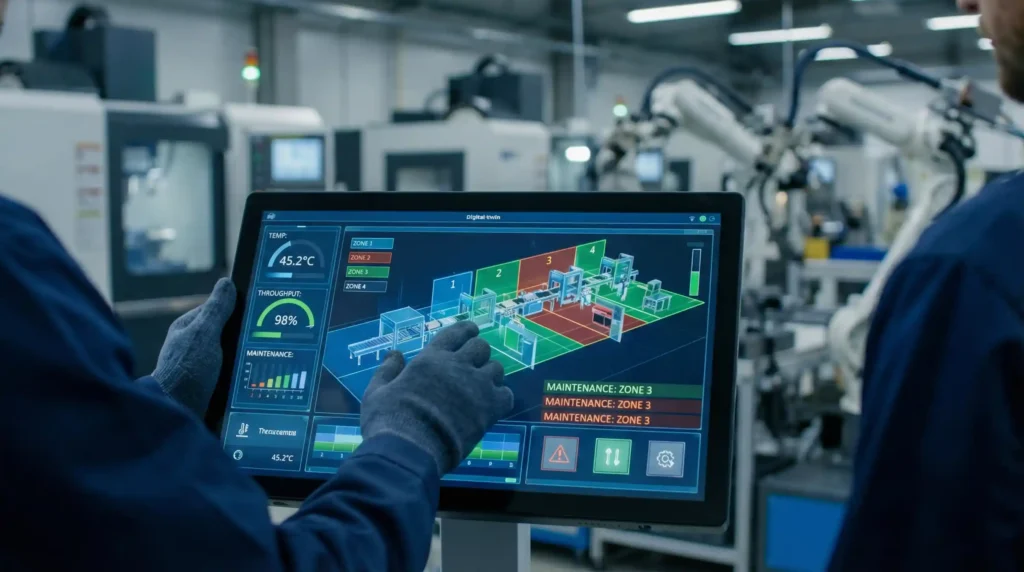
A production-grade predictive maintenance system for manufacturing operates across 4 technology layers. Each layer must be designed for reliability, scalability, and integration with existing shop-floor systems. The architecture below reflects what Redex deploys in real manufacturing environments, not theoretical reference models.
01
- Layer 1: Sensing
- MEMS accelerometers for vibration (100 Hz to 10 kHz sampling)
- RTD and thermocouple sensors for temperature monitoring
- Inline oil condition sensors (particle count, viscosity, moisture)
- Current transformers for motor electrical signature analysis
- Pressure transducers for hydraulic and pneumatic systems
02
- Layer 2: Edge Computing
- Industrial edge gateways with local data buffering (handles connectivity gaps)
- Real-time signal processing and feature extraction at the edge
- Protocol translation: Modbus, OPC-UA, MQTT to cloud-native formats
- Local anomaly detection for time-critical alerts (sub-second response)
03
- Layer 3: AI/ML Platform
- Time-series anomaly detection (LSTM, Transformer architectures)
- Failure mode classification trained on asset-specific data
- Remaining useful life (RUL) regression models
- Digital twin simulation for physics-informed predictions
- Automated model retraining with drift detection
04
- Layer 4: Integration
- CMMS integration (SAP PM, Maximo, Fiix, UpKeep) for work orders
- ERP connection for parts procurement and inventory management
- MES integration for production-context-aware predictions
- Business intelligence dashboards for management reporting
- Integration Priority
The most common failure point in predictive maintenance deployments is Layer 4: integration. Many manufacturers deploy sensors and build models, but never connect predictions to their CMMS or ERP. Without automated work order creation and parts procurement triggers, the system becomes expensive monitoring. Redex requires Layer 4 integration planning from day one of every engagement.
07. Roadmap
Implementation Roadmap: From Sensors to Autonomous Operations
Implementing this program follows a structured 4-phase progression. Each phase builds on validated foundations from the previous stage. Attempting to skip phases, such as deploying advanced ML models before establishing reliable data pipelines, is the primary reason these initiatives fail. The timeline below reflects realistic expectations for a mid-size manufacturer with 15 to 40 critical assets.
Phase 1: Sensor Foundation
Focus: Sensor deployment, data infrastructure, baseline analytics
- Month 1-4
- Audit production equipment and prioritize high-value, high-risk assets using criticality scoring
- Deploy IoT sensors on 5 to 10 critical machines: vibration, temperature, current, oil condition
- Establish cloud data pipeline with edge buffering for shop-floor connectivity
- Build baseline dashboards showing equipment health scores and trend lines
- Train maintenance team on digital inspection workflows and data interpretation
Target Outcome
Data capture rate above 95%, sensor uptime above 90%
Phase 2: Predictive Intelligence
Focus: ML model deployment, anomaly detection, predictive alerts
- Month 4-8
- Train anomaly detection models on 3+ months of operational data per asset class
- Deploy failure prediction for top 3 failure modes: bearings, motors, hydraulic systems
- Integrate alerts with CMMS and maintenance scheduling system
- Establish feedback loop where technicians validate or reject AI recommendations
- Expand sensor coverage to remaining critical and semi-critical equipment
Target Outcome
False positive rate below 15%, prediction accuracy above 80%
Phase 3: Operations Integration
Focus: Automated work orders, parts optimization, plant-wide learning
- Month 8-14
- Automate work order generation from AI predictions with priority scoring
- Integrate with procurement systems for just-in-time parts ordering
- Deploy plant-wide pattern recognition for cross-asset failure correlations
- Implement digital twin models for highest-value production equipment
- Optimize maintenance windows around production schedules and shift changes
Target Outcome
Unplanned downtime reduction above 40%, maintenance cost reduction above 25%
Phase 4: Autonomous Operations
Focus: Self-optimizing systems, continuous learning, strategic planning
- Month 14-20
- Deploy reinforcement learning for self-adjusting maintenance intervals
- Automate procurement decisions based on predicted demand and lead times
- Integrate equipment health data with production planning and capacity scheduling
- Establish continuous model retraining pipeline with drift detection
- Scale proven models to new equipment types and production lines
Target Outcome
Overall equipment effectiveness above 88%, ROI payback under 12 months
08. Performance Metrics
ROI Framework: Calculating the Business Case
The business case for this approach rests on five quantifiable value streams. The model below uses conservative assumptions for a mid-size manufacturer with $50M annual revenue, 25 critical production assets, and 4,000 annual operating hours per asset.
Value Stream
Baseline Cost
Reduction
Direct maintenance spend
$1.2M/year
18-25%
Unplanned downtime
480 hrs/year at $15K/hr
35-50%
Spare parts inventory
$800K carrying cost
20-30%
Equipment replacement (deferred)
$2M/year capex
20-40% life extension
Energy waste
$600K/year motors
5-10%
- RedEx Point of View
These numbers are conservative. They exclude secondary benefits such as improved safety outcomes, better insurance terms, higher customer satisfaction from on-time delivery, and the strategic value of equipment health data for capacity planning. In our experience, the realized value of a well-executed program typically exceeds initial projections by 20 to 30% once models mature beyond the first year of operation.
09. Assessment Framework
The Redex Manufacturing Intelligence Framework
Most predictive maintenance initiatives fail because they attempt to deploy advanced analytics before establishing reliable data foundations. The Redex Manufacturing Intelligence Framework provides a structured 4-level progression that ensures each capability layer is built on validated foundations. This framework applies to all digital transformation initiatives in manufacturing, with predictive maintenance as the highest-ROI entry point.
Level 1
Data Foundation
IoT sensors deployed on critical manufacturing assets. Structured data pipelines established from shop floor to cloud. Baseline condition data collected across vibration, temperature, pressure, and electrical parameters.
- Vibration sensors on CNC spindles and compressors
- Temperature monitoring on motors and panels
- Centralized time-series data lake
- Real-time equipment health dashboards
Level 2
Predictive Analytics
ML models process sensor streams to detect anomalies, classify failure modes, and estimate remaining useful life for critical components across the production floor.
- Anomaly detection algorithms tuned to each asset
- Failure mode classification (bearing, motor, hydraulic)
- Remaining useful life (RUL) estimation
- Threshold-based alerting with technician feedback loop
Level 3
Integrated Opertions
AI-generated maintenance recommendations automatically create work orders, schedule technicians, and trigger parts procurement. Predictive insights integrated with MES and ERP systems.
- Automated work order generation from predictions
- Optimal scheduling aligned with production windows
- Parts inventory optimization and just-in-time ordering
- Technician skill matching and dispatch
Level 4
Autonomous Optimization
Self-optimizing maintenance system that learns from plant-wide outcomes, adjusts strategies continuously, and drives procurement and production scheduling decisions autonomously.
- Plant-wide pattern learning across all assets
- Self-adjusting maintenance intervals via reinforcement learning
- Predictive procurement automation
- Continuous model retraining pipeline
10. Risk Mitigations
4 Common Pitfalls in Predictive Maintenance for Manufacturing
Redex has observed consistent failure patterns across these deployments. Understanding these pitfalls before starting saves months of wasted effort and tens of thousands in misallocated budget. Each pattern below includes the specific fix that has proven effective in our engagements.
Sensor Data Without Context
Deploying IoT sensors without establishing reliable data pipelines or contextual metadata. Without production context (machine state, product type, operator), raw sensor data generates 30 to 50% false positives that erode technician trust.
Redex Countermeasure
Start with edge gateways that capture both sensor readings and production context. Tag every data point with machine state, product run, and environmental conditions before training models.
Generic Models on Specific Machines
Training ML models on vendor-supplied reference data that does not reflect actual shop-floor conditions. Machines running high-mix production, operating in dusty environments, or subjected to frequent changeovers behave differently than clean-room baselines.
Redex Countermeasure
Collect 3 to 6 months of site-specific operational data before deploying predictive models. Include environmental and usage context in feature engineering. Validate models against known failure events.
Technician Bypass
Maintenance teams distrust AI recommendations because the system cannot explain why it flagged a component. They revert to time-based schedules, negating the investment entirely.
Redex Countermeasure
Deploy explainable AI models that show which sensor readings triggered alerts. Involve senior technicians in model validation. Start with recommendations, not mandates, and track accuracy to build trust incrementally.
Integration Isolation
Predictive maintenance runs as a standalone dashboard disconnected from CMMS, ERP, and MES systems. Insights exist but do not trigger automated actions, creating manual bottlenecks.
Redex Countermeasure
Require API integration with existing work-order and procurement systems from day one. Automated work orders are the minimum viable integration. Without action triggers, predictive maintenance is just expensive monitoring.
Transform Your Operations
Estimate the ROI of Your First Predictive Maintenance Pilot
Redex helps mid-size manufacturers implement these programs that deliver measurable ROI within 12 months. Our assessment identifies your highest-value assets, recommends the right sensor strategy, and builds a phased implementation plan aligned with your budget and production schedule.
FAQs
What does predictive maintenance for manufacturing cost to implement?
A typical implementation for a mid-size manufacturer (50 to 200 employees, 15 to 40 critical assets) costs $25K to $60K for the sensor foundation phase and $120K to $300K for a full 4-phase deployment over 18 to 20 months. The investment typically pays back within 8 to 14 months through reduced downtime, lower maintenance costs, and extended equipment life.
How long before we see measurable ROI from predictive maintenance?
Most manufacturers see initial returns within 4 to 6 months of deploying the first predictive models. Early wins come from catching high-cost failures (bearing seizures, motor burnouts) that would have caused $50K+ in emergency repairs. Full ROI, including inventory optimization and lifecycle extension, typically materializes by month 12 to 14.
Do we need to replace our existing CMMS or ERP system?
No. Effective predictive maintenance integrates with your existing systems rather than replacing them. The AI layer sits on top of your current CMMS (SAP PM, Maximo, Fiix, UpKeep) and feeds predictions directly into existing work-order workflows. The key requirement is API access to your CMMS for automated work order creation.
What types of manufacturing equipment benefit most from predictive maintenance?
The highest ROI comes from rotating equipment (CNC spindles, compressors, pumps, motors), hydraulic systems (stamping presses, injection molding), and electrical infrastructure (transformers, panels, drives). Prioritize assets where unplanned failure costs exceed $10K per incident or where downtime cascades across multiple production lines.
How does predictive maintenance for manufacturing differ from construction applications?
Manufacturing predictive maintenance operates in a controlled environment with consistent power, connectivity, and operating conditions, which enables higher model accuracy (85 to 95% vs. 75 to 85% for mobile construction equipment). Manufacturing also benefits from MES integration for production-context-aware predictions and tighter maintenance windows aligned with shift schedules.
Continue Your Manufacturing Modernization Journey