01. EXECUTIVE SUMMARY
The System Design Problem Behind AI Marketing Failure
Most organizations approach generative AI in marketing as a toolset problem. They experiment with content generation, automate isolated workflows, and deploy chatbots, yet fail to produce measurable business outcomes. The issue is not capability. It is lack of system design.
At Redex, we observe a consistent pattern across SMBs in manufacturing and construction: companies that achieve meaningful ROI from generative AI in marketing treat it as an operating model transformation, not a collection of tools. The marketing team at a typical mid-sized manufacturer or construction firm consists of one to three people expected to produce blog posts, manage social media, write proposals, run email campaigns, and generate qualified leads. They compete against enterprises with 20-person departments and 6-figure agency retainers.
According to McKinsey, generative AI in marketing could unlock $0.8–$1.2 trillion in annual value across sales and marketing. Yet 74% of companies struggle to achieve and scale value from AI (BCG). The gap between potential and reality is not a technology problem. It is an architecture problem.
This guide introduces a structured approach to generative AI in marketing covering architecture, execution layers, and measurable impact across the funnel. For the broader strategic context, see our AI strategy for SMBs pillar guide.
74%
Companies fail to scale AI value
$1.2T
Annual value in sales & marketing
50–70%
Content production time reduction
Cost per lead reduction
02. AI for SMBs
Generative AI in Marketing: A System, Not a Tool
Generative AI refers to models capable of producing text, images, and structured outputs. However, in a business context, its role is not content creation. It is decision acceleration and execution scaling. This is the critical distinction that separates successful implementations from expensive experiments.
In mature organizations, generative AI is embedded into 3 interconnected systems:
Content Supply Chains
End-to-end pipelines from brief generation through draft, review, localization, and multi-channel publishing, not isolated ChatGPT sessions.
Demand Generation Workflows
AI-driven lead scoring, automated qualification, and personalized nurture sequences connected to your CRM, not standalone chatbots.
Sales Qualification Processes
Automated proposal generation, competitive intelligence, and meeting preparation, not manual copy-paste from AI outputs.
"The shift is from 'creating content faster' to 'operating marketing systems more efficiently.' Tool selection matters less than integration architecture."
— Redex Consulting, AI Strategy Practice
For a practical implementation roadmap that maps specific tools to each phase, see our guide on building an AI roadmap for SMBs.
03. Our Approach
Our Strategic Approach to Generative AI in Marketing
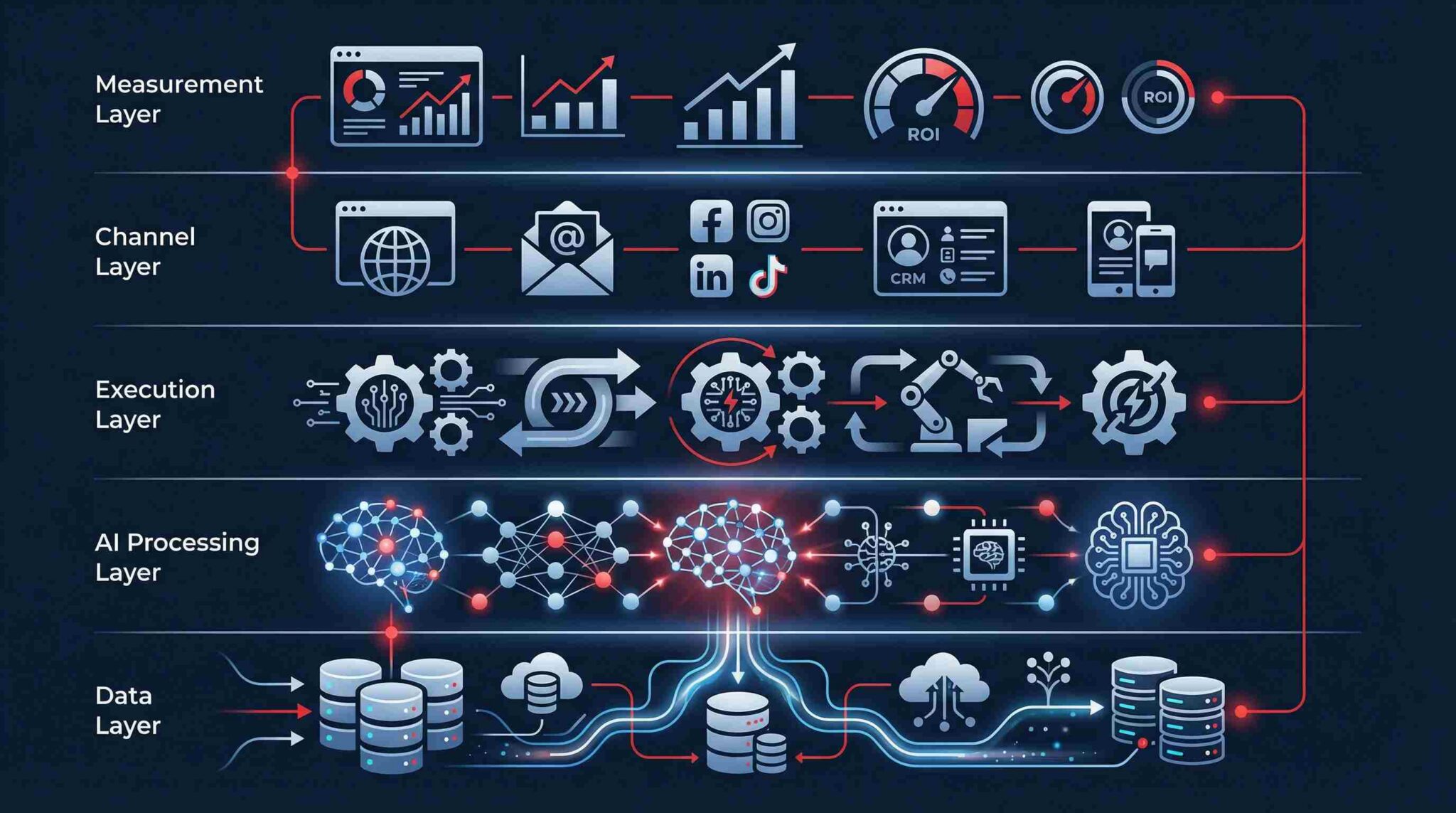
Instead of listing tools, we define the system. The Redex AI Marketing Operating Model structures AI marketing across 5 orchestrated layers. AI creates value only when these layers are connected.
Redex AI Marketing Operating Model
Data Layer
- Customer data: CRM records, behavioral signals, transactional history
- Content assets: existing collateral, brand guidelines, competitive intelligence
- Market intelligence: industry trends, search data, competitor positioning
AI Processing Layer
- LLMs for content generation, summarization, and personalization
- Predictive models for lead scoring, churn detection, and upsell signals
- Embedding and retrieval systems (RAG) for context-aware outputs
Execution Layer
- Content production pipelines: brief → draft → review → publish
- Campaign automation: trigger-based sequences across channels
- Lead nurturing workflows: score → qualify → route → follow up
Channel Layer
- Website and SEO: dynamic content, landing pages, blog publishing
- Email and CRM: segmented campaigns, personalized sequences
- Paid media and social: AI-optimized ad copy, audience targeting
- Sales enablement: proposals, case study matching, competitive briefs
Measurement Layer
- MQL / SQL conversion tracking with revenue attribution
- Content velocity: production speed, engagement rates, SEO rankings
- CAC reduction and cost per lead optimization
- Customer lifetime value (LTV) and retention metrics
Redex Point of View
Most companies fail because they deploy tools without orchestration. A ChatGPT subscription does not constitute an AI marketing strategy. The highest-performing SMBs we work with invest 20% of their effort in tool selection and 80% in integration architecture connecting AI outputs to CRM, CMS, and measurement systems.
04. Use Cases
High-Impact AI Marketing Use Cases at the System Level
These are not isolated tool applications. They are system-level workflows that SMBs in manufacturing and construction deploy to generate measurable business outcomes. Each use case connects multiple layers of the operating model.
Content Production Pipeline Automation
End-to-end content supply chain: AI-assisted briefs, drafts, localization, and publishing orchestrated through a single workflow.
Brief → Draft → Review → Publish
AI generates structured first drafts from content briefs. Human editors refine for brand voice and accuracy. Automated publishing triggers across channels.
40–70% reduction in production time
SEO Content at Scale
AI-driven topic clustering, semantic optimization, and internal linking. Manufacturing SMBs rank for long-tail terms competitors ignore.
2x keyword coverage within 6 months
Proposal & Bid Automation
Construction firms feed project specs into AI systems that draft data-backed proposals. Faster response time directly correlates with higher win rates.
2 weeks → 2 hours per proposal
Multi-Channel Content Repurposing
A single whitepaper becomes blog posts, email sequences, social captions, and sales decks automatically formatted for each channel’s requirements.
1 asset → 8+ channel-specific outputs
AI-Driven Lead Qualification & Routing
Behavioral and firmographic scoring that automatically routes MQLs to SQLs reducing sales cycle time and improving conversion efficiency.
Behavioral + Firmographic Scoring
AI analyzes 50+ signals (page visits, content downloads, company size, industry) to score leads. Sales teams focus exclusively on high-intent prospects.
+20–30% conversion efficiency
Automated MQL → SQL Routing
When a lead crosses the scoring threshold, AI routes them to the right sales rep with a pre-built context brief, no manual handoff delays.
50% reduction in response time
24/7 Lead Capture via AI Chatbots
Construction project managers browse late. AI chatbots qualify leads, capture requirements, and schedule calls even at midnight.
3x more after-hours inquiries captured
Predictive Churn & Upsell Signals
AI monitors engagement patterns to flag at-risk accounts and identify upsell opportunities before your competitors do.
15% increase in customer lifetime value
Personalization at Scale
Dynamic content, segmentation, and messaging powered by AI analysis of customer behavior delivering the right message to the right person at the right time.
AI-Powered Email Segmentation
Automatically segment audiences by behavior, industry vertical, engagement level, and purchase history. Each segment receives tailored messaging.
42% higher conversion rates
Dynamic Website Content
Visitor from construction? Show construction case studies. Visitor from manufacturing? Show manufacturing ROI data. AI adapts in real-time.
25% more quote requests
Predictive Content Recommendations
AI suggests relevant content, products, or services based on browsing patterns and firmographic data similar to how Amazon recommends products.
15–20% increase in average order value
Account-Based Personalization
For high-value prospects, AI generates personalized landing pages, email sequences, and sales collateral tailored to their specific business challenges.
35% higher engagement from target accounts
Sales Enablement Acceleration
AI-generated proposals, automated case study matching, and competitive intelligence briefs that arm your sales team with the right content at the right moment.
AI-Generated Proposals
AI drafts customized proposals by matching prospect requirements against your capability database. Sales reps edit and personalize, not start from scratch.
60% faster proposal turnaround
Automated Case Study Matching
When a sales rep enters a prospect’s industry and challenge, AI surfaces the most relevant case studies, testimonials, and ROI data.
2x more relevant proof points per pitch
Competitive Intelligence Briefs
AI monitors competitor content, pricing changes, and market positioning. Sales teams receive weekly intelligence briefs with actionable talking points.
React 2–4 weeks faster than competitors
Meeting Preparation Automation
AI compiles prospect research, recent interactions, and recommended talking points into a pre-meeting brief delivered automatically to the rep’s inbox.
30 minutes saved per meeting
Redex Point of View
The highest ROI comes from workflow automation, not content generation. Content creation is the entry point but lead qualification, personalization, and sales enablement are where AI marketing delivers transformational business impact.
05. AI Architecture
AI Marketing Stack Architecture for SMBs
Building a robust architecture is the cornerstone of successful Generative AI in Marketing deployment. The question is not “which AI tools should we buy?” The question is “how do these tools connect into a system that produces measurable outcomes?”. Below is the AI marketing stack architecture that our clients in manufacturing and construction deploy organized by system role, not vendor category.
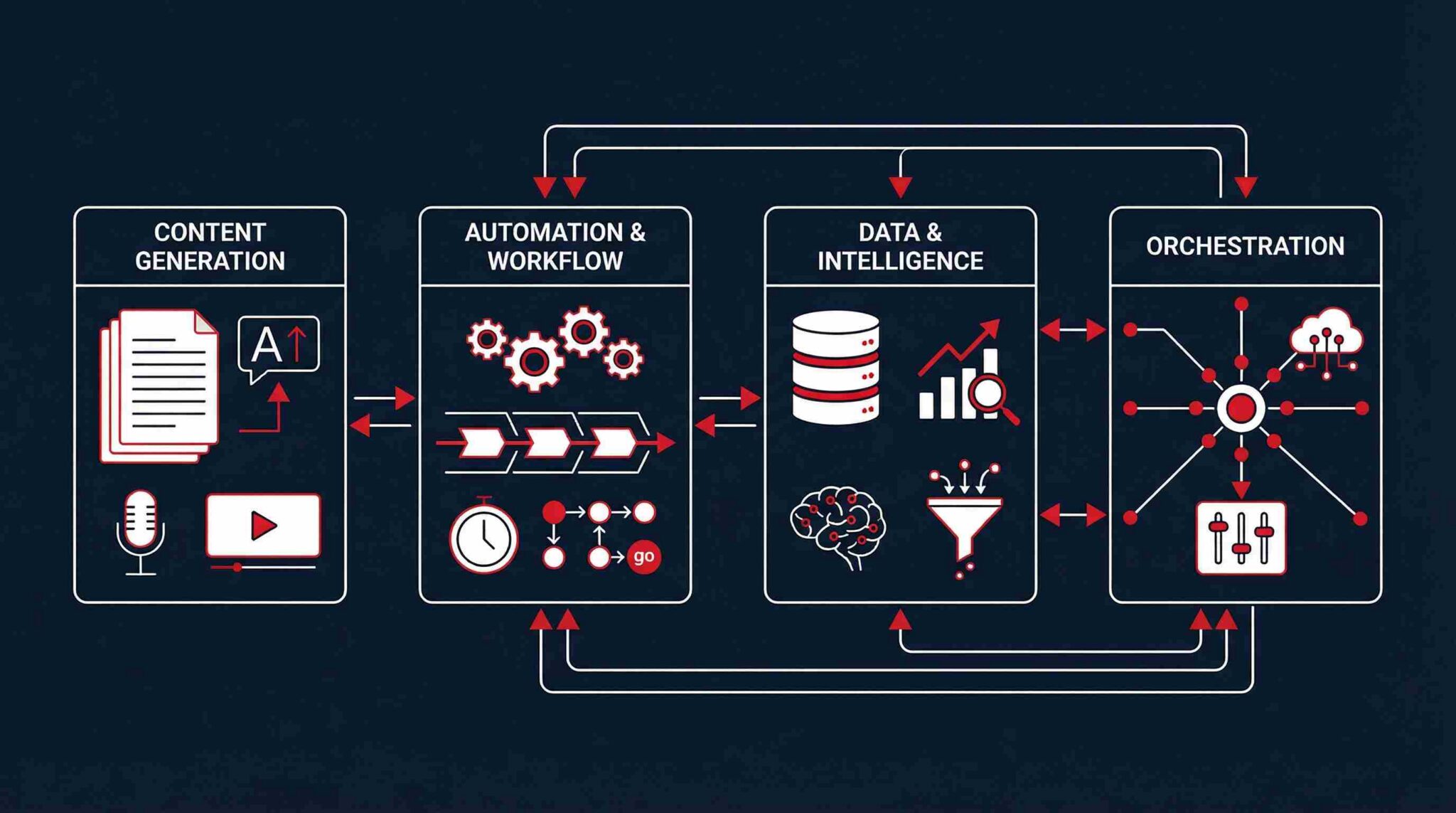
GenAI Marketing Tool Stack
Integrated marketing system with closed-loop measurement
System Layer
Role
Example Platforms
SMB Budget
Content Generation
Draft creation, SEO optimization, multi-format output
ChatGPT, Claude, Jasper, Surfer SEO
$120–300/mo
Automation & Workflow
Campaign execution, lead nurturing, task orchestration
HubSpot, ActiveCampaign, Zapier
$130–200/mo
Data & Intelligence
Analytics, competitive monitoring, predictive scoring
GA4, Brand24, Semrush
$100–200/mo
Orchestration
API integration, workflow engine, cross-tool coordination
Zapier, Make, custom integrations
$220–300/mo
Architecture Insight
The value of SMB AI marketing stack costs $570–1,000/month comes from integration, not individual tools. A $20/month ChatGPT subscription connected to your CRM through Zapier delivers more ROI than a $200/month enterprise platform used in isolation.
06. Pitfalls
Why Most AI Marketing Initiatives Fail
73% of marketing leaders cite AI hallucinations as a concern, and 74% of companies struggle to achieve and scale value from AI. After working with dozens of SMBs across manufacturing and construction, we have identified 4 systemic failure patterns and they are rarely about the technology.
Tool-First Approach
Deploying AI tools without defining workflows or integration points. Teams subscribe to 6–8 platforms, use each in isolation, and produce fragmented outputs that never connect to business outcomes.
Business impact
Wasted budget ($300–800/mo), no measurable ROI, team frustration
Resolution
Define workflows first, then select tools that fit. Map every AI output to a downstream action (publish, route, score, report).
Data Readiness Gap
Poor data quality produces poor AI outputs. CRM records are incomplete, customer segments are undefined, and content assets are scattered across drives and inboxes.
Business impact
AI personalization fails, lead scoring is inaccurate, content is generic
Resolution
Audit and clean your data before deploying AI. Establish data hygiene processes. Budget 2–4 weeks for data preparation.
No CRM / CMS Integration
AI generates content and scores leads, but outputs remain in the AI tool never flowing into your CRM, CMS, or marketing automation platform. The human becomes the integration layer.
Business impact
Manual copy-paste, delayed execution, lost leads, no attribution
Resolution
Use API integrations or workflow engines (Zapier, Make) to connect AI outputs directly to your execution systems.
Missing Governance
No control over content quality, brand consistency, or data privacy. Different team members use different AI tools with different prompts, producing inconsistent outputs.
Business impact
Brand damage, compliance risk, customer trust erosion
Resolution
Establish an AI governance framework: brand voice guidelines, data privacy policy, quality review process, and approved tool list.
Redex Point of View
AI without orchestration increases complexity instead of efficiency. Every failed AI marketing initiative we have audited shares the same root cause: the organization treated AI as a tool procurement exercise rather than a system design challenge. Understanding what AI can and cannot do is critical. Our research on whether AI makes employees experts provides the academic evidence behind these limitations.
07. KPIs & ROI
Measurable Impact: KPIs and ROI Benchmarks
Every AI marketing investment must be tied to measurable business outcomes. Based on Redex benchmarks across SMB engagements in manufacturing and construction, here are the KPIs that matter and the results our clients achieve.
KPI Category
Metric
Benchmark Impact
Measurement
Content Velocity
Production time per asset
↓ 50–70%
Hours per blog post, email, proposal
Lead Generation
MQL volume
↑ 15–30%
Monthly qualified leads from organic + paid
Conversion
MQL → SQL rate
↑ 20–30%
Percentage of MQLs that become sales-qualified
Campaign Speed
Deployment time
↑ 40–60% faster
Days from brief to live campaign
Cost Efficiency
Cost per lead
↓ 20–35%
Total marketing spend / qualified leads
Customer Value
Lifetime value (LTV)
↑ 15%
Revenue per customer over relationship
ROI Calculation for Decision-Makers
The cost-benefit formula for SMBs: A $5M-revenue manufacturer spending $300/month on AI marketing tools ($3,600/year) that achieves a 20% increase in MQL volume generates approximately $200,000–$400,000 in additional pipeline value annually, a 55–110x return on tool investment. The variable is not the tools. It is the integration architecture that connects AI outputs to revenue.
"Generative AI could boost marketing productivity by 5–15% of total marketing spend representing hundreds of billions of dollars in value annually."
— McKinsey Digital, 2024
08. Roadmap
The SMB AI Marketing Implementation Roadmap
Buying AI tools without a strategy is how SMBs waste money. The businesses that see real ROI follow a structured three-phase approach that connects marketing AI to their broader AI strategy. Each phase builds on the previous one. Do not skip ahead.
Phase 1: Efficiency
Months 1–2, $50–150/mo in tools
Focus: Automating repetitive marketing tasks
- Deploy AI for content first drafts (blog posts, emails, social captions)
- Automate email scheduling and basic segmentation
- Set up AI-powered FAQ chatbot for website
- Establish brand voice guidelines for all AI outputs
Target Outcome
30% reduction in admin time
Key KPIs
Content production velocity, time saved per task
Phase 2: Growth
Month 3–4, $150–400/mo in tools
Focus: AI-assisted content creation and lead generation at scale
- Build content production pipeline (brief → draft → review → publish)
- Implement AI-driven lead scoring and automated routing
- Deploy personalization engine for website and email
- Connect AI tools to CRM for closed-loop reporting
Target Outcome
2x lead volume without increasing headcount
Key KPIs
MQL volume, conversion rate, cost per lead
Phase 3: Insights
Month 5–6, $300–600/mo in tools + integration
Focus: Feeding CRM and behavioral data to AI for predictive intelligence
- Deploy predictive lead scoring with churn and upsell signals
- Build competitive intelligence monitoring system
- Implement AI agents for multi-step marketing workflows
- Establish measurement framework with revenue attribution
Target Outcome
15% increase in customer lifetime value (LTV)
Key KPIs
LTV, CAC ratio, revenue attribution accuracy
Phase
Focus
Typical ROI Metric
Timeline
Phase 1: Efficiency
Automating repetitive email, FAQ, and content drafting
30% reduction in admin time
Month 1–2
Phase 2: Growth
AI-assisted content creation and lead gen at scale
2x lead volume without headcount
Month 3–4
Phase 3: Insights
Feeding CRM data to AI to predict churn and upsellsMQL → SQL rate
15% increase in LTV
Month 5–6
For a detailed tool-by-tool implementation guide at each stage, see our AI roadmap for SMBs article, which maps specific tools to each phase of your AI journey.
09. Industry Uses
Manufacturing and Construction
Generic AI marketing advice fails in specialized industries. A construction firm’s content strategy is fundamentally different from a SaaS company’s. Below are the industry-specific applications that deliver the highest ROI for our core markets.
Manufacturing SMBs
- AI-generated product descriptions and spec sheets at scale
- Automated distributor communications and price update notifications
- Predictive demand content: publish before seasonal spikes
- Technical blog content targeting long-tail engineering queries
- Trade show follow-up sequences triggered by badge scan data
Construction SMBs
- AI-powered proposal and bid document generation
- Project portfolio content: case studies from completed builds
- Safety compliance content targeting regulatory search queries
- Subcontractor recruitment marketing with AI-optimized job posts
- Local SEO content targeting geographic service areas
Case in Point
A mid-sized construction materials distributor identified through AI-powered competitive monitoring that no competitor was creating content about sustainable building materials, a topic with rising search volume. They published 8 AI-generated articles targeting this gap and captured the #1 ranking for “sustainable construction materials supplier” within 4 months, generating 45 qualified leads per month from organic search alone. Total AI tool investment: $250/month.
10. The RedEx Perspective
From Tools to Systems
Most organizations are still experimenting with AI tools. Very few have built scalable systems that deliver consistent ROI. The difference is not technology. It is architecture, governance, and orchestration.
At Redex Consulting, we help SMBs in manufacturing and construction move from experimentation to operationalization through 3 principles:
01
Architecture Before Tools
We design the integration architecture first: how AI connects to your CRM, CMS, and data systems, then select tools that fit. This prevents tool sprawl and ensures every AI output flows into a measurable business action.
02
Industry-Specific Playbooks
Generic AI marketing advice fails in specialized industries. A construction firm’s buying cycle, decision-makers, and competitive landscape require tailored playbooks, not repurposed SaaS marketing templates.
03
Measurable 90-Day Sprints
Every AI marketing initiative starts with a clear 90-day goal: ‘Increase qualified leads by 30%’ or ‘Reduce content production cost by 50%.’ If we cannot measure it, we do not recommend it.
Ready to move from AI experimentation to AI operationalization? Explore our AI strategy consulting services to start with a custom assessment.
Build Your AI Marketing Operating Model
Stop Experimenting. Start Operationalizing.
Most organizations are still experimenting with AI tools. Very few have built scalable systems that deliver consistent ROI.
Redex helps companies design AI-driven marketing architectures, integrate AI with CRM, CMS, and data systems, and deploy scalable workflows across regions.
Key Takeaways
- The primary goal of Generative AI in Marketing is to bridge the gap between creative output and technical scale.
- 74% of companies fail to scale AI value. The gap is architecture, not technology.
- The Redex AI Marketing Operating Model structures AI across 5 layers: Data → AI Processing → Execution → Channel → Measurement.
- Tool selection matters less than integration architecture. A $300/month stack connected to your CRM outperforms $2,000/month in isolated tools.
- The highest ROI comes from workflow automation and lead qualification, not content generation alone.
- Four failure patterns derail AI marketing: tool-first approach, data readiness gaps, no CRM/CMS integration, and missing governance.
- Implement in 3 phases: Efficiency (month 1–2) → Growth (month 3–4) → Insights (month 5–6).
- SMBs in manufacturing and construction need industry-specific playbooks, not generic AI marketing advice.
- Every AI marketing investment must connect to measurable KPIs: MQL volume, conversion rate, cost per lead, and LTV.
FAQs
How should SMBs structure their AI marketing strategy?
SMBs should approach AI marketing as a system design challenge, not a tool selection exercise. Start by mapping your current marketing workflows, identifying bottlenecks, and defining measurable outcomes. Then build your AI marketing stack across four system layers: content generation, automation and workflow, data and intelligence, and orchestration. The Redex AI Marketing Operating Model provides a 5-layer framework (Data, AI Processing, Execution, Channel, Measurement) that ensures every AI investment connects to business outcomes.
What is the realistic ROI of AI marketing for a mid-sized manufacturer?
Based on Redex benchmarks, a $5M-revenue manufacturer investing $300/month in AI marketing tools can expect: 50-70% reduction in content production time, 15-30% increase in MQL volume, 20-35% reduction in cost per lead, and 40-60% faster campaign deployment. The total annual tool investment of $3,600 typically generates $200,000-$400,000 in additional pipeline value, a 55-110x return. The critical variable is integration architecture, not tool selection.
Why do most AI marketing initiatives fail?
74% of companies struggle to scale AI value (BCG). The four systemic failure patterns are: (1) Tool-first approach: deploying AI without defining workflows, (2) Data readiness gap: poor CRM data produces poor AI outputs, (3) No CRM/CMS integration: AI outputs remain in the AI tool instead of flowing into execution systems, (4) Missing governance: no control over quality, brand consistency, or data privacy. The root cause is treating AI as a procurement exercise rather than a system design challenge.
Does AI replace marketers in SMBs?
No. AI amplifies marketers. It does not replace them. Research from Harvard Business School shows that AI works best when humans maintain strategic oversight and creative direction. AI handles the ‘production layer’ (drafting, formatting, scheduling, data analysis) while humans handle the ‘strategy layer’ (brand positioning, creative concepts, relationship building, quality assurance). A two-person marketing team with the right AI system can produce the output of a 10-person team but human judgment remains essential for every piece that goes live.
How much should an SMB budget for AI marketing tools?
A realistic AI marketing budget for an SMB is $150-400/month for tools, plus 10-15 hours/month of team time for setup and optimization. Phase 1 (efficiency) costs $50-150/month. Phase 2 (growth) costs $150-400/month. Phase 3 (insights) costs $300-600/month including integration work. Start with 2-3 core tools, measure ROI monthly, and cut tools that do not demonstrate clear value within 90 days. The total investment should be less than 10% of what you would spend on an additional marketing hire.