01. EXECUTIVE SUMMARY
The Manufacturing Workforce Crisis Is a Business Crisis
AI workforce upskilling has become the most urgent strategic priority for mid-size manufacturers. The numbers tell a clear story. The proportion of manufacturing employees over age 55 has more than doubled in 20 years, rising from 10% to 25% of the total workforce. Retirement rates spiked to 2.2% in 2022 and remain elevated. Meanwhile, the total US manufacturing workforce has shrunk from 20.5 million to 15 million workers over the same period.
The result is a compounding skills gap. Experienced workers leave faster than new workers can be trained. McKinsey research shows that productivity gaps between high and low performers increase by as much as 800% as task complexity rises. Even in the simplest manufacturing roles, high performers deliver 50% more output than low performers.
For a midsize manufacturer, this translates to real money. McKinsey estimates that a midsize company could avoid more than $300 million in costs by addressing workforce gaps proactively. At the SMB level, with 50 to 500 employees, the impact is proportionally significant: a $40M manufacturer losing 3 to 5% of revenue to workforce inefficiency is leaving $1.2M to $2M on the table annually.
The path forward is not hiring more people. The labor market cannot supply enough skilled manufacturing workers. The path forward is AI workforce upskilling: using AI to train workers faster, retain knowledge from retiring experts, and build a workforce that can operate alongside intelligent systems. This article presents 5 essential strategies that mid-size manufacturers are using right now to close the skills gap and boost productivity by 40% or more.
40-60%
Faster Time to Proficiency
250-400%
Training ROI
25%
Workforce Over 55
Orgs Reskilled for AI
02. Our Approach
The RedEx Workforce Intelligence Maturity Model
Before investing in AI workforce upskilling, manufacturers need to understand where they stand today. The Redex Workforce Intelligence Maturity Model maps four phases of workforce capability, from ad hoc training to adaptive learning ecosystems. Most SMB manufacturers operate at Phase 1 or Phase 2. The 5 strategies in this article move organizations to Phase 3 and Phase 4, where AI workforce upskilling delivers compounding returns.
Phase 1
AD HOC
No structured training program. Skills transfer depends on informal mentoring. AI workforce upskilling is not on the leadership agenda.
Phase 2
STRUCTURED
Formal training programs exist but are not data-driven. Annual skills reviews. AI workforce upskilling begins with pilot literacy programs.
Phase 3
Intelligent
AI-driven skills assessment and personalized learning paths. Immersive training deployed. AI workforce upskilling delivers measurable productivity gains.
Phase 4
Adaptive
Self-optimizing learning ecosystem. AI predicts skill needs before gaps emerge. AI workforce upskilling is embedded in daily operations and culture.
For a deeper look at how Redex proprietary frameworks guide AI transformation, visit our Frameworks page to explore the complete methodology library.
03. AI Use Cases
5 Essential AI Workforce Upskilling Strategies for Manufacturers
Each strategy addresses a specific dimension of the workforce challenge. Implemented together over 18 to 24 months, they create a comprehensive AI workforce upskilling system that reduces time to proficiency by 40 to 60%, improves AI tool adoption to 75 to 90%, and delivers 250 to 400% training ROI.
Structured AI Literacy Programs
The problem
Most manufacturing workers have zero formal exposure to AI concepts. Surveys show only 15.8% of workers feel confident using AI tools at work. This confidence gap creates resistance to AI adoption and limits the return on technology investments.
AI Solution
Structured AI literacy programs teach workers what AI can and cannot do, how it applies to their specific roles, and how to interact with AI-powered tools effectively. Programs are delivered in 2-hour weekly modules over 8 to 12 weeks, using manufacturing-specific examples rather than generic technology training.
Outcome
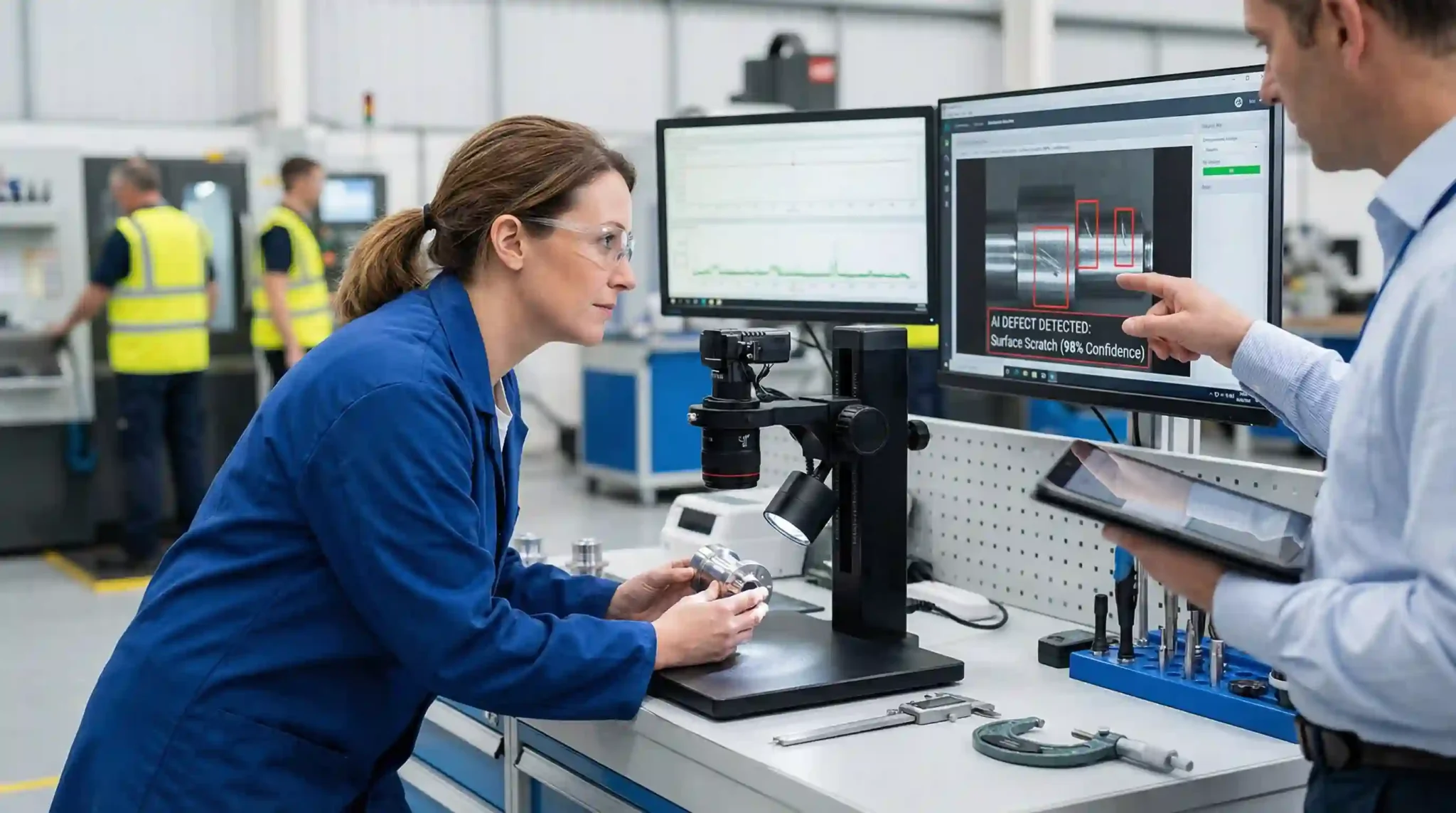
Worker confidence with AI tools increases from 15% to 75% within 3 months. AI tool adoption rates improve by 60 to 80%. One $28M metal fabricator saw AI-assisted quality inspection adoption jump from 22% to 89% after completing a structured AI workforce upskilling program for its 45 floor operators.
AI-Powered Immersive Training
The problem
Traditional manufacturing training relies on shadowing experienced workers for 6 to 18 months. With 25% of the workforce over age 55 and retirement rates at 2.2%, companies are losing institutional knowledge faster than they can transfer it. New hires take 12 to 24 months to reach full proficiency.
AI Solution
VR and AR training systems powered by AI create realistic simulations of manufacturing processes. AI adapts difficulty in real time based on learner performance, identifies skill gaps automatically, and generates personalized practice scenarios. Workers train on virtual equipment without risking real materials or production time.
Outcome
Time to proficiency decreases by 40 to 60%. Training material waste drops by 80%. A $35M precision machining company reduced new CNC operator training time from 14 months to 6 months using AI-powered simulation, saving $180K annually in training costs through AI workforce upskilling.
AI-Driven Skills Gap Assessment
The problem
Most manufacturers assess worker skills through annual reviews and supervisor observations. These methods miss 40 to 60% of actual skill gaps because they rely on subjective evaluation and infrequent measurement. Training budgets get allocated based on assumptions rather than data.
AI Solution
AI-driven assessment platforms continuously evaluate worker competencies through task performance data, quality metrics, and production output. Machine learning models identify patterns that predict which workers need specific training before performance issues emerge. The system maps individual skills against role requirements and generates personalized development plans.
Outcome
Skill gap identification accuracy improves from 40% to 90%. Training ROI increases by 35 to 50% because resources target actual gaps. A $42M automotive parts manufacturer reduced quality defects by 28% within 6 months by using AI workforce upskilling assessments to target training at the specific skills causing the most rework.
AI-Powered Knowledge Capture and Transfer
The problem
When experienced workers retire, their institutional knowledge leaves with them. McKinsey research shows the proportion of manufacturing employees over 55 has doubled in 20 years, from 10% to 25%. Companies face a brain drain that costs the average midsize manufacturer $300,000 to $800,000 per retiring expert in lost productivity and retraining costs.
AI Solution
AI knowledge capture systems record, transcribe, and structure expert workflows using video analysis, voice recording, and process mining. Natural language processing converts tacit knowledge into searchable digital playbooks. AI assistants then deliver this knowledge to workers in context, answering questions and providing step-by-step guidance during actual production tasks.
Outcome
Knowledge retention improves from 20% to 85% when experts retire. New worker ramp-up time decreases by 30 to 45%. A $30M industrial equipment manufacturer preserved 15 years of welding expertise from 3 retiring master welders using AI workforce upskilling tools, preventing an estimated $1.2M in productivity losses.
AI-Enabled Continuous Learning Ecosystems
The problem
Manufacturing training is typically a one-time event during onboarding. Workers receive no structured development after their initial training period. Skills decay over time, and new technologies arrive faster than training programs can adapt. Only 6% of organizations have reskilled their workforce for AI.
AI Solution
AI-enabled continuous learning ecosystems deliver micro-learning modules directly to workers during natural breaks in production. The system tracks individual progress, adapts content difficulty, and introduces new skills aligned with upcoming technology deployments. Gamification elements and peer benchmarking maintain engagement over months and years.
Expected Outcome
Ongoing skill development participation increases from 12% to 78%. Technology adoption speed improves by 50%. A $25M packaging manufacturer maintained 95% workforce readiness for 3 consecutive technology upgrades by implementing AI workforce upskilling as a continuous process rather than a one-time event, avoiding $400K in disruption costs.
"The manufacturers winning the AI race are not the ones with the best technology. They are the ones with the best-trained people. AI workforce upskilling is the highest-ROI investment a manufacturing CEO can make today."
Redex Advisory, 2026
04. Tech Stack
Build vs. Buy for AI Workforce Upskilling
Mid-size manufacturers face a critical decision for each AI workforce upskilling capability: build custom solutions or buy commercial platforms. The table below maps the options, ideal use cases, and monthly cost ranges for each of the 5 strategy areas. Most SMBs achieve the fastest ROI by buying proven platforms and customizing content to their specific manufacturing processes.
Capability
Build Option
Buy Option
Best For
AI Literacy Training
Internal LMS + custom content
Coursera for Business, Udemy
Companies with L&D teams
VR/AR Training
Unity + custom simulations
Strivr, Interplay Learning
High-risk or complex operations
Skills Assessment
Custom analytics dashboard
Degreed, Gloat, Eightfold
Workforce planning at scale
Knowledge Capture
Video + NLP pipeline
Poka, Tulip, SwipeGuide
Preserving expert knowledge
Continuous Learning
Micro-learning platform
Axonify, EdApp, TalentCards
Frontline worker engagement
Redex Point of View
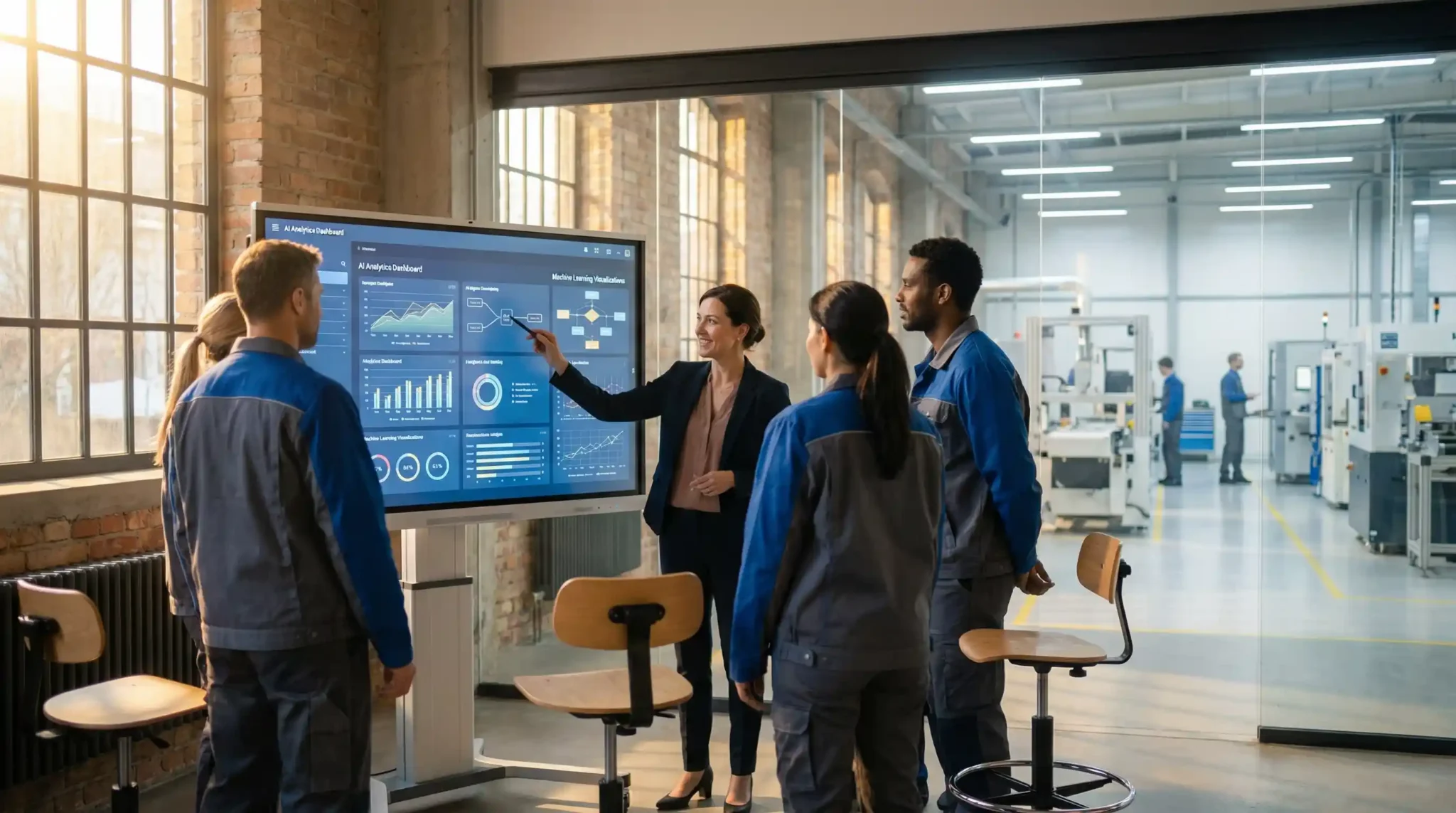
For most manufacturing SMBs, the buy-then-customize approach delivers the fastest time to value. Commercial platforms handle the AI infrastructure while your team focuses on creating manufacturing-specific training content. Redex helps clients evaluate vendors, negotiate contracts, and design integration architectures that connect learning platforms with production systems for real-time skills tracking.
05. Pitfalls
Why Most AI Workforce Upskilling Programs Fail
Redex has audited AI workforce upskilling programs at 30+ mid-size manufacturers. Four failure patterns account for 85% of program underperformance. Recognizing these patterns before you invest prevents wasted budgets and workforce disengagement.
Pattern 1: Technology Before Culture
Buying AI training platforms before addressing worker anxiety about job displacement. Adoption stalls at 15 to 25% because workers see AI as a threat rather than a tool.
Fix
Redex starts every AI workforce upskilling engagement with change readiness assessment and transparent communication about how AI augments rather than replaces roles.
Pattern 2: Generic Training Content
Using off-the-shelf AI courses designed for office workers. Manufacturing floor workers disengage because examples are irrelevant to their daily tasks and equipment.
Fix
Our programs use manufacturing-specific scenarios, actual production data, and hands-on exercises with the AI tools workers will use in their roles.
Pattern 3: No Measurement Framework
Investing in training without defining success metrics. Leadership cannot justify continued spending because there is no connection between training hours and business outcomes.
Fix
Redex defines KPIs before training begins: time to proficiency, defect rates, equipment utilization, and worker confidence scores tied directly to production metrics.
Pattern 4: One-Time Event Mindset
Treating AI workforce upskilling as a project with a start and end date. Skills decay within 3 to 6 months without reinforcement. New AI tools arrive and workers are unprepared again.
Fix
We design continuous learning ecosystems that deliver ongoing micro-training, adapt to new technologies automatically, and maintain workforce readiness as a permanent capability.
06. KPIs & ROI
KPI Benchmarks: Before and After AI Workforce Upskilling
The following benchmarks are based on Redex client engagements and published industry research. They represent typical results for mid-size manufacturers ($15M to $100M revenue) implementing AI workforce upskilling across all 5 strategy areas over 18 to 24 months.
Metric
Before AI
After AI
Improvement
Time to Proficiency
12-24 months
5-10 months
-50% faster
AI Tool Adoption Rate
15-25%
75-90%
+55-65 pts
Training ROI
Unmeasured
250-400%
Quantified
Worker Confidence (AI)
15-20%
70-85%
+55-65 pts
Knowledge Retention
20-30%
75-85%
+50-55 pts
Quality Defect Rate
Baseline
Reduced
-25-40% reduction
Employee Turnover
25-35%
15-20%
-30-40% reduction
ROI Worked Example
- Scenario: $35M precision machining manufacturer, 180 employees, 45 production workers, 8 workers approaching retirement within 24 months.
- Year 1 Investment: $85,000 (skills assessment, AI literacy program, VR training for CNC operations, knowledge capture for 3 retiring experts).
- Year 1 Savings: New hire training time reduced from 14 to 6 months, saving $180K in training costs and lost productivity. AI tool adoption increased from 20% to 82%, unlocking $120K in quality improvement gains. Knowledge capture from retiring experts prevented estimated $360K in productivity losses. Turnover decreased from 32% to 19%, saving $95K in recruitment costs. Total Year 1 savings: $755K. ROI: 788%.
- Year 2 Projection: Additional $45K investment for continuous learning ecosystem and expanded VR training. Incremental savings of $480K from sustained productivity gains and reduced defect rates. Cumulative 24-month ROI: 850% on total $130K investment.
07. Roadmap
Implementation Roadmap for AI Workforce Upskilling
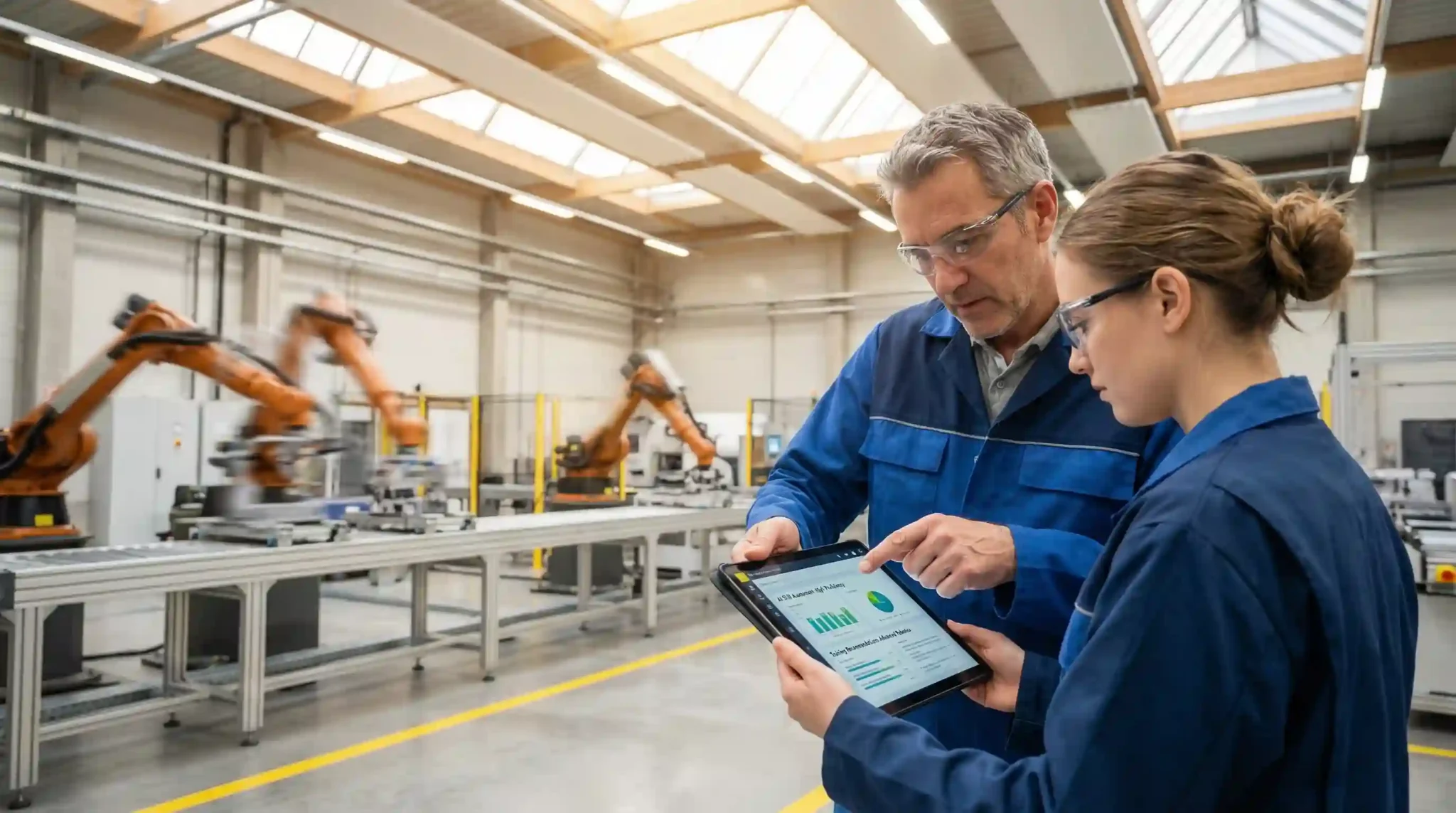
The following 4-phase roadmap is designed for mid-size manufacturers implementing AI workforce upskilling for the first time. Each phase builds on the previous one, ensuring that culture readiness, skills data, and learning infrastructure advance together. Total timeline: 18 to 24 months from kickoff to adaptive ecosystem.
Phase 1: Assessment & Foundation
- Month 1-3
- $10K-$25K
- Workforce skills audit and gap analysis across all roles
- AI readiness assessment: culture, infrastructure, data maturity
- AI literacy pilot program for 10-15 volunteer workers
- Baseline KPI measurement: proficiency time, defect rates, turnover
Target Outcome
Clear skills gap map and prioritized AI workforce upskilling roadmap with quick-win targets
Phase 2: Pilot Programs
- Month 4-8
- $20K-$50K
- Deploy AI literacy program across first production line or department
- Launch VR/AR training for highest-complexity roles
- Begin knowledge capture with 2-3 senior experts approaching retirement
- Implement AI-driven skills assessment for pilot group
Target Outcome
20-30% improvement in time to proficiency and 40% increase in AI tool adoption for pilot group
Phase 3: Scale
- Month 9-14
- $30K-$80K
- Extend AI literacy and immersive training to all production workers
- Deploy continuous learning ecosystem with micro-learning modules
- Integrate skills data with HR systems for workforce planning
- Launch peer mentoring program supported by AI matching
Target Outcome
Full AI workforce upskilling coverage with 40%+ productivity improvement across trained roles
Phase 4: Adaptive Ecosystem
- Month 15-24
- $20K-$50K/year
- Enable predictive skills gap identification before technology deployments
- Deploy AI-powered career pathing for all manufacturing roles
- Build self-updating knowledge base from ongoing expert capture
- Implement workforce readiness scoring for strategic planning
Target Outcome
Self-optimizing learning ecosystem that maintains workforce readiness as a permanent competitive advantage
For a broader AI implementation framework that covers organizational readiness beyond BIM, see our AI roadmap for SMBs guide.
08. Roadmap
AI Workforce Upskilling Across Manufacturing Sectors
While the 5 strategies apply broadly, the priority and implementation approach varies by manufacturing sector. The table below maps each strategy to its relative impact across four common manufacturing environments. Understanding these differences helps operations leaders prioritize their AI workforce upskilling investments for maximum ROI.
Strategy
Discrete Mfg
Process Mfg
Job Shop
Build Materials
AI Literacy Programs
High
High
High
High
Immersive Training
High
Medium
High
Medium
Skills Gap Assessment
High
High
Medium
High
Knowledge Capture
High
High
High
Medium
Continuous Learning
High
Medium
Medium
High
For a deeper look at how AI transforms specific manufacturing sectors, read our analysis of AI in manufacturing quality control and AI in supply chain optimization. Explore the manufacturing industry pillar for the complete Redex perspective on AI strategy for manufacturers.
Transform Your Operations
Stop Losing Talent. Start Building Capability.
Every month you delay AI workforce upskilling, your competitors close the gap. The 5 strategies in this article are not theoretical. They are being implemented right now by mid-size manufacturers who are cutting training time by 50% and boosting productivity by 40%. The question is not whether to invest in your people. The question is which strategy to deploy first.
- Assess your current workforce maturity level
- Identify the highest-ROI upskilling strategy for your operation
- Map your skills gaps across all production roles
- Build a phased roadmap with clear milestones and budgets
Frequently Asked Questions
What is AI workforce upskilling and why does it matter for manufacturing SMBs?
AI workforce upskilling is the structured process of training manufacturing workers to understand, use, and collaborate with AI-powered tools and systems. It matters because the manufacturing skills gap is widening: 25% of the workforce is over 55 and retiring, while AI adoption requires new competencies that traditional training programs do not address. For SMBs with 50 to 500 employees, AI workforce upskilling is the difference between realizing ROI on AI investments and watching expensive technology sit unused on the factory floor.
How much does AI workforce upskilling cost for a mid-size manufacturer?
For manufacturers with $15M to $100M in revenue and 50 to 500 employees, a phased AI workforce upskilling program typically costs $80,000 to $205,000 over 18 to 24 months. This includes skills assessment, AI literacy training, immersive simulation tools, knowledge capture systems, and continuous learning platforms. Most manufacturers see positive ROI within 6 to 9 months through reduced training time, lower defect rates, and improved employee retention. Annual ongoing costs range from $20,000 to $50,000 for platform licensing and content updates.
Which workers should we prioritize for AI workforce upskilling?
Start with two groups. First, train workers in roles where AI tools are already deployed or planned for deployment within 6 months. Their adoption directly determines whether your AI investment delivers ROI. Second, prioritize workers who interact with experienced employees approaching retirement. AI-powered knowledge capture is time-sensitive because once experts leave, their institutional knowledge is gone. After these groups, expand to production line supervisors and quality control teams, who typically see the fastest productivity gains from AI workforce upskilling.
Do we need to hire AI specialists to run an AI workforce upskilling program?
No. Most mid-size manufacturers implement AI workforce upskilling using commercial platforms that require configuration rather than custom development. Tools like Strivr, Axonify, and Poka are designed for operations teams, not data scientists. However, you do need a dedicated program owner, typically someone from operations or HR who understands both the production environment and learning objectives. Redex provides the strategic framework, vendor selection guidance, and change management support that eliminates the need for in-house AI expertise.
How do we measure the ROI of AI workforce upskilling?
Measure ROI across four dimensions. First, time to proficiency: track how quickly new hires reach target performance levels compared to pre-program baselines. Second, AI tool adoption: measure the percentage of workers actively using AI-powered tools versus those bypassing them. Third, production metrics: monitor defect rates, equipment utilization, and throughput for trained versus untrained workers. Fourth, retention: track turnover rates among workers who received AI workforce upskilling versus those who did not. Most manufacturers see 250 to 400% ROI within the first 18 months when these metrics are tracked rigorously.