01. EXECUTIVE SUMMARY
Why Digital Transformation Manufacturing Demands a Systems Approach
For mid-size manufacturers with 50 to 500 employees, quality control remains one of the most labor-intensive and least reliable processes on the production floor. Human inspectors working 8-hour shifts experience fatigue-related accuracy drops of 20-30% by mid-shift. They miss subtle defects that become expensive warranty claims. They apply inconsistent standards that create customer trust issues.
The numbers are stark: manufacturers typically spend 3-6% of revenue on cost of quality, with 40-60% of that attributable to inspection, rework, and scrap from missed defects. For a $20M manufacturer, that is $600K-$1.2M annually in quality-related costs—money that comes directly off the bottom line.
As McKinsey’s research on AI in industrial operations demonstrates, AI-based visual inspection can increase defect detection rates by up to 90% compared to human inspection. For manufacturing SMBs pursuing an AI strategy for manufacturing operations, quality control represents the highest-ROI starting point, a use case where the technology is mature, the data requirements are manageable, and the business case is unambiguous.
This article presents a structured approach to implementing AI-powered quality control, grounded in the Redex Manufacturing Quality Intelligence Maturity Model, a 4-phase framework that takes manufacturers from camera deployment through autonomous quality systems.
Up to 90%
Defect Detection Improvement
30%
Quality Cost Reduction
6-12 mo
Typical ROI Payback
AI Detection Accuracy
02. Def
What Is AI-Powered Quality Control?
AI-powered quality control uses computer vision, machine learning, and sensor analytics to inspect products at production speed with superhuman consistency. Unlike traditional automated inspection systems that rely on rigid, rule-based programming (if pixel value > threshold, then reject), AI quality systems learn to recognize defects the way experienced inspectors do—by pattern recognition across thousands of examples.
For manufacturing SMBs, this means deploying industrial cameras at critical inspection points along the production line, connected to edge computing hardware running trained neural networks. Each part is photographed, analyzed, and classified in under 100 milliseconds faster than the conveyor can move it to the next station.
Phase 1
Manual Inspection
$$$
- 70-80% detection rate
- Fatigue-dependent accuracy
- 2-5 seconds per part
- Subjective standards
- No data trail
Phase 2
Rule-Based Automation
$$
- 85-92% detection rate
- Rigid threshold logic
- Fast but inflexible
- High false reject rate
- Limited defect types
Phase 3
AI Quality Control
$
- 98-99.5% detection rate
- Consistent 24/7 accuracy
- Under 100ms per part
- Learns new defects
- Complete data history
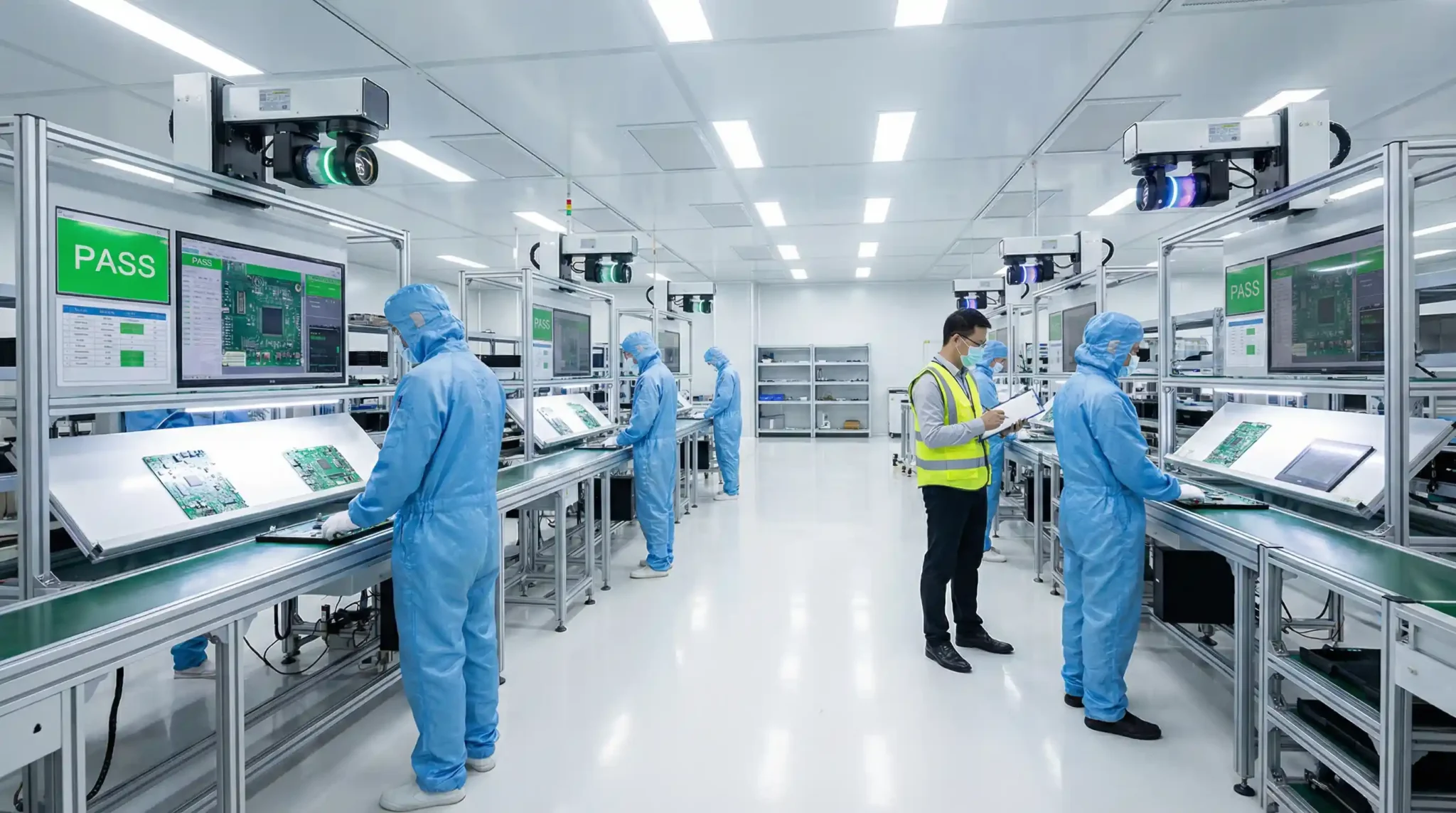
AI-based visual inspection can increase defect detection rates by up to 90% compared to human inspection, while operating continuously without fatigue or inconsistency.
McKinsey, 'Smartening Up with Artificial Intelligence'
03. Assessment Framework
The Redex Manufacturing Quality Intelligence Maturity Model
Most AI quality control initiatives fail because manufacturers attempt to deploy advanced analytics before establishing reliable data infrastructure. The Redex Manufacturing Quality Intelligence Maturity Model provides a structured 4-phase progression that ensures each capability layer is built on validated foundations from camera deployment through autonomous quality systems.
Phase 1
Data Capture
Industrial cameras, structured lighting, and sensor infrastructure deployed at critical inspection points. Baseline defect data collected and labeled for ML training.
- High-resolution camera stations
- Defect image labeling pipeline
- Structured lighting arrays
- Baseline quality metrics dashboard
Phase 2
Pattern Recognition
Machine learning models trained on defect patterns specific to your production processes. Real-time classification deployed at inspection stations with human-in-the-loop validation.
- CNN-based defect classifiers
- Real-time pass/fail decisions
- Confidence scoring per inspection
- Human override and feedback loop
Phase 3
Predictive Quality
AI models correlate upstream process parameters with downstream quality outcomes. Defects are predicted before they occur, enabling proactive process adjustments.
- Process-quality correlation models
- Early warning alerts
- SPC integration with AI overlay
- Root cause analysis automation
Phase 4
AutonomouS Quality
Self-correcting production systems that automatically adjust process parameters based on real-time quality feedback. Continuous improvement loops operate without manual intervention.
- Closed-loop process control
- Automated parameter optimization
- Digital twin quality simulation
- Supplier quality intelligence
RedEx Point of View
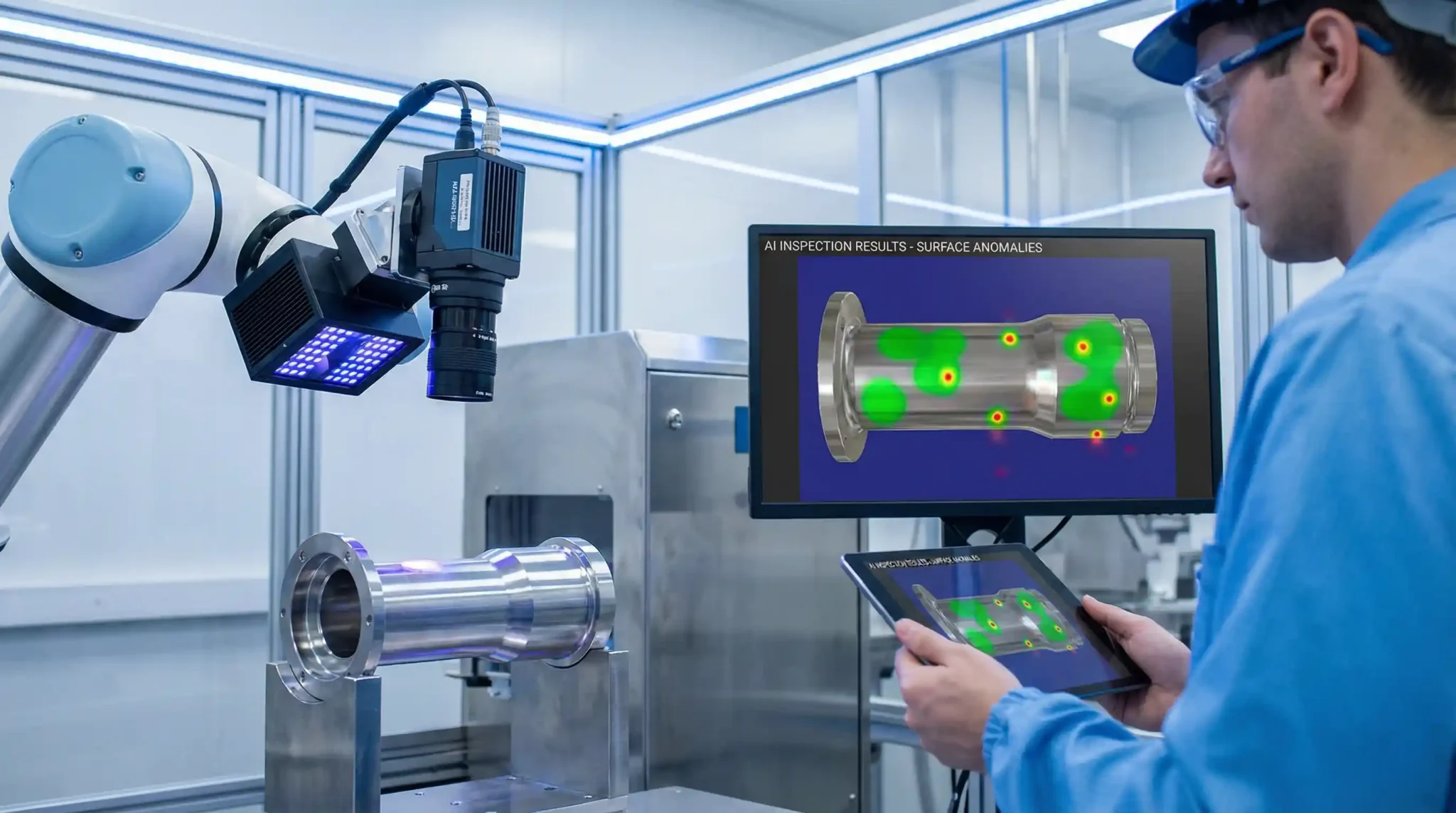
The biggest mistake we see in manufacturing AI quality deployments is underinvesting in Phase 1 lighting and camera infrastructure. Machine vision performance is 80% dependent on image acquisition quality, not model sophistication. Our recommendation: spend 40% of your Phase 1 budget on structured lighting and camera positioning, not analytics software.
04. Strategic Playbook
Five High-Impact Use Cases for Manufacturing SMBs
Each use case below represents a proven application of AI-powered intelligence in manufacturing operations. We present the business problem, the technical solution, and the measurable outcome, grounded in real deployment data from mid-size manufacturers.
Visual Defect Detection
The problem
Human inspectors catch only 70–80% of surface defects on production lines running at full speed. A single missed defect on a critical component can trigger a $50K–$200K product recall. For mid-size manufacturers producing 10,000+ units per day, manual inspection simply cannot scale.
The Solution
AI-powered machine vision systems use high-resolution cameras and convolutional neural networks to inspect every unit at production speed. The system learns your specific defect taxonomy: scratches, dents, discoloration, dimensional deviations and classifies each part in under 100 milliseconds.
Outcome
Detection rates increase from 75% to 99%+. False reject rates drop below 0.5%. One automotive parts manufacturer reduced customer-reported defects by 37% within 6 months of deployment.
Weld Quality Assessment
The problem
Weld quality inspection in metal fabrication relies on destructive testing (cutting samples) and subjective visual assessment. Only 5–10% of welds are typically inspected, creating significant quality blind spots. A failed weld on a structural component can cause catastrophic failures.
The Solution
AI-powered ultrasonic and visual inspection systems analyze every weld in real-time. Machine learning models evaluate penetration depth, porosity, undercut, and bead geometry against acceptance criteria, providing instant pass/fail decisions with confidence scores.
Outcome
Inspection coverage increases from 5–10% to 100% of welds. Destructive testing costs drop by 60–80%. One structural steel fabricator reduced weld-related rework by 45% and cut inspection labor by 70%.
Dimensional Accuracy
The problem
CNC-machined parts require precise dimensional verification. Manual measurement with calipers and CMMs is slow (2–5 minutes per part) and creates production bottlenecks. Sampling-based inspection misses drift patterns that cause batch-level quality failures.
The Solution
3D scanning and AI-powered dimensional analysis systems measure every critical dimension in seconds. Machine learning models detect process drift before parts go out of specification, correlating tool wear patterns with dimensional trends.
Outcome
Measurement time drops from 3 minutes to 8 seconds per part. Process drift is detected 2–4 hours before out-of-spec production begins. One precision machining shop reduced scrap rates by 28% and eliminated 3 CMM operator positions through automation.
Surface Finish Inspection
The problem
Surface finish quality on painted, coated, or polished parts is inherently subjective. Different inspectors apply different standards, creating inconsistent quality gates. Customer complaints about cosmetic defects account for 15–25% of all quality claims in consumer-facing manufacturing.
The Solution
AI vision systems trained on thousands of labeled surface images establish objective, repeatable quality standards. The system detects orange peel, runs, sags, inclusions, and color variations that human inspectors frequently miss under production lighting conditions.
Outcome
Cosmetic defect escapes reduced by 50–65%. Inspector-to-inspector variation eliminated entirely. One appliance manufacturer cut warranty claims related to finish quality by 40% within the first year.
Assembly Verification
The problem
Complex assemblies with 50–200+ components are prone to missing parts, incorrect orientation, and wrong variants. Manual verification checklists catch only 85–90% of assembly errors. Each escaped error costs $500–$5,000 in field service or recall expenses.
The Solution
Multi-camera AI systems verify component presence, orientation, and variant correctness at each assembly station. The system cross-references the work order BOM against visual confirmation, flagging discrepancies before the unit moves to the next station.
Outcome
Assembly error escape rate drops from 2–5% to under 0.1%. Field service calls related to assembly defects decrease by 70–80%. One electronics manufacturer saved $1.2M annually in warranty costs through AI-powered assembly verification.
05. Technology Stack
Build vs. Buy for Manufacturing SMBs
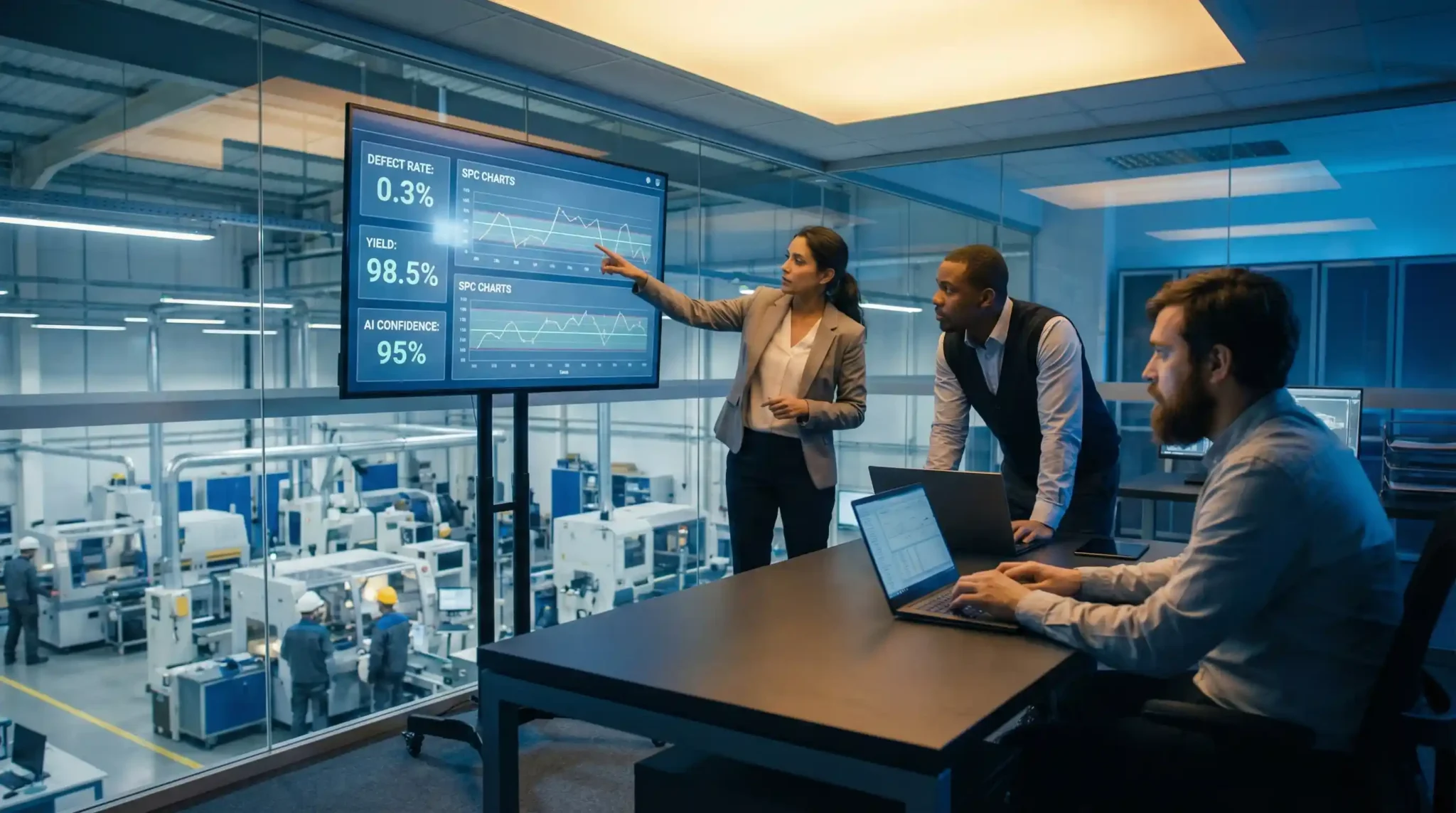
The AI quality control technology landscape offers options at every price point. The right choice depends on your production volume, defect complexity, and internal technical capability. Here is how the options compare for a typical manufacturing SMB.
Component
Build (Custom)
Buy (Platform)
Camera Hardware
Industrial cameras + custom mounts ($5K-$15K/station)
Turnkey vision pods ($15K-$30K/station)
Lighting System
Structured lighting design ($3K-$8K/station)
Pre-configured light domes ($8K-$15K/station)
Edge Computing
Azure, AWS, or GCP hosting with auto-scaling
Vendor appliance ($5K-$10K)
ML Model Development
Custom CNN training ($30K-$75K)
No-code AI platform ($500-$2K/mo)
MES/ERP Integration
Custom API development ($10K-$25K)
Pre-built connectors ($5K-$15K)
Dashboard & Analytics
Custom BI development ($15K-$30K)
Platform analytics ($200-$500/mo)
06. Risk Mitigation
Why Most AI Quality Control Initiatives Fail
Based on our experience across manufacturing AI deployments, we have identified 4 systemic failure patterns that account for 80% of failed implementations. Understanding these patterns before you start is the difference between a 6-month ROI and a 6-month write-off.
Starting with the Wrong Use Case
Many manufacturers begin AI quality control with their most complex inspection challenge. This maximizes risk and minimizes early wins.
Redex Countermeasure
Start with a high-volume, binary pass/fail inspection where the defect is visually obvious. Build confidence and data infrastructure before tackling nuanced quality decisions.
Insufficient Training Data
AI models need thousands of labeled defect images to achieve production-grade accuracy. Most manufacturers underestimate the data collection phase by 3–5x.
Redex Countermeasure
Plan for 8–12 weeks of dedicated data collection before model training. Invest in a structured labeling process with your quality engineers. Their domain expertise is the model's foundation.
Machine vision performance is 80% dependent on lighting conditions. Ambient light changes, reflections, and shadows cause more false rejects than model limitations.
Redex Countermeasure
Invest 30–40% of your hardware budget in structured lighting. Enclose inspection stations to control ambient conditions. This single decision determines whether your system achieves 95% or 99% accuracy.
No Feedback Loop to Production
AI inspection that only sorts good from bad is a expensive replacement for manual sorting. The real value is feeding quality data back to production to prevent defects.
Redex Countermeasure
Design the system architecture to close the loop from inspection to process control from day one. Connect quality signals to upstream parameters. This is where the 10x ROI lives.
07. Performance Metrics
KPI Benchmarks: Before and After AI Quality Control
The following benchmarks are derived from manufacturing SMB deployments across metal fabrication, plastics, electronics assembly, and food processing. Your specific results will vary based on current quality maturity, product complexity, and production volume.
Metric
Before AI
After AI
Improvement
First Pass Yield
85–92%
96–99%
+7–14 pts
Defect Detection Rate
70–80%
98–99.5%
+18–29 pts
Inspection Throughput
1–3 parts/min
10–60 parts/min
5–20x faster
False Reject Rate
3–8%
0.2–0.5%
−90–95%
Quality Labor Cost
$150K–$400K/yr
$40K–$100K/yr
−60–75%
Customer Complaint Rate
2–5%
0.3–0.8%
−70–85%
Cost of Quality (% Revenue)
3–6%
1–2.5%
−50–60%
Worked ROI Example: $20M Metal Fabricator
Current state: 3 full-time inspectors ($180K/yr total), 4.5% cost of quality ($900K/yr), 2.8% customer complaint rate.
AI investment: $95K first year (hardware + model development + integration). $24K/yr ongoing (compute, maintenance, model updates).
Year 1 results: Quality labor reduced to 1 inspector + AI system ($60K + $24K = $84K/yr). Cost of quality drops to 2.2% ($440K/yr). Customer complaints drop to 0.6%.
Annual savings: $96K labor + $460K quality costs = $556K. ROI: 485% in Year 1.
08. Roadmap
Implementation Roadmap for Manufacturing SMBs
This 4-phase roadmap is designed for manufacturers with 50-500 employees, 1-5 production lines, and no prior AI deployment experience. Each phase builds on the previous one, with clear deliverables and decision gates before advancing. Total timeline: 14-20 months. Total investment: $120K-$280K.
Phase 1: Foundation
- Month 1-4
- $30K-$70K
- Quality process audit and inspection point mapping
- Camera and lighting hardware specification and procurement
- Defect taxonomy development with quality engineering team
- Data collection infrastructure and labeling pipeline setup
- Baseline quality metrics documentation
Phase 2: Intelligence
- Month 4-8
- $35K-$80K
- ML model training on collected defect datasets
- Integration with production line PLC/SCADA systems
- Real-time inspection dashboard deployment
- Human-in-the-loop validation and model refinement
- First production line pilot with parallel manual inspection
Phase 3: Optimization
- Month 8-14
- $25K-$60K
- Multi-line rollout based on pilot results
- Process-quality correlation model development
- SPC integration with AI-powered anomaly detection
- Predictive quality alerts for upstream process drift
- Quality reporting automation for compliance
Phase 4: Autonomy
- Month 14-20
- $30K-$70K
- Closed-loop process control integration
- Automated parameter adjustment based on quality signals
- Supplier incoming quality AI inspection
- Digital twin quality simulation for new products
- Continuous model improvement pipeline
Transform Your Operations
Stop Accepting Defects as a Cost of Doing Business.
Your production line is generating quality data right now. The question is whether you are using it to prevent defects or just counting them after the fact. Every day without AI-powered quality control is another day of preventable scrap, avoidable rework, and unnecessary customer complaints.
Redex helps manufacturing SMBs design and implement AI-powered quality intelligence systems that deliver measurable ROI within 6-12 months. Our approach starts with your specific quality challenges, not generic technology demos.
FAQs
How much does AI quality control cost for a manufacturing SMB?
A single-line AI inspection system typically costs $25K–$75K for hardware (cameras, lighting, compute) plus $30K–$60K for model development and integration. Total first-year investment ranges from $55K–$135K. Most manufacturers see ROI within 6–12 months through reduced scrap, fewer customer complaints, and lower inspection labor costs. The key cost driver is the complexity of defects you need to detect: simple binary pass/fail is significantly cheaper than nuanced multi-class classification.
Can AI quality control work with our existing production equipment?
Yes. AI quality control systems are designed as add-on inspection stations that integrate with existing production lines. They connect to your PLC/SCADA systems via standard industrial protocols (OPC UA, Modbus, EtherNet/IP). No modifications to your existing machines are required. The cameras and lighting are mounted at inspection points along your existing conveyor or handling systems. Integration typically takes 2–4 weeks per line.
How many defect images do we need to train an accurate AI model?
For production-grade accuracy (98%+), you typically need 500–2,000 labeled images per defect class, plus 2,000–5,000 images of good parts. Modern transfer learning techniques can achieve useful results with as few as 200–300 defect images, but accuracy improves significantly with more data. Plan for 8–12 weeks of dedicated data collection. Your quality engineers’ expertise in labeling and classifying defects is the most critical factor in model accuracy.
What happens when the AI encounters a defect type it hasn't seen before?
Well-designed AI quality systems include an ‘uncertainty threshold’ when the model’s confidence falls below a set level (typically 85–90%), the part is flagged for human review rather than auto-classified. This prevents false passes on novel defect types. The human-reviewed images are then added to the training dataset, and the model is retrained periodically (typically monthly) to learn new defect patterns. This continuous learning loop means the system gets smarter over time.
Will AI quality control replace our quality inspectors?
AI quality control changes the role of quality inspectors rather than eliminating it. Instead of performing repetitive visual inspection, your quality team focuses on higher-value activities: analyzing quality trends, investigating root causes, managing the AI system, and handling edge cases the AI flags for review. Most manufacturers redeploy 60–70% of inspection labor to quality engineering roles while maintaining or reducing total headcount. The result is a more skilled, more engaged quality team.
Continue Your Manufacturing Modernization Journey