01. EXECUTIVE SUMMARY
Why Manufacturing Supply Chains Are Breaking
The average mid-size manufacturer loses 5-8% of annual revenue to supply chain inefficiencies. These losses accumulate across demand forecasting errors, excess inventory carrying costs, supplier disruptions, logistics waste, and production scheduling gaps. For a $30M manufacturer, that translates to $1.5M to $2.4M in preventable costs every year.
The root cause is not a lack of effort. Operations teams work long hours managing purchase orders, tracking shipments, and adjusting production schedules. The problem is that human planners cannot process the volume and velocity of data required to make optimal decisions across a modern supply chain. A typical manufacturer with 5,000 SKUs, 100 suppliers, and 50 customers generates millions of data points daily. No spreadsheet can keep up.
According to McKinsey’s 2025 research on AI in supply chains, gen AI alone is poised to unlock $190 billion in value across logistics operations and $18 billion specifically in supply chain management. Yet most of this value remains concentrated in large enterprises. Mid-size manufacturers have been slower to adopt because they lack the implementation roadmaps designed for their scale and budget.
That is exactly what this article provides. We outline 7 proven strategies for AI in supply chain optimization, each validated through Redex client engagements with manufacturers in the $15M to $100M revenue range. Every strategy includes the specific problem it solves, how the AI system works, and the measurable business outcome it delivers.
25-35%
Inventory Cost Reduction
85-92%
Forecast Accuracy
$9.9B
AI Supply Chain Market 2025
Typical Time to ROI
The manufacturers winning with AI in supply chain optimization are not the ones with the biggest budgets. They are the ones who start with the right sequence: forecast first, then inventory, then everything else.
Redex Advisory, 2026
02. Our Approach
The RedEx Supply Chain Intelligence Maturity Model
Before implementing any of the 7 strategies, manufacturers need to understand where they currently stand. The Redex Supply Chain Intelligence Maturity Model provides a clear assessment framework. Most SMB manufacturers operate at Phase 1 or Phase 2. The goal of AI in supply chain optimization is to move systematically toward Phase 3 and eventually Phase 4, where supply chain decisions become largely autonomous.
Phase 1
Reactive
Manual processes, spreadsheet tracking, no real-time visibility. Decisions based on historical averages and intuition.
Phase 2
Informed
Basic analytics dashboards, ERP-connected reporting, batch demand forecasting. Data exists but is not actionable in real time.
Phase 3
Predictive
ML-driven forecasting, automated reorder triggers, supplier risk scoring. AI in supply chain optimization begins delivering measurable ROI.
Phase 4
Autonomous
Self-optimizing supply networks, autonomous procurement, real-time adaptive scheduling. Full AI in supply chain optimization across all nodes.
This maturity model connects directly to the Redex Frameworks library, where you can explore how our DATA Methodology and Jagged Frontier Discovery Protocol support each phase transition. The key insight is that AI in supply chain optimization is not a single project. It is a capability that matures over 18 to 24 months through deliberate, phased investment.
03. AI Use Cases
7 Proven Strategies for AI in Supply Chain Optimization
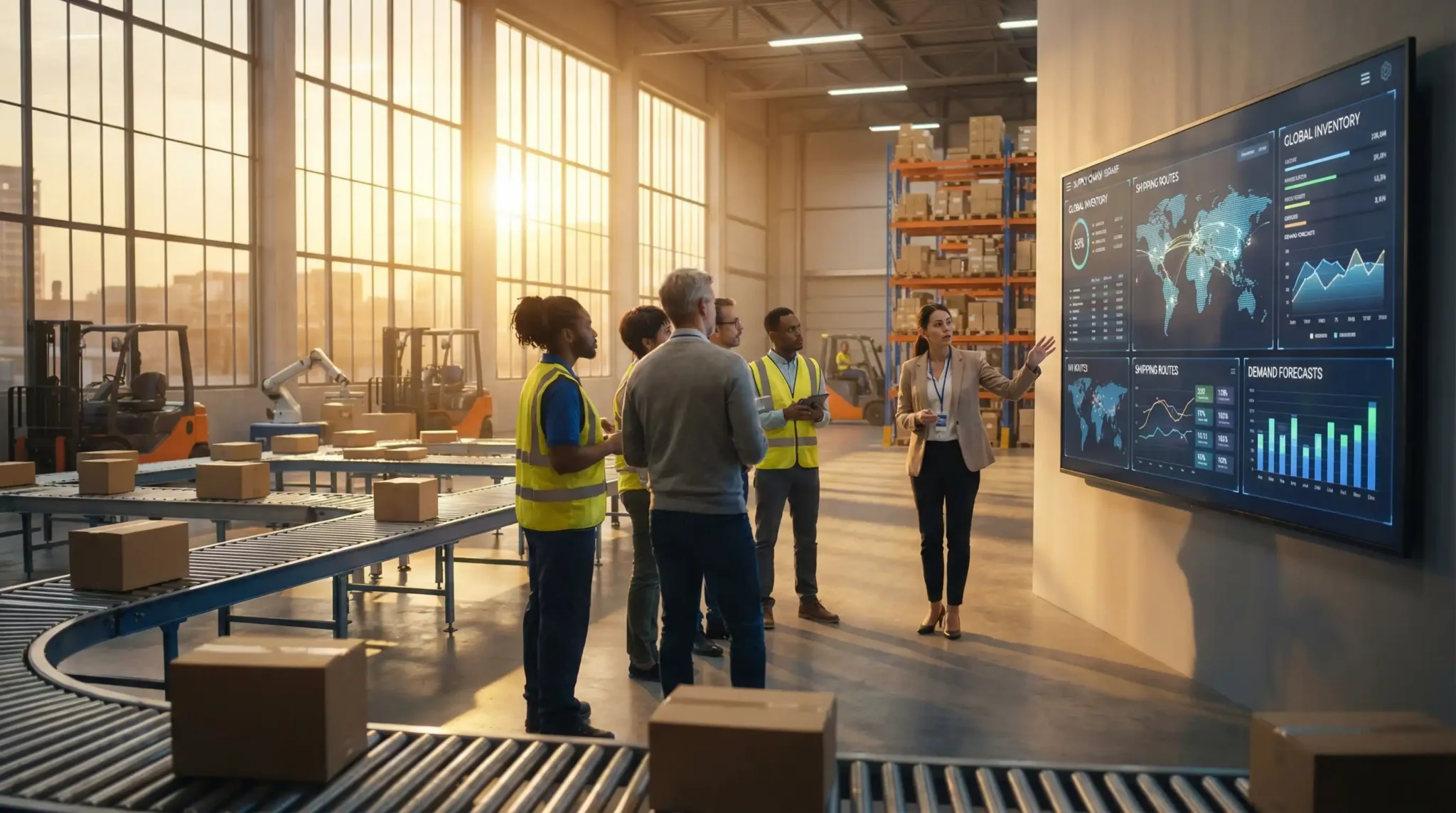
Each strategy below has been validated through Redex engagements with mid-size manufacturers. We present them in the recommended implementation sequence: start with demand forecasting, then build outward. This sequence ensures that each layer of AI in supply chain optimization compounds the value delivered by the previous one.
AI-Powered Demand Forecasting
The problem
Most mid-size manufacturers still rely on spreadsheet-based forecasting that uses 12 months of historical sales data and manual adjustments. Forecast accuracy typically ranges from 55% to 65%, leading to chronic overproduction or stockouts.
AI Solution
Machine learning models ingest 50+ demand signals including historical orders, seasonality patterns, economic indicators, weather data, and competitor pricing. These models continuously retrain on new data, adapting to market shifts within days rather than quarters.
Outcome
Forecast accuracy improves from 60% to 85-92%. Stockout rates drop by 50-70%. Overproduction waste decreases by 25-40%. One $30M industrial parts manufacturer reduced excess inventory by $2.1M in the first year after deploying AI in supply chain optimization for demand planning.
Intelligent Inventory Optimization
The problem
Manufacturers carry 15-25% more inventory than necessary because safety stock calculations rely on static formulas. Working capital sits locked in warehouses while stockouts still occur on high-demand SKUs.
AI Solution
AI-driven inventory systems calculate dynamic safety stock levels for every SKU based on demand variability, lead time uncertainty, and service level targets. The system recommends optimal reorder points and quantities, adjusting in real time as conditions change.
Outcome
Inventory carrying costs decrease by 20-35%. Working capital improves by 15-25%. Service levels increase from 92% to 97-99%. A $45M metal fabricator freed $3.2M in working capital within 8 months by applying AI in supply chain optimization to inventory management.
Supplier Risk Intelligence
The problem
Most SMB manufacturers manage 50-200 suppliers using spreadsheets and quarterly reviews. When a critical supplier faces financial distress, production delays, or quality issues, the manufacturer often discovers the problem weeks after it begins affecting deliveries.
AI Solution
AI platforms continuously monitor supplier health using financial filings, news sentiment, shipping data, and quality scorecards. Risk scores update daily, and automated alerts trigger when a supplier crosses predefined thresholds for delivery performance, financial stability, or compliance.
Outcome
Supply disruption events decrease by 35-50%. Supplier quality incidents drop by 40%. Lead time variability reduces by 30%. A $25M precision components manufacturer avoided $800K in production delays by detecting a tier-2 supplier's financial distress 6 weeks before default.
Dynamic Logistics and Route Optimization
The problem
Transportation costs represent 8-15% of total product cost for most manufacturers. Static routing plans fail to account for real-time traffic, weather, fuel prices, and delivery window changes. Trucks run at 60-70% capacity utilization.
AI Solution
AI routing engines process real-time data from GPS, traffic feeds, weather services, and customer delivery windows to generate optimal routes. Load optimization algorithms maximize truck utilization while respecting weight limits and delivery priorities.
Outcome
Transportation costs decrease by 10-25%. Truck utilization improves from 65% to 85-90%. On-time delivery rates increase from 88% to 96%. A regional building materials distributor saved $420K annually through AI in supply chain optimization for route planning across 35 vehicles.
AI-Driven Procurement Intelligence
The problem
Procurement teams at mid-size manufacturers spend 60-70% of their time on transactional tasks: processing purchase orders, chasing approvals, and reconciling invoices. Strategic sourcing decisions rely on gut feel rather than data-driven analysis.
AI Solution
AI procurement platforms automate routine purchasing workflows, analyze spend patterns across categories, and identify consolidation opportunities. Natural language processing extracts key terms from supplier contracts, flagging unfavorable clauses and upcoming renewal dates.
Expected Outcome
Procurement cycle time decreases by 40-60%. Spend under management increases from 50% to 85%. Contract compliance improves by 30%. A $35M packaging manufacturer achieved 8% procurement savings ($2.8M annually) by deploying AI in supply chain optimization for strategic sourcing.
Intelligent Production Scheduling
The problem
Production schedulers juggle dozens of variables: machine availability, operator skills, material constraints, customer priorities, and changeover times. Manual scheduling typically achieves 70-80% overall equipment effectiveness (OEE) and struggles with rush orders.
AI Solution
AI scheduling engines evaluate thousands of possible production sequences in minutes, optimizing for throughput, on-time delivery, and changeover minimization. The system adapts schedules dynamically when machines go down, materials arrive late, or rush orders enter the queue.
Expected Outcome
OEE improves from 75% to 85-90%. Changeover time decreases by 20-30%. Rush order accommodation improves by 50%. A $40M automotive parts manufacturer increased daily throughput by 18% without adding equipment after implementing AI in supply chain optimization for production planning.
Warehouse Operations Intelligence
The problem
Warehouse operations at mid-size manufacturers rely on experienced staff who know product locations from memory. Pick paths are inefficient, slotting decisions are static, and labor allocation follows fixed schedules regardless of actual workload.
AI Solution
AI warehouse systems optimize pick paths based on order patterns, dynamically adjust slotting to place fast-moving items in accessible locations, and predict labor requirements based on incoming order volumes and shipping schedules.
Outcome
Pick rates improve by 25-40%. Labor productivity increases by 15-30%. Order accuracy reaches 99.8%+. A $20M industrial supplies distributor reduced warehouse labor costs by $340K annually through AI in supply chain optimization for pick path and slotting decisions.
Redex Point of View
Most manufacturers attempt to optimize their supply chain by adding point solutions: a forecasting tool here, a routing app there. This creates a fragmented technology landscape that mirrors the very data silos it was meant to solve. The Redex approach to AI in supply chain optimization is architectural. We design the integration layer first, ensuring that every AI capability feeds data to and receives data from every other capability. When your demand forecast improves, your inventory system adjusts automatically. When a supplier risk score changes, your procurement system activates alternative sourcing. This is the difference between a collection of tools and an intelligent supply chain.
04. Tech Stack
Build vs. Buy for Each Strategy
One of the most common questions from manufacturers exploring AI in supply chain optimization is whether to build custom solutions or buy commercial platforms. The answer depends on your internal capabilities, timeline, and budget. The table below provides our recommendation for each of the 7 strategy areas. As a general rule, buy first for quick wins, then consider building custom models once you have clean data and proven ROI.
Category
Build Option
Buy Option
Best For
Demand Planning
Python + Prophet/LightGBM
Kinaxis, o9 Solutions
SMBs with data science capability
Inventory Optimization
Custom safety stock models
EazyStock, Netstock
Immediate ROI, limited IT staff
Supplier Risk
Web scraping + NLP pipeline
Resilinc, Everstream
Complex supplier networks (100+)
Route Optimization
OR-Tools + custom solver
Routific, OptimoRoute
Fleet operations (20+ vehicles)
Procurement
RPA + spend analytics
Coupa, GEP SMART
High-volume purchasing operations
Production Scheduling
Constraint programming
Opcenter, PlanetTogether
Complex job shop environments

For a detailed assessment of which approach fits your organization, explore our Agentic AI consulting services. Redex helps manufacturers evaluate, select, and integrate the right technology stack for their specific supply chain complexity and maturity level.
05. Pitfalls
Why Most AI Supply Chain Initiatives Fail
Industry research consistently shows that 60-70% of AI projects in manufacturing fail to deliver expected ROI. In our experience advising mid-size manufacturers on AI in supply chain optimization, we see four recurring failure patterns. Each one is preventable with the right approach.
Pattern 1: Tool-First Thinking
Buying supply chain software before mapping current processes and data flows. The tool becomes shelfware within 6 months.
Fix
Redex starts with process mapping and data audit before any technology selection.
Pattern 2: Data Silos Persist
ERP, WMS, TMS, and procurement systems remain disconnected. AI models receive incomplete data and produce unreliable outputs.
Fix
Our DATA Methodology ensures integration architecture is designed before AI deployment begins.
Pattern 3: No Change Management
Planners and buyers resist AI recommendations because they were not involved in system design. Adoption stalls at 20-30%.
Fix
Redex embeds change management into every phase, training users as co-designers rather than passive recipients.
Pattern 4: Wrong KPIs
Measuring AI success by model accuracy instead of business outcomes like fill rate, inventory turns, or cost per order.
Fix
We define business KPIs first, then select AI approaches that directly improve those metrics.
06. KPIs & ROI
KPI Benchmarks: Before and After AI in Supply Chain Optimization
The following benchmarks are based on Redex client engagements and published industry research. They represent typical results for mid-size manufacturers ($15M to $100M revenue) implementing AI in supply chain optimization across all 7 strategy areas over 18-24 months.
Metric
Before AI
After AI
Improvement
Forecast Accuracy
55-65%
85-92%
+30-37 pts
Inventory Carrying Cost
25-30% of value
15-20% of value
-35% reduction
Stockout Rate
8-15%
2-4%
-70% reduction
On-Time Delivery
85-90%
95-98%
+8-10 pts
Procurement Cycle Time
5-10 days
1-3 days
-60% faster
Transportation Cost/Unit
Baseline
Optimized
-15-25% reduction
Working Capital (Inventory)
Excess 15-25%
Right-sized
15-25% freed
ROI Worked Example
Scenario: $35M metal fabrication manufacturer, 3,200 SKUs, 85 suppliers, 12 delivery vehicles.
Year 1 Investment: $120,000 (process mapping, data prep, demand forecasting, inventory optimization, supplier monitoring).
Year 1 Savings: Inventory reduction of $1.8M (freed working capital). Stockout-related lost sales reduced by $420K. Procurement savings of $280K through spend consolidation. Transportation cost reduction of $180K through route optimization. Total Year 1 savings: $2.68M. ROI: 2,133%.
Year 2 Projection: Additional $80K investment for production scheduling and warehouse optimization. Incremental savings of $1.2M. Cumulative 24-month ROI: 1,940% on total $200K investment.
07. Roadmap
Implementation Roadmap for AI in Supply Chain Optimization
The following 4-phase roadmap is designed for mid-size manufacturers implementing AI in supply chain optimization for the first time. Each phase builds on the previous one, ensuring that data quality, team capability, and technology maturity advance together. Total timeline: 18 to 24 months from kickoff to autonomous operations.
Phase 1: Foundation
- Month 1-3
- $15K-$40K
- Supply chain process mapping and data audit
- ERP data quality assessment and cleansing
- Demand forecasting pilot (top 20% SKUs by revenue)
- Baseline KPI measurement across all 7 strategy areas
Target Outcome
Clear data readiness score and prioritized AI in supply chain optimization roadmap
Phase 2: Quick Wins
- Month 4-8
- $25K-$60K
- Deploy demand forecasting across all active SKUs
- Implement dynamic safety stock calculations
- Launch supplier risk monitoring dashboard
- Automate routine procurement workflows
Target Outcome
10-15% inventory reduction and 20% improvement in forecast accuracy
Phase 3: Scale
- Month 9-14
- $40K-$100K
- Integrate route optimization across delivery fleet
- Deploy AI production scheduling engine
- Implement warehouse pick path optimization
- Connect all systems into unified supply chain dashboard
Target Outcome
Full AI in supply chain optimization coverage with 25%+ total cost reduction
Phase 4: Autonomy
- Month 15-24
- $30K-$80K/year
- Enable autonomous reorder and procurement decisions
- Deploy predictive supplier qualification system
- Implement self-optimizing production scheduling
- Build digital twin of end-to-end supply chain
Target Outcome
Self-optimizing supply network with minimal manual intervention
For a broader AI implementation framework that covers organizational readiness beyond BIM, see our AI roadmap for SMBs guide.
08. Roadmap
AI in Supply Chain Optimization Across Manufacturing Sectors
While the 7 strategies apply broadly, the priority and implementation approach varies by manufacturing sector. The table below maps each strategy to its relative impact across four common manufacturing environments. Understanding these differences helps operations leaders prioritize their AI in supply chain optimization investments for maximum ROI.
Strategy
Discrete Mfg
Process Mfg
Job Shop
Build Materials
Demand Forecasting
High
High
Medium
High
Inventory Optimization
High
High
Medium
High
Supplier Risk
High
Medium
High
Medium
Logistics/Routing
Medium
Low
Low
High
Procurement
High
High
Medium
Medium
Production Scheduling
High
Medium
High
Low
Warehouse Ops
High
Medium
Low
High
For a deeper look at how AI transforms specific manufacturing sectors, read our analysis of AI in manufacturing quality control and explore the manufacturing industry pillar for the complete Redex perspective on AI strategy for manufacturers.
Transform Your Operations
Stop Losing Money to Supply Chain Inefficiency.
Every month you delay AI in supply chain optimization, your competitors gain ground. The 7 strategies in this article are not theoretical. They are being implemented right now by mid-size manufacturers who are cutting costs by 25% and improving service levels to 97%+. The question is not whether to start. The question is which strategy to deploy first.
Frequently Asked Questions
What is AI in supply chain optimization and how does it differ from traditional supply chain management?
AI in supply chain optimization uses machine learning, predictive analytics, and automation to make supply chain decisions faster and more accurately than traditional methods. Traditional supply chain management relies on historical averages, static rules, and manual analysis. AI systems process thousands of variables simultaneously, learn from outcomes, and adapt to changing conditions in real time. For mid-size manufacturers, this means moving from reactive firefighting to proactive decision-making across demand planning, inventory, procurement, and logistics.
How much does AI in supply chain optimization cost for a mid-size manufacturer?
For manufacturers with $15M to $100M in revenue, a phased implementation of AI in supply chain optimization typically costs $80,000 to $280,000 over 18-24 months. This includes process mapping, data preparation, tool deployment, integration, and training. Most manufacturers see positive ROI within 6-9 months, starting with demand forecasting and inventory optimization. Annual software licensing ranges from $5,000 to $15,000 depending on the tools selected and the number of supply chain nodes covered.
Which supply chain function should we optimize with AI first?
Start with demand forecasting. It delivers the fastest ROI because improved forecast accuracy directly reduces both excess inventory and stockouts. Most manufacturers can improve forecast accuracy by 25-35 percentage points within 3-4 months using readily available historical data from their ERP system. Once forecasting is stable, move to inventory optimization, which builds directly on better demand signals. This sequence ensures each AI investment compounds the value of the previous one.
Do we need a data science team to implement AI in supply chain optimization?
No. Most mid-size manufacturers implement AI in supply chain optimization using commercial platforms that require configuration rather than custom model development. Tools like EazyStock, Netstock, and Routific are designed for operations teams, not data scientists. However, you do need clean, consistent data in your ERP system. Redex recommends a data quality audit before any AI deployment to identify gaps in item master data, transaction history, and supplier records.
How does AI in supply chain optimization handle supply chain disruptions?
AI systems improve disruption response in 3 ways. First, predictive models identify potential disruptions before they occur by monitoring supplier financial health, geopolitical risk indicators, and logistics network stress signals. Second, scenario simulation engines model the impact of disruptions across the supply chain, helping planners evaluate response options in minutes rather than days. Third, automated contingency plans trigger alternative sourcing, routing, or scheduling when predefined risk thresholds are crossed.