01. EXECUTIVE SUMMARY
Why AI Copilot Manufacturing Is Now a Strategic Imperative
AI copilot manufacturing has emerged as the most practical path to operational intelligence for mid-size manufacturers. Unlike full automation, which requires millions in capital investment and years of implementation, ai copilot manufacturing augments existing workers with real-time intelligence at a fraction of the cost.
The urgency is real. According to McKinsey’s COO100 Survey, 93% of manufacturing COOs plan to increase AI spending over the next five years, yet only 2% have fully embedded AI across operations. The gap between ambition and execution is enormous. Most manufacturers are stuck in pilot mode because they pursued automation before augmentation.
For SMBs with 50 to 500 employees, ai copilot manufacturing solves three critical problems simultaneously. First, it addresses the workforce crisis: 2.1 million manufacturing jobs will go unfilled by 2030 as experienced workers retire. Second, it closes the productivity gap: mid-size manufacturers operate at 60 to 75% of their theoretical capacity because operators lack real-time decision support. Third, it preserves institutional knowledge that would otherwise walk out the door with every retirement.
93%
COOs Increasing AI Spend
2.1M
Unfilled Mfg Jobs by 2030
35%
Avg Productivity Gain
Time to Positive ROI
The manufacturers winning with AI are not the ones buying robots. They are the ones giving their existing operators superpowers through ai copilot manufacturing systems that make every worker perform like a 20-year veteran.
Redex AI Strategy Practice
02. Our Approach
The Redex AI Copilot Maturity Model
Most manufacturers attempt to jump from Phase 1 directly to Phase 4. This framework provides a structured path for ai copilot manufacturing adoption that delivers ROI at every stage.
Phase 1
REACTIVE
No ai copilot manufacturing capability exists. Operators rely entirely on experience and tribal knowledge. Decisions are manual, inconsistent, and undocumented.
Phase 2
ASSISTED
Basic dashboards and alerts provide operators with data visibility. The ai copilot manufacturing system offers simple threshold-based notifications but lacks contextual intelligence.
Phase 3
COLLABORATIVE
AI copilot manufacturing platforms deliver real-time recommendations based on historical patterns and sensor data. Operators and copilots work together on decisions. Knowledge capture is active.
Phase 4
AUTONOMOUS
AI copilot manufacturing systems handle routine decisions independently. Operators focus on exceptions and strategic improvements. Continuous learning drives ongoing optimization.
RedEx Point of View
Most mid-size manufacturers we assess are at Phase 1 or early Phase 2. The good news: moving from Phase 1 to Phase 3 typically takes 6 to 12 months and delivers 200 to 400% ROI. You do not need to reach Phase 4 to see transformative results from ai copilot manufacturing.
03. AI Use Cases
8 Essential AI Copilot Manufacturing Applications
Each application follows the Redex problem, solution, outcome framework with real metrics from mid-size manufacturers deploying ai copilot manufacturing systems.
Real-Time Operator Decision Support
The problem
Machine operators at mid-size manufacturers make hundreds of micro-decisions per shift. When parameters drift, most operators rely on experience and guesswork to adjust settings. New hires take 6 to 18 months to develop the intuition that experienced operators carry. The result: inconsistent output quality, 10 to 20% excess scrap during shift transitions, and heavy dependence on a shrinking pool of senior workers.
AI Solution
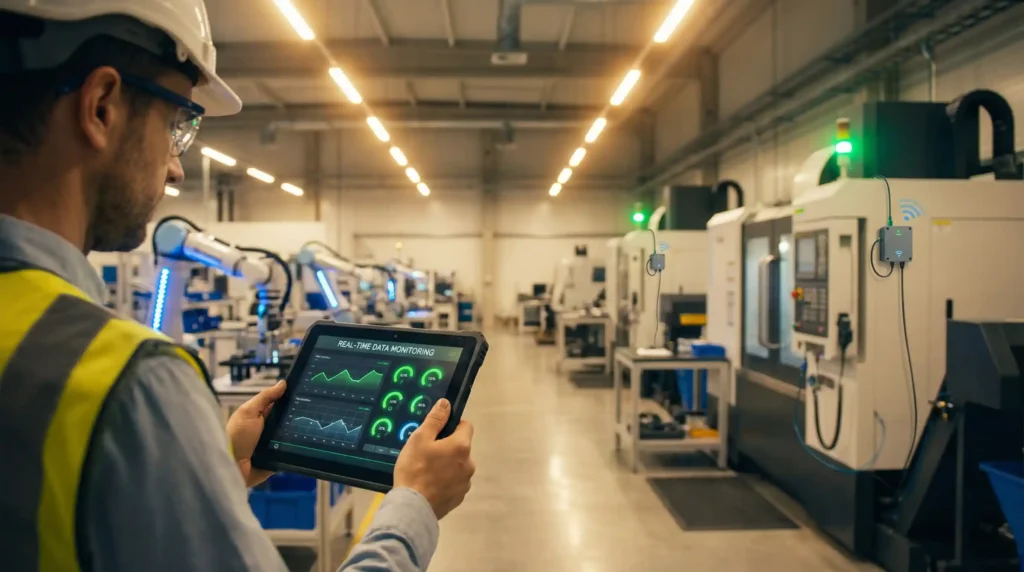
An ai copilot manufacturing system monitors real-time sensor data from each machine and provides contextual recommendations directly to the operator's tablet or HMI screen. When temperature, pressure, or feed rate drifts toward conditions that historically produce defects, the copilot alerts the operator and suggests specific parameter adjustments. The system learns from every correction, continuously improving its recommendations.
Outcome
A $30M precision parts manufacturer deployed an ai copilot manufacturing system across 8 CNC machines. Operator decision time dropped 65%. Scrap rates during shift transitions decreased from 12% to 3.5%. New operators reached competency benchmarks 40% faster. Annual savings exceeded $280,000 in reduced waste and rework.
AI-Guided Maintenance Troubleshooting
The problem
When equipment fails unexpectedly, maintenance technicians spend 30 to 60% of their time diagnosing the root cause before they can begin repairs. Mid-size manufacturers typically have 3 to 8 maintenance staff covering dozens of machines. Tribal knowledge lives in the heads of senior technicians. When those workers retire or call in sick, diagnostic time doubles or triples.
AI Solution
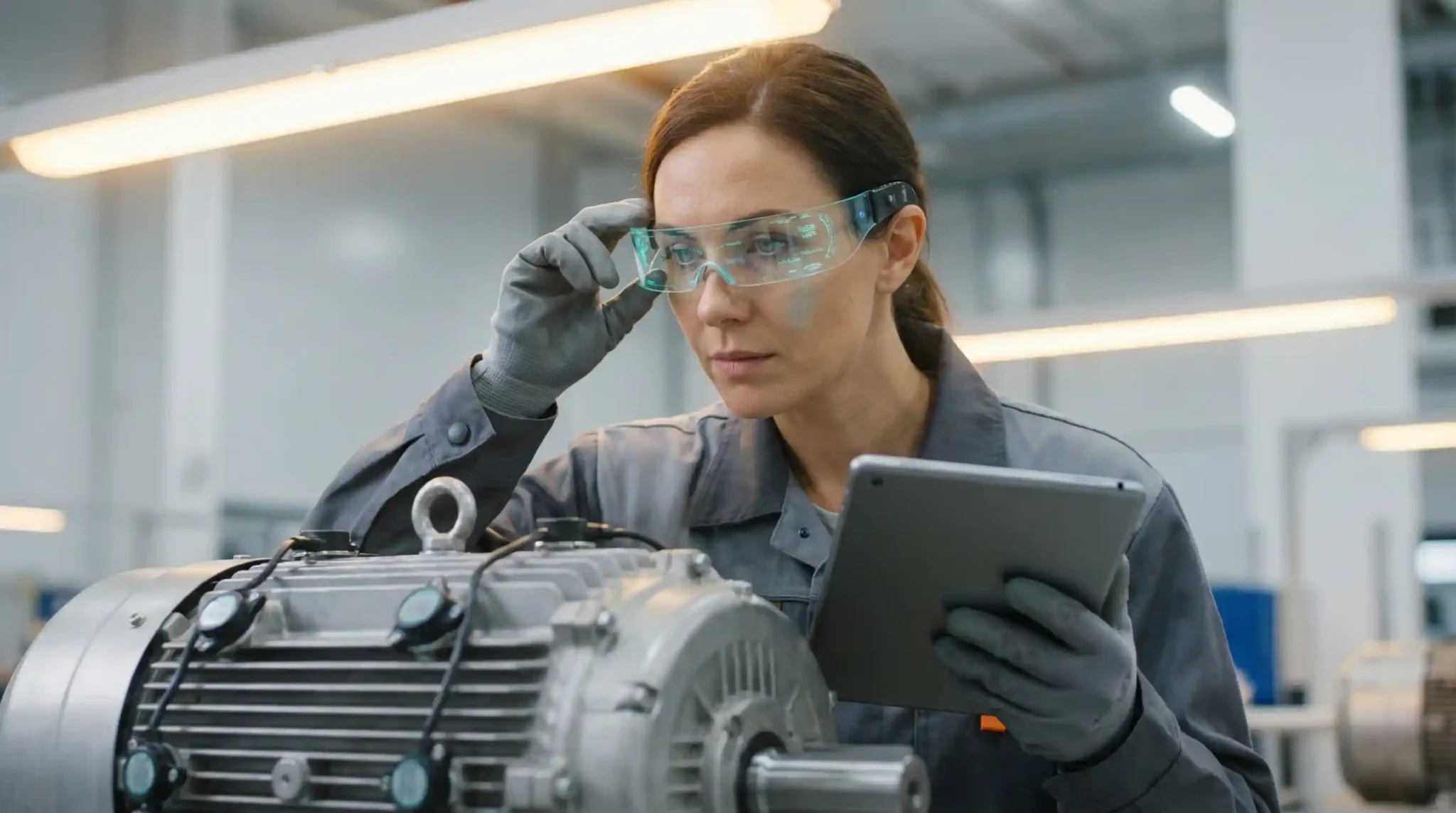
The ai copilot manufacturing platform ingests equipment manuals, historical repair logs, sensor data, and technician notes into a searchable knowledge base. When a machine faults, the copilot analyzes current sensor readings against historical failure patterns and presents the most likely root causes ranked by probability. It provides step-by-step repair procedures with photos and videos from previous successful repairs.
Outcome
A $45M metal fabrication company implemented an ai copilot manufacturing diagnostic system for its 35 production machines. Mean time to repair dropped 45%. First-time fix rates improved from 62% to 88%. The system captured 15 years of tribal knowledge from 3 retiring senior technicians, preserving institutional expertise that would have been lost permanently.
Inline Quality Prediction and Correction
The problem
Traditional quality control catches defects after they occur. By the time an inspector identifies a dimensional deviation or surface flaw, dozens of defective parts may already exist in the production pipeline. For mid-size manufacturers, quality costs typically represent 15 to 25% of revenue when accounting for scrap, rework, warranty claims, and customer returns.
AI Solution
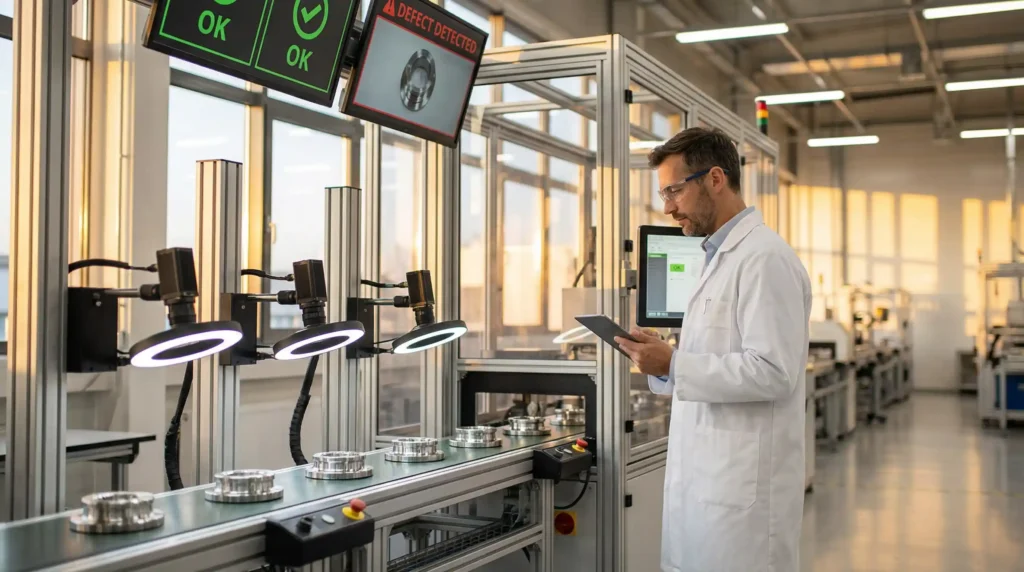
An ai copilot manufacturing quality system monitors process parameters in real time and predicts quality outcomes before parts are completed. The copilot compares current conditions against thousands of historical production runs to identify patterns that precede defects. When the system detects drift toward out-of-spec conditions, it alerts operators with specific corrective actions: adjust feed rate by 3%, increase coolant flow by 15%, or replace the worn insert at station 4.
Outcome
A $35M automotive parts supplier deployed an ai copilot manufacturing quality system on its stamping and welding lines. First-pass yield improved from 91% to 97.8%. Scrap costs dropped 42%. The system prevented an estimated 12,000 defective parts per month from reaching downstream processes. Annual quality cost savings exceeded $450,000.
Production Scheduling and Optimization
The problem
Production schedulers at mid-size manufacturers juggle dozens of variables: machine availability, material lead times, labor shifts, customer priorities, and changeover times. Most rely on spreadsheets and tribal knowledge. When rush orders arrive or machines go down, rescheduling takes hours. The result is 15 to 25% underutilized capacity and 10 to 20% excess overtime costs.
AI Solution
The ai copilot manufacturing scheduling system ingests data from ERP, MES, and shop floor sensors to build a real-time model of production capacity. When schedulers need to accommodate new orders or respond to disruptions, the copilot generates optimized schedule options in minutes. It evaluates thousands of sequencing combinations, balancing throughput, changeover minimization, and delivery commitments.
Outcome
A $40M packaging manufacturer implemented an ai copilot manufacturing scheduling system. Weekly scheduling time dropped from 12 hours to 2 hours. Machine utilization increased from 72% to 86%. Overtime costs decreased 28%. On-time delivery improved from 89% to 97%. The system paid for itself within 4 months through capacity gains alone.
Institutional Knowledge Preservation
The problem
The manufacturing sector faces an acute workforce crisis. The average age of skilled manufacturing workers exceeds 45 years. Over the next decade, an estimated 2.1 million manufacturing jobs will go unfilled due to retirements and skills gaps. When experienced operators and technicians leave, they take decades of process knowledge, troubleshooting intuition, and best practices with them.
AI Solution
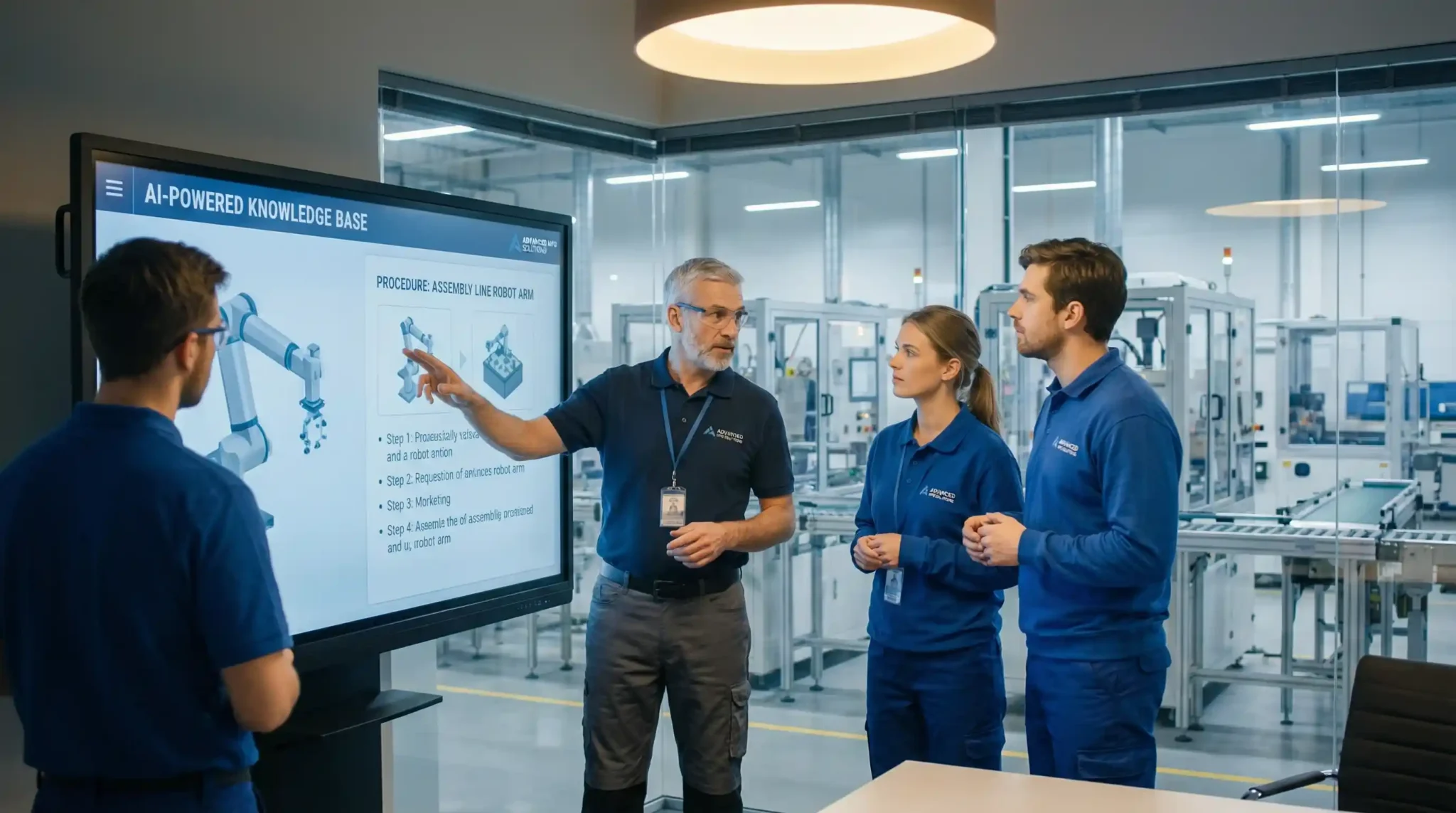
An ai copilot manufacturing knowledge system captures expert knowledge through structured interviews, observation logging, and continuous learning from daily operations. The copilot records how experienced workers handle edge cases, unusual material batches, and equipment quirks. This knowledge becomes searchable, contextual guidance available to every worker on the floor through natural language queries.
Expected Outcome
A $25M industrial equipment manufacturer used an ai copilot manufacturing knowledge platform to capture expertise from 5 retiring master machinists. The system documented 2,400 unique procedures and 850 troubleshooting scenarios. New hire onboarding time decreased from 14 months to 8 months. Quality consistency across shifts improved 25% as all operators gained access to best-practice guidance.
Energy Consumption Intelligence
The problem
Energy costs represent 5 to 15% of total manufacturing costs for mid-size operations. Most manufacturers lack visibility into which equipment, processes, or production sequences consume the most energy relative to output. Peak demand charges can add 20 to 40% to monthly electricity bills. Without granular data, energy reduction efforts rely on guesswork rather than analysis.
AI Solution
The ai copilot manufacturing energy system maps real-time energy consumption to every machine, process step, and production scenario. The copilot identifies which combinations of equipment scheduling, operating parameters, and production sequences minimize energy use per unit of output. It recommends optimal production timing to avoid peak demand periods and suggests equipment settings that reduce consumption without affecting quality.
Expected Outcome
A $50M metal fabrication company deployed an ai copilot manufacturing energy optimization system across 3 facilities. Total energy costs dropped 16% within 6 months. Peak demand charges decreased 25% through optimized scheduling. The copilot identified $110,000 in annual savings from equipment parameter adjustments that had zero impact on product quality or throughput.
Proactive Safety Monitoring and Alerts
The problem
Manufacturing remains one of the most hazardous industries, with 395,300 nonfatal workplace injuries reported annually in the US alone. Mid-size manufacturers often lack dedicated safety analytics teams. Incident investigations happen after injuries occur. Near-miss reporting is inconsistent, and safety data sits in spreadsheets disconnected from operational systems.
AI Solution
An ai copilot manufacturing safety system integrates data from wearable sensors, environmental monitors, equipment status feeds, and historical incident reports. The copilot identifies conditions that correlate with elevated injury risk: unusual vibration patterns near operator stations, temperature anomalies in confined spaces, or fatigue indicators from wearable data. It delivers real-time alerts to supervisors and recommends preventive actions before incidents occur.
Expected Outcome
A $35M building materials manufacturer implemented an ai copilot manufacturing safety system across its production facility. Recordable incidents dropped 38% in the first year. Near-miss reporting increased 300% as the system made reporting effortless. Workers' compensation costs decreased $95,000 annually. The copilot identified 4 previously unrecognized hazard patterns that traditional safety audits had missed.
Procurement and Inventory Intelligence
The problem
Mid-size manufacturers carry 15 to 25% excess safety stock to buffer against supply uncertainty. Procurement decisions rely on historical averages and supplier promises rather than real-time intelligence. When material prices spike or lead times extend, purchasing teams react slowly because they lack visibility into demand patterns, consumption rates, and alternative sourcing options.
AI Solution
The ai copilot manufacturing procurement system analyzes consumption patterns, supplier performance data, market price trends, and production schedules to generate intelligent purchasing recommendations. The copilot alerts buyers when reorder points approach, suggests optimal order quantities based on projected demand, and identifies alternative suppliers when primary sources face disruptions or price increases.
Expected Outcome
A $40M industrial components manufacturer deployed an ai copilot manufacturing procurement system. Safety stock levels decreased 30%, freeing $480,000 in working capital. Stockout incidents dropped 55%. Material cost savings averaged 4.2% through better timing and supplier selection. The copilot reduced procurement team workload by 35%, allowing staff to focus on strategic supplier relationships.
04. Tech Stack
AI Copilot Manufacturing Technology Stack: Build vs. Buy
Mid-size manufacturers face a critical decision for each AI workforce upskilling capability: build custom solutions or buy commercial platforms. The table below maps the options, ideal use cases, and monthly cost ranges for each of the 5 strategy areas. Most SMBs achieve the fastest ROI by buying proven platforms and customizing content to their specific manufacturing processes.
Category
Build Option
Buy Option
Best For
AI/ML Platform
Custom Python ML pipeline
Azure AI, AWS SageMaker, Google Vertex
Core copilot intelligence
LLM/NLP Engine
Open-source LLM fine-tuning
Azure OpenAI, AWS Bedrock, Anthropic
Natural language operator interface
IoT/Sensor Platform
Custom MQTT + edge gateway
Azure IoT Hub, AWS IoT Core, PTC ThingWorx
Real-time machine data ingestion
Knowledge Base
Custom vector database + RAG
Microsoft Copilot Studio, Guru, Notion AI
Searchable institutional knowledge
Integration Middleware
Custom API layer
MuleSoft, Boomi, Workato
Connecting MES/ERP/IoT systems
Operator Interface
Custom tablet/HMI app
Tulip, Poka, Augmentir
Shop floor copilot delivery
Redex Stack Recommendation
For most mid-size manufacturers starting their ai copilot manufacturing journey, we recommend a hybrid approach. Buy the IoT platform and integration middleware to accelerate deployment. Build the AI/ML models and operator interface custom to your specific processes and workflows. This combination typically delivers 30 to 40% lower total cost of ownership compared to pure-buy approaches while maintaining the flexibility to adapt the copilot to your unique operations.
05. Pitfalls
Why Most AI Copilot Manufacturing Initiatives Fail
After assessing dozens of ai copilot manufacturing deployments across manufacturing SMBs, Redex has identified four systemic failure patterns that account for 80% of stalled initiatives.
Tool-First Thinking
Purchasing an ai copilot manufacturing platform before defining which operator decisions need support. The technology gets deployed, but nobody uses it because it does not address real workflow pain points.
Fix
Redex starts every AI copilot manufacturing engagement with operator shadowing and decision mapping. We identify the 5 to 10 highest-impact decisions before evaluating any technology.
Data Disconnection
Deploying an ai copilot manufacturing system that cannot access real-time machine data because sensors, PLCs, and historians are not integrated. The copilot provides generic advice instead of contextual recommendations.
Fix
Our data readiness assessment maps every data source, identifies integration gaps, and builds the connectivity layer before deploying copilot capabilities. Real-time data is non-negotiable.
Ignoring the Human Layer
Building sophisticated ai copilot manufacturing algorithms without investing in operator training and change management. Workers distrust the system, override recommendations, or ignore alerts entirely.
Fix
Redex designs ai copilot manufacturing rollouts with operator champions, hands-on training, and feedback loops. We measure adoption rates alongside technical KPIs to ensure the system delivers value.
Knowledge Silo Persistence
Implementing an ai copilot manufacturing system that generates recommendations but does not capture operator feedback or corrections. The system never improves because it lacks a learning loop.
Fix
Every Redex ai copilot manufacturing deployment includes a structured feedback mechanism. Operator corrections train the model. The system gets smarter with every shift, creating a compounding knowledge asset.
06. KPIs & ROI
AI Copilot Manufacturing KPI and ROI Benchmarks
These benchmarks reflect observed outcomes from ai copilot manufacturing deployments at manufacturers with $15M to $100M in annual revenue.
Metric
Before AI
After AI
Improvement
Operator Decision Time
5-15 min/decision
1-3 min/decision
-65 to 80%
Scrap Rate
8-15%
3-6%
-40 to 55%
Mean Time to Repair
4-8 hours
1.5-3 hours
-45 to 60%
First-Time Fix Rate
55-70%
85-95%
+20-30 pts
New Hire Onboarding
12-18 months
6-9 months
-40 to 50%
Energy Cost per Unit
Baseline
Reduced
-12 to 18%
Safety Incidents
Baseline
Reduced
-30 to 45%
ROI Worked Example
- Scenario: $35M precision manufacturer, 45 production employees, 12 CNC machines, current scrap rate 11%, MTTR 6 hours.
- AI copilot manufacturing investment: $55,000 Year 1 (pilot + optimization), $35,000/year ongoing.
- Year 1 savings: Scrap reduction ($185,000) + maintenance efficiency ($120,000) + scheduling gains ($95,000) + energy savings ($45,000) = $445,000.
- Year 1 ROI: 709%. Payback period: 4.2 months.
07. Industry Applications
AI Copilot Manufacturing by Industry Sector
Different manufacturing sectors benefit from different ai copilot manufacturing applications. This comparison shows the highest-impact starting point for each sector.
Sector
Top Application
Typical ROI
Time to Value
Metal Fabrication
Operator guidance for CNC parameter optimization
250-400%
3-5 months
Automotive Parts
Inline quality prediction for stamping and welding
300-500%
4-6 months
Food and Beverage
Recipe optimization and batch consistency copilot
200-350%
3-4 months
Packaging
Production scheduling and changeover optimization
250-600%
4-7 months
Industrial Equipment
Maintenance diagnostics and knowledge capture
200-400%
5-8 months
Electronics Assembly
Defect detection and process parameter tuning
300-550%
3-5 months
Redex Stack Recommendation
Regardless of sector, the fastest path to ROI with ai copilot manufacturing starts with the same question: which operator decisions cost you the most money when they go wrong? Start there. Build confidence. Then expand. Our Redex Frameworks provide the structured methodology to identify and prioritize these high-impact decisions.
08. Roadmap
AI Copilot Manufacturing Implementation Roadmap
A phased approach to ai copilot manufacturing that delivers measurable ROI at every stage. Designed for manufacturers with $15M to $100M in revenue.
Phase 1: Discovery & Pilot
- Month 1-3
- $15K-$40K
- Operator shadowing and decision mapping across 2 to 3 production lines
- Data readiness assessment: sensor coverage, MES/ERP integration, data quality
- Identify top 3 highest-impact copilot use cases based on ROI potential
- Deploy ai copilot manufacturing pilot on 1 production line or work cell
Target Outcome
Working ai copilot manufacturing prototype for one use case with baseline KPIs established and operator feedback collected
Phase 2: Optimize & Validate
- Month 4-8
- $30K-$80K
- Integrate ai copilot manufacturing with MES and ERP for automated data feeds
- Deploy knowledge capture system to document expert operator procedures
- Expand copilot to 2 to 3 additional use cases based on pilot learnings
- Train operator champions and establish feedback loops for continuous improvement
Target Outcome
Validated ai copilot manufacturing system delivering measurable ROI across multiple use cases with documented operator adoption metrics
Phase 3: Scale & Integrate
- Month 9-14
- $50K-$150K
- Roll out ai copilot manufacturing across all production lines and shifts
- Deploy advanced capabilities: predictive quality, energy optimization, safety monitoring
- Integrate copilot recommendations with automated equipment controls where appropriate
- Build executive dashboard connecting copilot KPIs to business outcomes
Target Outcome
Enterprise-wide ai copilot manufacturing deployment with full operator coverage and clear ROI documentation for leadership
Phase 4: Autonomous Operations
- Month 15-24
- $40K-$120K/year
- Enable autonomous decision-making for routine copilot recommendations
- Deploy cross-functional copilots connecting production, quality, maintenance, and supply chain
- Implement continuous learning pipelines that improve copilot accuracy with every shift
- Establish ai copilot manufacturing center of excellence for ongoing optimization
Target Outcome
Self-improving ai copilot manufacturing ecosystem that compounds operational intelligence over time and delivers sustained competitive advantage
For a broader AI implementation framework that covers organizational readiness beyond BIM, see our AI roadmap for SMBs guide.
Transform Your Operations
Stop Losing Productivity to Information Gaps. Start Deploying AI Copilot Manufacturing.
Your operators make thousands of decisions every week. An ai copilot manufacturing system ensures every decision is informed by data, guided by best practices, and optimized for outcomes. Redex helps mid-size manufacturers deploy copilot systems that deliver measurable ROI within 4 months.
FAQs
What is ai copilot manufacturing and how does it differ from full automation?
AI copilot manufacturing refers to AI systems that augment human operators rather than replace them. Unlike full automation, which removes human involvement from specific tasks, an ai copilot manufacturing system works alongside operators to provide real-time recommendations, contextual guidance, and decision support. The operator retains control and judgment while the copilot handles data analysis, pattern recognition, and knowledge retrieval. This approach is particularly effective for mid-size manufacturers where full automation is cost-prohibitive and human expertise remains essential for handling variability and exceptions.
How much does an ai copilot manufacturing system cost for a mid-size manufacturer?
For manufacturers with $15M to $100M in revenue, a typical ai copilot manufacturing deployment costs $15,000 to $40,000 for the initial pilot phase, $30,000 to $80,000 for optimization and validation, and $50,000 to $150,000 for enterprise-wide scaling. Ongoing costs range from $40,000 to $120,000 per year. Most clients achieve positive ROI within 4 to 8 months of their first ai copilot manufacturing deployment, with Year 1 returns typically ranging from 200% to 500% depending on the use cases selected.
For manufacturers with $15M to $100M in revenue and 50 to 500 employees, a phased AI workforce upskilling program typically costs $80,000 to $205,000 over 18 to 24 months. This includes skills assessment, AI literacy training, immersive simulation tools, knowledge capture systems, and continuous learning platforms. Most manufacturers see positive ROI within 6 to 9 months through reduced training time, lower defect rates, and improved employee retention. Annual ongoing costs range from $20,000 to $50,000 for platform licensing and content updates.
Which manufacturing processes benefit most from ai copilot manufacturing?
The highest-ROI applications for ai copilot manufacturing are maintenance troubleshooting (reducing diagnostic time by 45 to 60%), quality prediction (improving first-pass yield by 5 to 8 percentage points), production scheduling (increasing machine utilization by 10 to 15 percentage points), and knowledge capture (reducing new hire onboarding time by 40 to 50%). Processes with high variability, complex decision-making, and significant cost-of-error deliver the strongest returns from ai copilot manufacturing investment.
Do we need to replace our existing MES and ERP systems to implement ai copilot manufacturing?
No. An ai copilot manufacturing system is designed to integrate with your existing technology stack, not replace it. The copilot connects to your MES, ERP, and sensor systems through APIs and middleware to access real-time data. Most mid-size manufacturers can deploy their first ai copilot manufacturing use case without any changes to core systems. Integration typically requires 2 to 4 weeks of configuration work, not a full system replacement.
How do we get operators to actually use an ai copilot manufacturing system?
Operator adoption is the single biggest determinant of ai copilot manufacturing success. Redex recommends three strategies: first, involve operators in the design process so the copilot addresses their actual pain points. Second, start with use cases where the copilot clearly saves time or reduces frustration, building trust through demonstrated value. Third, designate operator champions on each shift who receive advanced training and serve as peer advocates. Our clients typically achieve 80%+ adoption within 3 months using this approach.