
4
Core Platform Modules
3
GHG Scopes Covered
8
Deliverables
5
Expected Impact Areas
Market Context
Navigating the $20B Carbon Management Shift
The global ESG Platform software market is projected to grow from USD 1.24 billion in 2025 to USD 5.19 billion by 2033, reflecting a CAGR of 20.1%. Meanwhile, the demand for carbon footprint management market alone is expected to reach USD 20.44 billion by 2030. This explosive growth is driven by an unprecedented convergence of regulatory mandates, investor expectations, and supply chain pressure.
In ASEAN, the regulatory landscape is accelerating rapidly. Singapore introduced mandatory climate-related disclosures for listed companies effective January 2025. Thailand, Malaysia, and Indonesia are following with their own ESG reporting mandates aligned with ISSB standards. The EU’s Corporate Sustainability Reporting Directive (CSRD) has extraterritorial reach, affecting ASEAN firms embedded in global supply chains. For sustainability advisory firms, the message is clear: technology-enabled ESG Platform services are no longer optional, they are the baseline for credibility.
$5.19B
ESG Software Market by 2033, CAGR 20.1%
$20.4B
Carbon Mgmt Market by 2030, CAGR 9.3%
6
ASEAN Nations with ESG Mandates, Singapore leading
2025
CSRD Compliance Deadline, Extraterritorial reach
We take our clients’ confidentiality seriously. While we’ve changed their names and certain identifying details, the results are real.
01. Executive Summary
Designing a Scalable ESG Platform
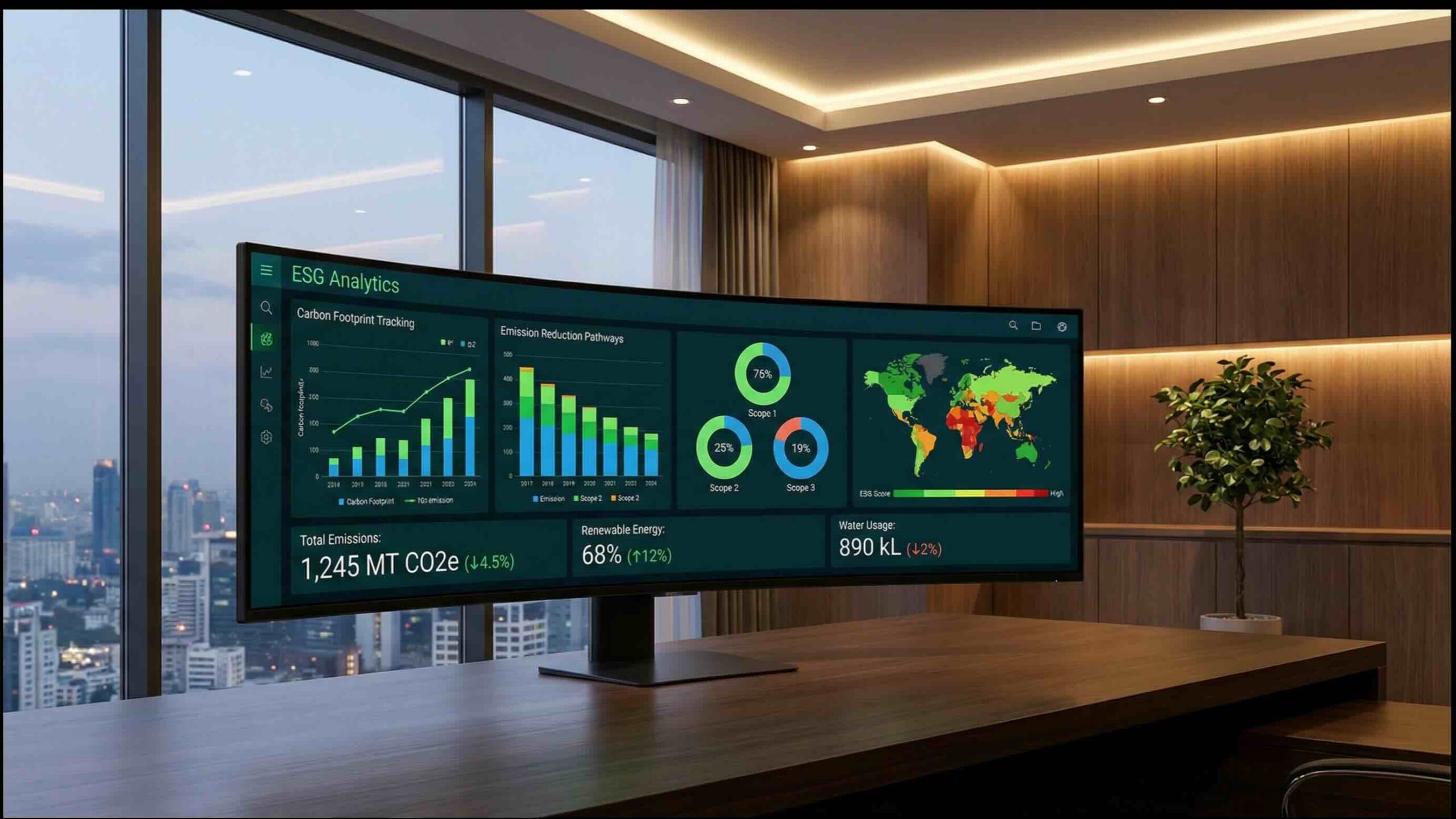
An ESG and climate advisory firm operating across ASEAN engaged our team to design a next-generation ESG Platform and integrated Carbon Footprint Tool. Despite a strong reputation in carbon audits and sustainability transformation, the firm’s operational model relied on manual spreadsheets and long consultancy cycles, which hindered regional scalability.
This reliance on manual data slowed carbon footprint tool reporting, prevented real-time client insights, and weakened their competitive positioning against tech-enabled rivals. To support commercial growth, they required a unified product strategy that bridged the gap between traditional consulting and digital orchestration.
Our team was engaged to design an end-to-end ESG Platform that transforms raw sustainability data into audit-ready insights. By automating the carbon footprint tool, we enabled the firm to deliver scalable, data-driven climate services across multiple industries and geographies, ensuring they remain the baseline for credibility in a rapidly evolving market.
02
The Challenge Landscape
Manual, Excel-Based Operations
Carbon audits and ESG data collection relied entirely on spreadsheets, creating bottlenecks, version control issues, and error-prone calculations across multiple client engagements.
Slow Reporting Cycles
Carbon footprint reports took weeks to compile manually. Clients expected faster turnaround as regulatory deadlines tightened across ASEAN markets.
Limited Regional Scalability
The consulting model could not scale across ASEAN's diverse regulatory environments without a standardized digital platform to normalize data and workflows.
No Real-Time Client Insights
Clients received one-time audit reports with no ongoing visibility into their ESG performance, reducing engagement retention and perceived value.
Regulatory Compliance Gaps
With Singapore mandating climate disclosures from 2025 and EU CSRD reaching ASEAN supply chains, the firm needed a platform aligned with GHG Protocol and ISSB standards.
Competitive Credibility Gap
Tech-enabled competitors like Persefoni, Watershed, and Salesforce Net Zero Cloud were capturing market share with automated platforms, leaving traditional consultancies behind.
03
ESG Carbon Footprint Tool Approach
Our 4-Phase Methodology
We applied our proven Strategy → Architecture → Platform → Performance framework to design a comprehensive ESG product ecosystem.
Layer 1
Strategy: ESG Vision & Product Definition
We defined the product narrative, mapped target audiences across industrial manufacturers, FMCG & retail groups, supply chain partners, and SMEs beginning their sustainability journey. The MVP was prioritized around 4 core functions:
ESG Platform Carbon Footprint Calculator
Scope 1 & 2 baseline, Scope 3 categories (transportation, materials, energy, waste), emission factor library, automated calculations
ESG Data Management
Standardized data templates, corporate ESG score, KPI dashboards with industry benchmarking
Reporting Module
PDF export of ESG reports, year-over-year comparison, industry benchmark views, automated executive summaries
Client Portal
Multi-company management, project tracking, secure data submission, role-based access control
Layer 2
ESG Platform Architecture: Data Model & Carbon Engine
We designed the core architecture ensuring technical soundness, accuracy, and scalability. The carbon footprint engine was built on GHG Protocol guidelines, with emission factor mapping, activity data validation, and automated calculations normalized across industries.
ESG Data Schema
Energy, water, waste, materials, social & governance indicators with validation rules and audit trails
Carbon Engine
Emission factor mapping, automated calculations, data normalization built on GHG Protocol
System Blueprint
Admin console, client portal, carbon engine, reporting services, integration layer (IoT, ERP, CSV)
ESG Scoring Model
Three-layer model: Compliance (policies), Performance (KPIs vs targets), Improvement (YoY change)
Layer 3
Platform: UX/UI Design & Prototype
We created a clean, authoritative design system reflecting trust, clarity, and professionalism which is critical for ESG products. The platform features a neutral color palette inspired by nature, modular card-based components, accessible typography, and mobile-first responsive design.
Carbon Footprint Dashboard
Scope 1/2/3 distribution, KPI trends, industry benchmarking, hotspot detection with interactive visualizations
ESG Scorecard
Governance readiness, operational sustainability, social impact metrics with radar charts and ranking systems
Reporting Interface
PDF report builder, export templates, automated executive summaries with year-over-year comparisons
Multi-Client Management
For consultants managing multiple companies (user roles & permissions, project lifecycle view, secure data submission)
Layer 4
Performance: KPIs & Operational Model
We created a clean, authoritative design system reflecting trust, clarity, and professionalism which is critical for ESG products. The platform features a neutral color palette inspired by nature, modular card-based components, accessible typography, and mobile-first responsive design.
04
ASEAN Regulatory Landscape for ESG Platform
The platform was designed to address the rapidly evolving ESG regulatory environment across Southeast Asia, ensuring compliance readiness from day one.
Country
Regulation / Framework
Status
Key Requirement
Singapore
SGX Climate Disclosure
Mandatory (2025)
Climate-related disclosures for listed companies, aligned with ISSB
Thailand
SEC Sustainability Reports
Mandatory (2025)
Sustainability reports aligned with ISSB standards for listed firmsEngagement ↑ dramatically
Malaysia
Bursa Malaysia ESG
Mandatory (2025)
Enhanced sustainability reporting with climate-related metrics
Indonesia
OJK ESG Reporting
Mandatory (2024)
ESG reporting for financial institutions and listed companies
ASEAN-wide
ASEDG for SMEs
Launched (2025)
Simplified ESG disclosure guide for SMEs in global supply chains
Vietnam
MOF Sustainability
Voluntary (2025)
Sustainability disclosure guidelines for large enterprises
EU (Extraterritorial)
CSRD / ESRS
Phased (2024–2028)
Non-EU companies with significant EU operations must comply
05
ESG Platform Outcomes
Key Deliverables
Product Vision & Narrative
Compelling positioning as a unified ESG platform for ASEAN markets
ESG Platform MVP Scope
Four core modules prioritized for market entry and client adoption
Carbon Footprint Data Architecture
GHG Protocol-aligned data model with Scope 1/2/3 coverage
ESG Scoring Framework
Three-layer model: Compliance, Performance, Improvement
ESG Scoring Framework
Clickable prototypes ready for technical development
Dashboard & Reporting Designs
Carbon footprint dashboard, ESG scorecard, and report builder
Dashboard & Reporting Designs
Governance & Operational Workflows
Development Roadmap
Prioritized backlog with AI insights and predictive modeling phases
Benefits of an ESG Platform
01
Faster Carbon Footprint Reporting
Weeks → Hours
What used to take weeks manually can now be completed in hours with automated calculations and standardized data templates.
02
Improved Data Accuracy
90%+ Reduction
Standardized templates and embedded validation rules dramatically reduce human error in ESG data collection and carbon calculations.
03
Scalable ESG Services
3× Client Capacity
The firm can support significantly more clients without increasing headcount, transforming the unit economics of sustainability consulting.
04
Regulatory Compliance Ready
6+ Frameworks
Platform aligned with GHG Protocol, ISSB, CSRD, and ASEAN-specific mandates — ensuring clients meet evolving disclosure requirements.
04
Stronger Market Positioning
Tech-Enabled
A technology-enabled ESG platform increases credibility and competitiveness against global players like Persefoni and Watershed.
04
Better Client Experience
Real-Time Access
Clients gain ongoing visibility into their ESG performance — not just one-time audit reports — increasing retention and engagement.
06
Insights & Lessons Learned
The platform was designed to fill a critical gap in the market: most ESG software solutions are built for Western markets with limited ASEAN-specific features.
01
ESG Is Becoming a Product, Not Just a Service
The shift from consulting-only to platform-enabled sustainability services is inevitable. Firms that build technology early will capture disproportionate market share as regulatory mandates accelerate across ASEAN.
02
ASEAN Needs Localized Solutions
Global ESG platforms are designed for EU/US markets. ASEAN’s diverse regulatory landscape from Singapore’s mandatory disclosures to Vietnam’s voluntary guidelines requires purpose-built, multi-jurisdiction platforms.
03
Carbon Accuracy Requires Architectural Discipline
A carbon footprint tool is only as credible as its data architecture. Emission factor libraries, validation rules, and audit trails must be designed from the ground up, not bolted on after launch.
04
The Consultant-to-Platform Transition Is Strategic
Moving from manual advisory to a digital platform changes the business model fundamentally. It requires product thinking and technology from pricing strategy to client onboarding to data governance.
07. RedEx Perspective
Action That Translates Strategy
This project demonstrates that the future of sustainability consulting lies at the intersection of domain expertise and digital product design. The firms that will lead the ASEAN ESG market are those that invest in technology infrastructure today, not just to serve current regulatory requirements, but to anticipate the next wave of climate disclosure mandates.
This is the first step toward an integrated ESG Platform performance ecosystem built on clarity, credibility, and data-driven impact.
Engagement Team
Lead Consultant
ESG Strategy & Product Vision
Data Architect
Carbon Engine & ESG Data Model
UX/UI Designer
Platform Design & Prototyping
Sustainability SME
GHG Protocol & Regulatory Alignment
Business Analyst
Market Research & Competitive Analysis
About the Client
An ASEAN Sustainability Advisory Firm
The client organization is a sustainability and climate advisory firm operating across Southeast Asia, delivering carbon audits, ESG advisory, and sustainability transformation programs to enterprises across multiple industries. With deep expertise in GHG Protocol, ISSB standards, and ASEAN-specific regulatory frameworks, the firm serves industrial manufacturers, FMCG groups, and supply chain partners navigating the transition to sustainable operations.
The organization’s vision extends beyond traditional consulting aiming to become a technology-enabled sustainability partner that delivers scalable, data-driven ESG insights to clients across the region.