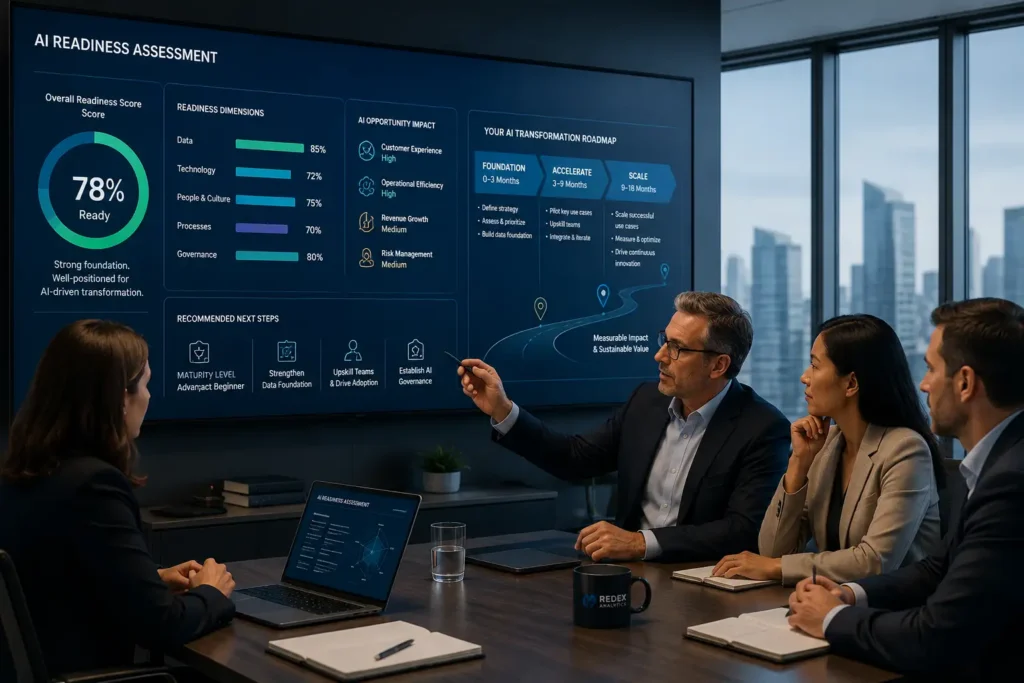
Achieving a consistent Enterprise AI ROI has become the primary challenge for boardrooms in 2025. Enterprises today are investing aggressively in artificial intelligence. Across industries, the average organization now allocates $6,000 per employee per year to AI software, infrastructure, and integration.
Enterprise AI has transitioned from experimental technology to a board-level imperative in 2025. Yet, a critical disconnect remains: organizations are pouring an average of $26.7 million annually into AI initiatives, but only 10% report significant ROI from agentic systems. This gap defines the “AI Fascination Paradox”, a state where investment velocity far outpaces realized returns. Our research, synthesizing data from MIT Sloan, Deloitte, and McKinsey, reveals that the primary driver of failure is not technology, but the lack of an integrated ecosystem.
“The GenAI Divide”
MIT researchers have identified a stark divide: 95% of isolated GenAI pilots deliver zero measurable value, while integrated ecosystems deliver 45% faster ROI.
Yet despite the urgency, only 10% of companies report meaningful ROI from agentic and generative AI programs. Pilots multiply. Budgets rise. Expectations escalate. But measurable impact remains elusive.
Bridging the GenAI Divide to Secure Enterprise AI ROI
“Enterprises assume they are buying AI tools. In reality, they must build AI systems. Only the organizations willing to make that shift ever cross the ROI threshold.”
The Executive summary
THE PROBLEM
Why Most Pilots Fail?
Across construction, manufacturing, and energy, a staggering 80% of AI projects fail to reach ROI. Not because the AI lacks power, but because the system around it does. Budgets burn in pilots that never scale. Data remains fragmented in silos. Teams move on to the next “shiny object” before results arrive. This phenomenon, known as “Pilot Purgatory,” is the defining challenge of the GenAI era.
And yet, every business leader still asks the same question: How do we make AI real fast?
Frictionless Demos
Pilots that glide from demo to deployment without addressing real-world data messiness collapse when they hit scale.
Lack of Governance
Without a managed service layer, AI models drift, hallucinations go unchecked, and trust evaporates.
The "Novelty" Trap
Most teams chase what's new, not what works. A model delivers answers; a system delivers outcomes.
Disconnected Strategy
Strategy and engineering often sit in different buildings. RedEx unites them in one rhythm.

3 reasons why enterprises overspent but underdeliver
1. They confuse "using AI" with "integrating AI"
A $25 ChatGPT subscription gives a single user flexibility. A $6,000 enterprise AI program gives an entire organization integration, trust, and scale.
- Secure data access
- Integration into CRM/ERP/operations
- Workflow redesign
- Governance & compliance
2. 95% of AI Pilots Fail Because Data Isn't Ready
64% of enterprises cite poor data quality as the #1 barrier to ROI. AI cannot reason, forecast, or automate with inconsistent or siloed data.
Insight: "AI failures" are actually "data failures." Companies often accelerate AI projects before fixing the foundation.
3. Adding AI to Broken Processes
According to McKinsey, the only organizations achieving >5% EBIT impact are those that redesign workflows end-to-end, rather than just adding AI as a "tool" to existing inefficiencies.
The Silent 70% Cost: Integration
For every $1 spent on models, enterprises spend $7-$12 on integration. This is the difference between one-time automation and enterprise-wide impact.
The Visible Cost
Model licenses, GPU compute, User seats.
The Hidden Integration Layer
• APIs & Middleware • Security & Privacy Audits • Identity & Permissions • Change Management • Monitoring & Orchestration
validation
The ROI Reality Check
Current Status (2025)
of enterprises report positive ROI from AI initiatives, while 33% break even and 14% face losses.
The High-Performer Gap
Top-quartile performers achieve more than double the ROI of average performers (7%) through workflow redesign.
The “Pilot Purgatory” Problem
The paradox emerges from a fundamental misalignment: enterprises deploy AI as tools (like ChatGPT) rather than as ecosystems. Consumer AI tools excel at individual tasks but fail in enterprise contexts because they lack:
- Governance for data security
- Ability to learn from specific workflows
- Persistence of organizational context
- Deep integration with ERP/CRM systems
THE INSIGHT
“You don’t need more tools. You need measurable orchestration: systems that adapt as your business evolves.”
ROI Comes From Ecosystems, Not Tools
When enterprises shift from tool adoption to ecosystem design, the economics change. The ROI compounds because each new AI use case becomes cheaper, faster, and more powerful when built on shared infrastructure.
Faster Time-to-ROI
Efficiency Gains
Cost Reduction
Infrastructure is the New Alpha
Organizations that treat AI as an ecosystem (investing in data pipelines, governance, and orchestration) outperform their peers significantly. It’s not about having the best model, it’s about having the best connected system.
Data Layer
Unified lakes and warehouses that provide the "fuel" for accurate decision making.
Integration
Secure APIs connecting AI to ERP, CRM, and DMS systems for actionability.
Orchestration
Agentic workflows that coordinate complex, multi-step business processes.
the convictions
The 4-Pillar Value Model
Sustainable ROI isn’t just about cost cutting. Our research identifies four distinct sources of value that mature AI ecosystems unlock simultaneously.
Cost Reduction & Efficiency
40% of ROI
Labor savings (30-60%) and error reduction (75%) through agentic automation of repetitive workflows.
✓ 90% customer service cost reduction ✓ 41% reduction in unplanned downtime
Revenue Uplift & Growth
35% of ROI
Sales productivity boosts and conversion improvements through hyper-personalized customer experiences.
✓ 30% sales productivity increase ✓ 16.3% incremental sales lift in retail
Risk Mitigation
15% of ROI
Enhanced compliance monitoring, fraud detection, and operational resilience against supply chain shocks.
✓ 35% workflow efficiency gains ✓ Real-time compliance auditing
Strategic Value
10% of ROI
Data asset creation and competitive differentiation that drives long-term market capitalization.
✓ 3x market cap potential ✓ Institutional knowledge capture
Orchestrating human expertise and Inteligent systems to deliver Performance.
From fragmented tools to a coherent system that learns and adapts with your organization.
Human
Designing systems around people.
Intelligent
Solutions that think and learn in the context.
Measuarable
If it's not measurable, it's not transformation.
THE APPROACH
the orchestration layer that connects your data, teams, and tools
The AI system integrator that connects the dots between strategy, platform delivery, and agentic AI orchestration in your organization. We makes every lead count, every process smarter, and every system easier to run.
Human-in-the-loop
Dashboard | Approvals | Training
Agentic OS
Orchestrator | Workflows | Analytics
Data
ERP | CRM | IoT Sensors
We focus on the industrial core where AI orchestration drives the highest operational ROI.
- Construction: AI takeoff, Proposal automation, Delivery orchestration
- Manufacturing: Predictive maintenance, Capacity planning, Quality control
- Energy: Asset performance, ESG & compliance, Field operations
- Mid-market companies: Pilot-first, modular adoption model.
our solution
The RedEx BUILT Framework
Our methodology is rooted in the BUILT Framework: a five-phase architecture that makes AI measurable, adoptable, and scalable. This is not a trial. It’s the first iteration of your operating system.
01 BENCHMARK
Assess & Baseline
We assess process, data, and performance baselines to create a measurable starting point.
02 UNCOVER
Identify Value Levers
We identify pain points and ready-to-solve use cases, focusing investment on impact, not experimentation.
03 IMPLEMENT
Deploy Agile Sprints
We deploy 1-2 use cases in agile sprints, integrating with ERP, CRM, or IoT data to prove ROI within 60 days.
04 LEARN
Measure & Refine
We measure adoption, collect user feedback, and refine models, turning pilots into learning systems.
05 TRANSFORM
Scale with Governance
We scale to adjacent workflows under a governed, managed service, institutionalizing continuous improvement.
proven methodology
Powered by the Hybrid Delivery Engine
RedEx Hybrid Model closes the gap left by giant consultancies and tech vendors.
1. AI Strategy
6-to-8-week workshops align leadership, process, and KPIs before touching technology.
2. Agentic Platform
The orchestration layer that connects data (ERP to sensors) and deploys specialized AI agents.
3. Managed Services
Continuous optimization and role-based training ensure 85%+ user adoption.
Proof: 60% of Pilots Scale
RedEx engineers build the integrated data and agentic infrastructure that delivers 31% ROI. By combining strategy, platform, and human rhythm, we prove that AI can perform.
ADOPTION RATE
TIME TO ROI
PRODUCTIVITY
Real-World Impact
- Construction: Reduced bid turnaround from 30 days to 5 days.
- Manufacturing: Cut defect rates by 30% and saved $200K in 6 months.
- Energy: Predictive operations lowered maintenance costs by 20-30%.
Crossing the GenAI Divide
Enterprises don’t fail because the model is weak. They fail because the system around the model does not exist. We help enterprises build the ecosystem (data, workflows, and governance) that makes AI valuable.
- The RedEx Point of View
- Buying tools without strategy
- Skipping data readiness
- Ignoring workflow redesign
- Why 90% Fail
- Building an AI ecosystem
- Investing in data foundations
- Redesigning core processes
- How 10% Succeed
- REFERENCES
- Deloitte. (2025). The AI ROI Performance Index: European and Middle Eastern Market Analysis. Survey of 1,854 executives.
- IBM Institute for Business Value. (2024). Beyond the Hype: Enterprise AI Readiness Report. Analysis of 2,413 IT decision-makers.
- Gartner (2026). “Avoiding the Pilot Trap: Governance in the Age of Agentic AI.”
- Gartner. (2024). Hyperautomation and the Future of Work. Strategic technology trends report.
- McKinsey & Company (2025). “The State of AI in 2025: Scaling from Pilot to P&L.”
- MIT Sloan Management Review (2025). “The GenAI Divide: Why 95% of Pilots Fail.”