
Retail & ecommerce operations
Turn product data into catalogue that gets ready to sell.
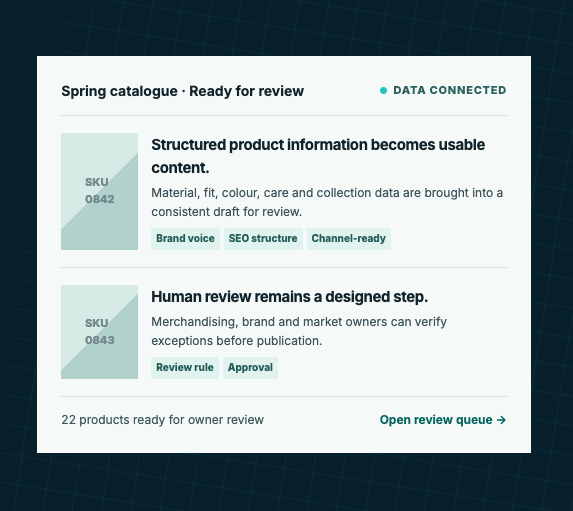
Turn approved product information into titles, descriptions and channel-specific content. Give your team a clear path from source data to review and publication, with responsibility for accuracy and brand approval built into the workflow.
Reliable product inputs
Ground content in approved attributes, specifications and category rules.
Accountable brand review
Give product and brand owners clear responsibility for checking and approving content.
Content prepared for each channel
Adapt approved information to the formats your selected storefronts and marketplaces require.
Reduce repetitive drafting
Prepare content across product ranges using consistent inputs and editorial rules.
Reduce avoidable corrections
Check product claims and brand requirements before content reaches publication.
Simplify publishing handoffs
Prepare approved content for its destination without repeatedly copying and reformatting it.
Make launch blockers visible
Identify products waiting on missing information, review or publishing follow-up.
The Reality
Products are ready. Content is holding them back.
A new range can be ready for sale while its listings are still waiting on specifications, descriptions or brand approval. As the catalogue grows, repeated drafting and disconnected handoffs consume more time and make launch dates harder to manage.
The opportunity is to shorten the path from available product information to approved, publishable content, while keeping accuracy and editorial control visible.
The Challenge
Where catalogue content gets stuck
01 / Data
Incomplete inputs
Teams chase supplier specifications, product attributes and approved claims before they can finish a listing.
02 / Content
Repeated production work
Similar products still require separate drafts, corrections and formatting, adding effort with every new SKU.
03 / Publishing
Disconnected publishing
Approved content is copied and checked again as it moves between product systems, storefronts and marketplaces.
Product content generator
From product facts to approved listings
Product content generator connects the information, rules and decisions needed to prepare listings at scale. AI supports repetitive content production; your team retains responsibility for product facts, brand standards and release.
THE WORKFLOW WE CONNECT
From product inputs to a governed content launch flow.
01 / Use approved product information
Bring the relevant attributes and category rules into the workflow. Flag missing or conflicting facts for an owner to resolve.
02 / Prepare consistent drafts
Generate titles, descriptions and selected metadata using agreed product inputs and editorial guidance.
03 / Review and approve
Route content to the appropriate reviewers, with clear checks for product accuracy, brand voice and channel requirements.
04 / Prepare content for publication
Format approved content for agreed destinations and make publishing exceptions visible for follow-up.
Where it creates value
Support new launches, catalogue updates & channel expansion
The strongest fit is a business with recurring product launches, large volumes of similar content and clear owners for product facts and brand approval.
01 /
Get new ranges ready sooner
Prepare drafts across a collection or category and see which products are waiting on information or approval.
Business priority: shorter time from available product data to approved listings
02 /
Refresh existing listings with less rewriting
Update affected content when specifications, product information or editorial guidance change.
Business priority: less manual rewriting and fewer inconsistent listings
03 /
Reuse approved content across channels
Adapt product information to agreed channel and language requirements, with market review where needed.
Business priority: fewer repeated handoffs when expanding distribution
Built around your existing technology
Connect your product data, content approvals and sales channels
Your PIM, spreadsheets and ecommerce platform may already hold much of the information required. RedEx shapes the solution around those sources, your approval responsibilities and the destinations your content needs to reach.
Product information and ownership
Establish which sources govern each product attribute and who resolves missing or conflicting information.
Content and publishing connections
Connect the selected inputs, review steps and publishing destinations according to the access and capabilities of your existing systems.
Review & operational control
Make approval status, exceptions and publishing follow-up visible so the team knows what is ready and what still needs attention.
Our Approach
Start with the catalogue bottleneck that matters most
Choose a product category, recurring update or upcoming launch where content delays have a clear business consequence.
Define the content requirements and compare preparation time, review effort and correction rates against the current workflow.
Use that evidence to decide where the solution should expand.
01 /
Content Operations Diagnostic
Map product data, source systems, review paths, publishing channels and the catalogue bottleneck worth solving first.
Typical output:
content-flow map and a bounded pilot charter
02 /
Catalogue Launch Pilot
Build the smallest governed flow for one category or market: data input, drafting, human review and channel-ready output.
Typical output:
a working content workflow with evidence against agreed measures
03 /
Scale Across Products & Markets
Extend the pattern with PIM/DXP integration, language and category rules, operating roles and ongoing optimisation.
Typical output:
a repeatable product-content capabilitya repeatable product-content capability
Client engagement
AI Product-description Generator
Explore how RedEx approached high-volume product-description generation for a fashion retailer, using product information and brand guidance to support catalogue content production.
The engagement provides a relevant example of description automation. Your solution scope will depend on the content types, approval requirements and publishing connections your business needs.

- PREMIUM Case Study
What is holding up your next catalogue launch?
- Are descriptions or missing product facts delaying publication?
- Does your team repeatedly rewrite or reformat similar content?
- Are approval responsibilities and release requirements clear?
- Which measure matters most: preparation time, review effort or time to publication?
Bring one category or upcoming launch where content is delaying progress. We can examine the missing inputs, repeated work and approval steps and identify where a connected workflow could make the greatest difference.
FAQs
Frequently Asked Questions
What content can the solution cover?
The starting scope can include product titles, descriptions and selected metadata generated from approved product information. Category, language and channel requirements determine which outputs belong in your workflow.
Is this a software subscription?
This is a solution built for your business. RedEx defines the workflow around your catalogue, brand rules, approval responsibilities and selected systems. Any third-party software, licensing and ongoing support requirements are clarified within the agreed scope.
Do we need to replace our PIM or ecommerce platform?
The starting point is your current environment. The solution can be scoped around existing systems where their access and publishing options support the required workflow.
What happens when product information is missing?
Missing or conflicting facts are flagged for resolution. Product claims need a reliable source; a fluent AI-generated description does not establish that a specification is true.
How do we measure business value?
Start with the time and effort required to move product information into approved, published content. Useful measures include preparation time per SKU, review effort, correction rates and time to publication. Track these against a baseline for comparable products and channels.