SOP & Training Management
Keep SOP Updates, Approvals and Training Connected
A revised SOP is only useful when the people affected can find it and understand what to do differently. RedEx connects document control, approval workflows and role-based training around your existing operations, helping owners manage changes and managers follow up on outstanding actions.
Approved sources
Build updates and learning materials from the procedures your organisation has approved.
Accountable review
Route proposed changes to responsible owners before release.
Traceable follow-up
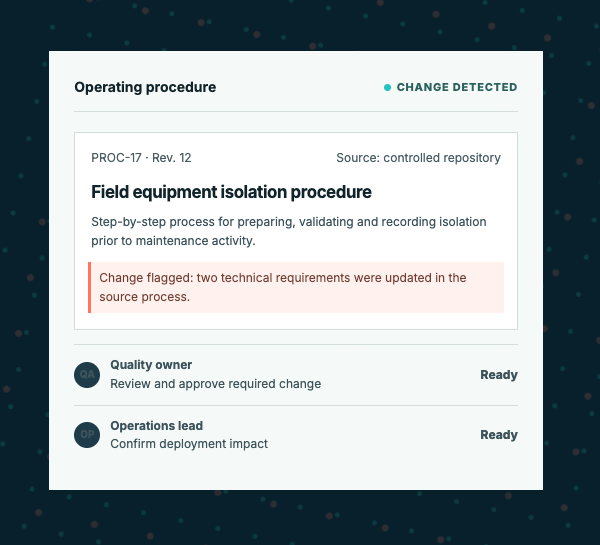
Keep version history, approvals and related training records connected.
Clear version ownership
Help teams identify the applicable procedure, current version and responsible owner.
Less manual coordination
Reduce repeated handoffs between document owners, reviewers and training teams.
Visible outstanding actions
See who still needs to acknowledge an update or complete assigned training.
Connected records
Retrieve the procedure version, approval history and related learning records together.
The Reality
The Process changed. Has Everyone caught up?
An SOP is revised, but a local copy stays in use. Training still explains the previous method. Managers have no clear view of who has received the update. Each gap makes consistent execution harder across teams, shifts and sites.
RedEx helps connect these steps: identify what changed, obtain approval, update the affected learning materials and follow up with the people who need to act.
The Challenge
Keep procedures, people and training in step.
01 / Source
Teams use different versions
Local copies and informal workarounds make it difficult to know which procedure applies across shifts and sites.
02 / Change
Updates depend on manual follow-up
Owners chase revisions across documents, training materials and email lists, increasing the chance that something is missed.
03 / Adoption
Managers cannot see who needs support
Separate approval and training records make it harder to identify who needs an update, additional learning or support.
SOP management solution
Connect Every SOP Change to the People Who Need It
THE WORKFLOW WE CONNECT
From Proposed Revision to Training Follow-Up
01 / Find the applicable SOP
Make the approved version, responsible owner and relevant site or role clear where teams access their procedures.
02 / Review the impact before release
Identify affected procedures and learning materials, then route proposed changes to authorised reviewers.
03 / Update and assign the required learning
Prepare guidance, acknowledgement tasks and assessments from the approved revision, with review before distribution.
04 / Track outstanding actions
Bring approval history and learning status together so managers can follow up and retrieve supporting records.
Where it creates value
where an outdated SOP has a real cost.
The strongest fit is a business where procedures change regularly, several teams depend on them and missed updates create rework, delays or quality risk.
01 /
Keep sites and shifts aligned
Connect shared procedures with approved local requirements so teams can find the guidance that applies to their work.
Business priority: consistent execution across locations
02 /
Prepare people for process changes
Link revised working methods to the roles that need new learning, with visibility of outstanding tasks before people take on changed responsibilities.
Business priority: fewer missed updates and less manual chasing
03 /
Make review evidence easier to retrieve
Bring together the applicable version, approval history and related training records when leaders need to review a change or investigate an issue.
Business priority: faster evidence retrieval and clearer accountability
Built around your existing technology
Connect Your Document and Learning Systems
Your existing document repositories and learning platforms may already provide much of what you need. RedEx assesses how they handle versions, permissions, approvals and training, then designs the integrations or additional capabilities needed to connect the workflow.
Process and ownership clarity
Define who owns each SOP, who approves changes, which roles are affected and what records need to be retained.
Engineering around your systems
Connect document repositories, approval workflows and learning platforms so approved updates can move between them with appropriate access controls.
Adoption & ongoing improvement
Build review responsibilities, exception handling and manager follow-up into daily work, then improve the workflow using feedback and agreed measures.
Our Approach
Start With One Process Where Missed Updates Matter
Choose a procedure or small group of related SOPs with clear ownership and a recurring update problem. Establish a baseline, test the workflow from revision through training follow-up, and use the findings to decide what to extend.
01 /
SOP & Training Assessment
Map current repositories, approval steps, affected roles and training requirements. Identify where updates stall or records become disconnected.
Typical output:
Workflow map, priority gaps and an agreed pilot scope.
02 /
Connected Workflow Pilot
Configure and test a bounded workflow covering revision, human approval, learning updates and follow-up with one defined team or site.
Typical output:
Working pilot, connected records and an evaluation against agreed measures.
03 /
Operational Rollout
Extend the validated workflow to additional procedures, teams and systems, with clear ownership, support and ongoing review.
Typical output:
Rollout plan, integrated workflows and an operating guide for process owners and managers.
Client engagement
Connecting Documentation & Workforce Learning
RedEx’s AI Documentation Generator & E-Learning engagement describes a phased approach for an energy-sector organisation: documentation change detection and human validation first, followed by an e-learning phase covering content generation, distribution and tracking.

- PREMIUM Case Study
Is this solution right for your Team?
- Several teams or sites rely on procedures that change regularly.
- Document revisions and training updates are managed separately.
- Owners spend time chasing approvals and acknowledgements.
- Managers need clearer visibility of outstanding learning and supporting records.
Bring one SOP change that was difficult to communicate or put into practice. We’ll help map where the handoffs break down and define a practical starting point for connecting document control and workforce training.
FAQs
Frequently Asked Questions
What does SOP management cover?
SOP management covers how standard operating procedures are created, reviewed, approved, versioned and made available to the people who use them. This solution also connects approved changes to relevant workforce learning and follow-up records.
Is this a ready-made software subscription?
RedEx provides a scoped design and implementation engagement. Depending on your requirements, this may involve configuring existing tools, integrating systems or developing additional capabilities. The assessment defines what is needed and how it will be supported.
Can it work with our existing document and learning systems?
We assess your systems’ integration options, permissions, version controls and training records before defining the approach. The aim is to retain useful capabilities and address the gaps between them.
Where does AI fit into the workflow?
Where suitable, AI can help identify document changes and draft revisions or learning materials. Designated owners review and approve content before release. The scope depends on your source quality, access requirements and review process.
Does training completion demonstrate competence?
Completion shows that an assigned activity was finished. It does not, by itself, show that someone can perform the work correctly. Where required, the workflow can include assessments, supervisor sign-off or practical checks defined by your organisation.
How would we measure business value?
Agree a baseline and pilot measures before implementation. These may include time from approval to training availability, administrative effort per update, overdue learning tasks and time spent retrieving records. Where reliable operational data exists, the evaluation can also examine rework or deviations associated with missed updates.