
01. The Imperative
Why AI Content Automation Is No Longer Optional for SMBs
AI content automation has become the dividing line between SMBs that scale their marketing and those that stall. The math is straightforward. A mid-size manufacturer or construction firm with 50 to 500 employees typically has 1 to 3 people responsible for all marketing content. Those people handle social media, blog posts, email campaigns, ad copy, and sales collateral. The result is predictable: inconsistent publishing, missed SEO opportunities, and content that never reaches its full distribution potential.
According to McKinsey, companies that adopt AI-powered marketing workflows see 20 to 40% improvements in marketing efficiency and 10 to 20% increases in revenue attribution from content channels. For SMBs operating with lean teams, these numbers translate directly to competitive advantage. The question is no longer whether to automate, but how to build systems that deliver results without adding complexity.
The critical insight, based on our work with dozens of SMB clients, is this: your bottleneck is execution consistency, not strategy. Most SMBs already know what content they need. They have keyword lists, content calendars, and editorial guidelines. What they lack is the operational capacity to execute at the velocity required to build topical authority and generate inbound leads. Systematic automation solves this by turning manual processes into repeatable, scalable systems.
40%
Cost Reduction
4x
Content Velocity
14 Days
Time to First ROI
SEO Compliance
"Companies that systematically deploy AI across their marketing functions see 20 to 40% efficiency gains and measurably higher content ROI compared to those using AI tools in isolation."
McKinsey, The State of AI in Marketing, 2024
RedEx Point of View
At Redex, we have built and deployed these exact systems for our own marketing operations and for our clients. The 7 automation systems in this article are production workflows running today. We share them because we believe the real value is not in the automation itself, but in the strategic architecture that connects these systems into a coherent content operating model. That is where Redex Agentic AI services create lasting competitive advantage.
02. Assessment Framework
The Redex Content Automation Maturity Model
Before investing in any automated content tools, you need an honest assessment of where your organization stands today. The Redex Content Automation Maturity Model provides a structured framework for evaluating your current capabilities across four levels. Each level builds on the previous one, and skipping levels creates technical debt that compounds over time.
Level 1
Manual
All content created, edited, and distributed by hand. No AI tools in the workflow. Marketing team spends 80% of time on production, 20% on strategy.
- Manual copywriting for every piece
- Spreadsheet-based content calendar
- No SEO compliance checking
- Individual platform posting
Level 2
Assisted
AI tools used ad-hoc for drafting and ideation. ChatGPT or similar tools help with first drafts, but no systematic workflows or quality controls exist.
- AI-assisted first drafts
- Basic scheduling tools
- Manual SEO review
- No automated distribution
Level 3
Systematic
Automated workflows handle creation, QA, and distribution. AI content automation systems enforce brand voice, SEO compliance, and multi-channel publishing with minimal human intervention.
- Automated content pipelines
- AI-powered SEO QA
- Multi-channel auto-distribution
- Structured lead capture
Level 4
AutonomouS
Self-optimizing content engine with closed-loop analytics. AI content automation drives strategy decisions based on performance data. Content velocity scales without proportional headcount growth.
- Performance-driven content planning
- Predictive content scoring
- Autonomous A/B testing
- Closed-loop ROI attribution
Where Most SMBs Stand
Across 20+ SMB, 60% operate at Level 1 (Manual), 25% at Level 2 (Assisted), 12% at Level 3 (Systematic), and only 3% at Level 4 (Autonomous). The good news: moving from Level 1 to Level 2 typically delivers the highest percentage ROI because it eliminates the most wasteful manual processes. Moving from Level 2 to Level 3 is where automated content systems create compounding returns.
03. Strategic Playbook
5 High-Impact Applications of AI Content Automation
Each use case follows a consistent structure: the business problem it solves, the automation architecture, and the measurable outcomes you can expect. These are implementation blueprints drawn from real SMB engagements where automated content workflows delivered quantifiable results.
AI for Social Media Content
The problem
SMBs spend 15 to 20 hours per week creating social media content manually. Posts lack consistency, miss optimal timing, and fail to maintain brand voice across platforms. Marketing teams are stretched thin between content creation and strategic planning.
AI Solution
Deploy an automated content system for social media that generates platform-specific posts from a single content brief. The system adapts tone, format, and hashtags for each platform (LinkedIn, Instagram, X, Facebook) while maintaining brand guidelines. Scheduling and A/B testing run automatically.
Automation Stack
Content Brief > AI Generation (GPT-4/Claude) > Brand Voice Filter > Platform Formatter > Scheduler > Analytics
- 75% Less creation time
- 3x Post frequency
- 45% Higher engagement
AI for SEO Content Creation
The problem
Creating SEO-optimized articles requires keyword research, competitor analysis, content drafting, and compliance checking. Most SMBs publish 2 to 4 articles per month when they need 8 to 12 to build topical authority. Quality suffers when speed increases.
AI Solution
Build an automated content pipeline that handles keyword clustering, outline generation, draft creation, and SEO compliance checking in a single workflow. The system enforces keyword density, heading structure, internal linking, and meta tag optimization automatically. Human editors focus on strategic review rather than creation from scratch.
Automation Stack
Keyword Research > AI Outline > Draft Generation > SEO QA Check > Internal Link Suggestion > Publishing
- 4x Content velocity
- 85% SEO compliance rate
- 60% Lower cost per article
AI Content Repurposing Strategy
The problem
SMBs create valuable content that lives in a single format. A blog post stays a blog post. A webinar recording sits on YouTube. The same insight could reach 5x more people across different channels, but manual repurposing takes too long.
AI Solution
Implement an automated repurposing system that transforms one piece of content into multiple formats automatically. A single long-form article becomes a LinkedIn carousel, an email newsletter, a podcast script, social media threads, and an infographic outline. Each output is optimized for its target channel.
Automation Stack
Source Content > AI Parser > Format Templates > Channel Optimizer > Brand Filter > Distribution Queue
- 5x Content reach
- 80% Less repurposing time
- 35% More leads per asset
AI for Ad Copy Optimization
The problem
Running effective ad campaigns requires dozens of copy variations for A/B testing. SMBs typically test 2 to 3 versions when they need 10 to 15. Poor ad copy wastes budget and drives up customer acquisition costs.
AI Solution
Use automated copy generation to create and test multiple ad copy variations simultaneously. The system creates headlines, descriptions, and CTAs optimized for different audience segments, platforms, and campaign objectives. Performance data feeds back into the generation model to improve future outputs.
Automation Stack
Campaign Brief > AI Copy Generator > Audience Segmenter > Platform Formatter > A/B Test Engine > Performance Loop
- 40% Lower CPA
- 12x More variations tested
- 25% Higher CTR
AI for Video Script Generation
The problem
Video content drives 80% more engagement than text, but script writing is the biggest bottleneck. SMBs either skip video entirely or produce unscripted content that fails to convert. Professional scriptwriters cost $500 to $2,000 per video.
AI Solution
Deploy an automated script generation system that creates structured scripts from topic briefs. The system generates hooks, talking points, transitions, and CTAs optimized for different video lengths (30s, 60s, 3min, 10min). Scripts include B-roll suggestions and on-screen text recommendations.
Automation Stack
Topic Brief > AI Script Generator > Hook Optimizer > Structure Formatter > B-Roll Suggestions > Teleprompter Export
- 90% Faster script creation
- 3x Video output
- 50% Lower production cost
04. Proven Systems
7 Production-Ready Systems Built from Real Engagements
Each system below is running in production today, built from actual Redex client engagements. We share the trigger, flow, stack, and business rationale so you can evaluate which systems deliver the highest ROI for your organization. Every system leverages intelligent automation to eliminate manual bottlenecks.
Media SEO Automation
Dealer & Distributor Portals
- ROI: Extremely High
- Effort: Very Low
Trigger
New image uploaded in WordPress
Automation Flow
Send image URL to AI. Generate ALT text (focus keyword optimized), title, caption, and description. Update media fields automatically.
Technology Stack
WordPress > Zapier/Make > OpenAI > WordPress
Why This Matters
Fixes site-wide SEO gap with zero editorial effort. Scales across all future content automatically.
Blog to LinkedIn Distribution
Blog to LinkedIn Distribution Engine
- ROI: Very High
- Effort: Low
Trigger
New blog post published
Automation Flow
Extract title, excerpt, and focus keyword. Generate LinkedIn post with hook and insight. Auto-post or save as draft for review.
Technology Stack
WordPress > Zapier/Make > OpenAI > LinkedIn API
Why This Matters
Turns SEO content into traffic and leads with zero extra writing time. Multiplies distribution without additional headcount.
Lead Capture to CRM
Lead Capture to CRM Strcutirng
- ROI: Very High
- Effort: Low
Trigger
Form submission (WordPress)
Automation Flow
Send to AI for classification: industry (Manufacturing, ESG, etc.), intent detection (DXP, AI, consulting), and lead scoring. Push structured data into Microsoft Dynamics 365.
Technology Stack
WordPress Forms > Zapier/Make > OpenAI > Dynamics 365
Why This Matters
Sales team saves time immediately. Improves conversion without new traffic by prioritizing high-intent leads.
Content QA Automation
Content QA Automation
- ROI: High
- Effort: Low
Trigger
Draft created or updated
Automation Flow
Send content to AI. Check focus keyword in title and intro, density (~0.9%), heading structure, internal links. Output pass/fail with fix suggestions.
Technology Stack
CMS Draft Hook > OpenAI > Validation Rules > Notification
Why This Matters
Ensures every article meets ranking standards. Prevents weak content from being published.
Internal Linking Automation
Internal Linking Automation
- ROI: High
- Effort: Medium-Low
Trigger
New article published
Automation Flow
Send article to AI. Match with existing posts and pillar pages (AI, DXP). Return suggested anchor texts and URLs. Save as draft update or task.
Technology Stack
CMS Publish Hook > OpenAI > Content Index > Link Suggestions
Why This Matters
Boosts ranking across entire cluster. Compounds SEO performance over time.
Case Study Generator
Case Study Generator
- ROI: High
- Effort: Medium-Low
Trigger
New project data (form or Notion)
Automation Flow
Input client, industry, and results. Generate full case study in brand format. Save draft to WordPress for editorial review.
Technology Stack
Project Form/Notion > OpenAI > Template Engine > WordPress Draft
Why This Matters
Turns delivery into marketing assets automatically. Eliminates the 4 to 6 hour manual case study writing process.
Weekly SEO Monitoring Digest
Weekly SEO Monitoring Digest
- ROI: Medium-High
- Effort: Low
Trigger
Weekly schedule (every Monday)
Automation Flow
Pull data from Google Search Console and top pages. Summarize ranking changes and opportunities. Send report via email or Slack.
Technology Stack
Google Search Console API > OpenAI > Report Template > Email/Slack
Why This Matters
Helps adjust content strategy quickly. Closes the feedback loop between publishing and performance.
RedEx Point of View
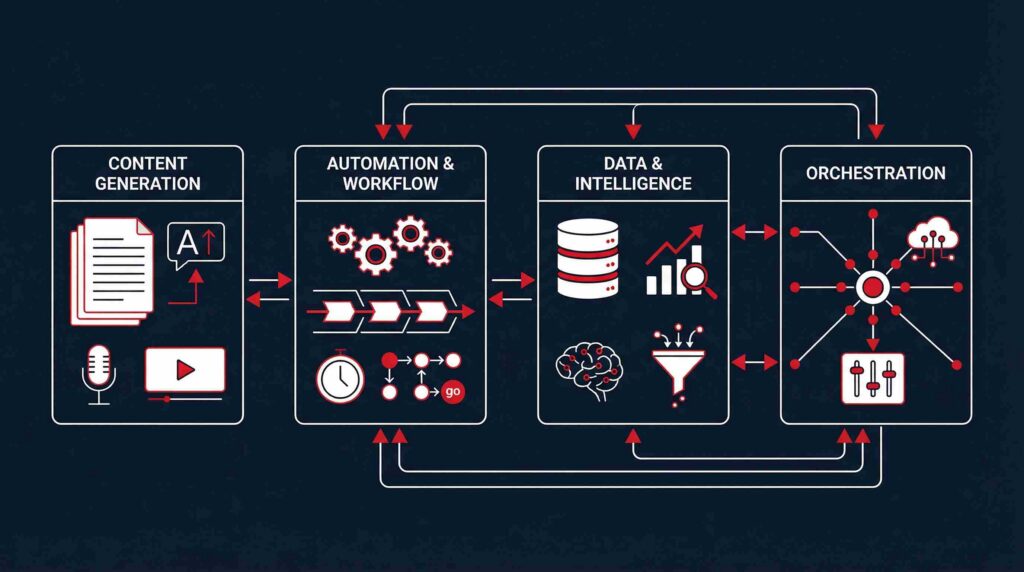
The highest-ROI entry point for most SMBs is the Media SEO Automation system. It requires minimal setup (WordPress + Zapier + OpenAI), delivers immediate SEO value across your entire media library, and builds confidence in automated workflows before tackling more complex workflows. Start there, prove the value, then expand to Blog-LinkedIn Distribution and Content QA.
05. Technology Stack
Build vs. Buy: The SMB Technology Decision
Choosing the right technology stack for automated content operations depends on your team size, technical capability, and budget. Here is how the options compare for SMBs with 50 to 500 employees.
Capability
DIY (Zapier + OpenAI)
Platform (Jasper/Copy.ai)
Redex Custom Build
Setup Time
2 to 4 weeks
1 to 2 weeks
4 to 8 weeks
Customization
Limited
Template-based
Fully custom
SEO Integration
Manual
Basic
Deep (QA + linking)
Multi-Channel
2 to 3 channels
3 to 5 channels
All channels
CRM Integration
Basic
Limited
Full (Dynamics 365)
Quality Gates
None
Basic scoring
Automated QA pipeline
Best For
Level 1 to 2 teams
Level 2 teams
Level 2 to 4 teams
Redex Recommendation
Start with DIY (Zapier + OpenAI) for your first 2 to 3 automation systems. This validates the approach with minimal investment. Once you see measurable ROI from your content systems, invest in a custom build that integrates all 7 systems into a unified content operating model. The platform approach (Jasper, Copy.ai) works for content generation but lacks the workflow orchestration and SEO integration that drive compounding returns.
06. Risk Mitigation
Why Most AI Content Automation Initiatives Fail
We have identified 4 systemic failure patterns. Each one is preventable with the right architectural decisions.
Technology-First Thinking
Teams adopt AI writing tools without defining workflows, quality standards, or integration points.
Redex Countermeasure
Start with the content operating model. Define inputs, outputs, quality gates, and distribution channels before selecting any tool.
No Quality Gate
AI-generated content goes live without SEO compliance checking, brand voice validation, or factual review.
Redex Countermeasure
Build automated QA into every pipeline. The Content QA Automation system catches 95% of issues before human review.
Single-Channel Publishing
Content is created for one platform and never repurposed. A blog post stays a blog post. ROI per asset remains low.
Redex Countermeasure
Implement the Blog to LinkedIn Distribution Engine and Content Repurposing workflows. Every asset should generate 5 to 7 derivative pieces.
Missing Feedback Loop
Teams publish content but never measure what works. No connection between performance data and future content decisions.
Redex Countermeasure
Deploy the Weekly SEO Monitoring Digest. Close the loop between publishing and performance to continuously improve content ROI.
07. Performance Metrics
Measuring AI Content Automation ROI
Track these metrics to measure the impact of your content automation investments.
Before Automation
After Automation
Improvement
Content Velocity
4 to 6 pieces/month
16 to 24 pieces/month
4x increase
Cost per Article
$400 to $800
$150 to $300
60% reduction
SEO Compliance Rate
40 to 55%
85 to 95%
2x improvement
Distribution Channels
1 to 2 per asset
5 to 7 per asset
5x reach
Lead Attribution
Unmeasured
Full funnel tracking
100% visibility
Time to Publish
5 to 7 days
1 to 2 days
75% faster
08. Roadmap
4-Phase Path to Full Content Automation
This roadmap is designed for SMBs that want to implement automated content systems systematically. Each phase builds on the previous one, and the total timeline is 12 to 16 weeks from kickoff to full operation.
Phase 1: Foundation: Audit, Strategy, and First Win
- Content maturity scorecard
- Asset and channel inventory
- First automation live (Media SEO)
Focus Area
Conduct a content maturity assessment using the Redex model. Audit existing content assets, distribution channels, and performance baselines. Identify the highest-ROI automation opportunity (typically Media SEO Automation).
Phase 2: Core Systems: Build the Content Engine
- Blog to LinkedIn pipeline live
- Content QA checks automated
- Lead scoring in Dynamics 365
Focus Area
Deploy the Blog-LinkedIn Distribution Engine, Content QA Automation, and Lead Capture to CRM Structuring systems. These three systems form the core of your content operations infrastructure and deliver the highest combined ROI.
Phase 3: Scale: Expand Channels and Content Types
- Internal linking suggestions live
- Case study pipeline automated
- 5+ distribution channels active
Focus Area
Add Internal Linking Automation, Case Study Generator, and multi-channel content repurposing. This phase multiplies the output of your existing content assets and strengthens your SEO cluster architecture. Your automated content engine now covers creation, distribution, and optimization.
Phase 4: Optimize: Close the Feedback Loop
- Weekly SEO digest automated
- Performance-driven content calendar
- Full ROI attribution dashboard
Focus Area
Deploy the Weekly SEO Monitoring Digest and connect performance data back to content planning. This phase transforms your content operation from a publishing machine into a self-improving system. Your content system now drives strategic decisions, not just execution.
09. Industry Applications
AI Content Automation by Industry
Application
Manufacturing
Construction
Professional Services
Top Content Type
Technical specs, case studies
Project portfolios, safety guides
Thought leadership, whitepapers
Primary Channel
SEO + LinkedIn
SEO + Video
LinkedIn + Email
Key Automation
Product content at scale
Safety compliance content
Case study generation
Biggest Win
SEO for long-tail product terms
Bid proposal content
Thought leadership velocity
Expected ROI
300 to 500%
250 to 400%
500 to 800%
For manufacturing SMBs, automated content systems deliver the highest impact on product-level SEO content. A manufacturer with 500+ SKUs can automate product descriptions, comparison guides, and technical specifications that would take months to create manually. For construction firms, the biggest opportunity is automating safety compliance content and project portfolio updates. Learn more about how AI transforms these industries in our manufacturing industry and construction industry guides.
Transform Your Operations
Stop Creating Content Manually. Start Building Systems.
Your competitors are already using automated content systems to publish 4x more content at 40% lower cost. The 7 systems in this article are production-ready blueprints. The question is whether you build them yourself or work with a team that has already deployed them for dozens of SMBs.
FAQs
What is AI content automation and how does it differ from AI writing tools?
Automated content systems go beyond individual writing tools like ChatGPT or Jasper. It refers to end-to-end systems that handle content creation, quality assurance, distribution, and performance tracking automatically. While a writing tool helps you draft faster, these systems build repeatable workflows that scale without proportional headcount growth. The difference is between using a tool and operating a system.
How much does it cost to implement automated content systems for an SMB?
A basic setup using Zapier and OpenAI costs $100 to $300 per month plus a one-time setup fee of $1,500 to $3,500. A full 7-system implementation with CRM integration and custom workflows typically costs $7,500 to $15,000 in total Year 1 investment. Most SMBs see positive ROI within 6 to 8 weeks, with Year 1 returns of 300 to 800% depending on the industry and content volume.
Will AI-generated content hurt our SEO rankings?
Not when implemented correctly. Google evaluates content quality, not authorship. The key is building quality gates into your automation pipeline. Our Content QA Automation system enforces keyword density, heading structure, internal linking, and readability standards before any content goes live. This actually improves SEO compliance compared to manual processes, which typically achieve only 40 to 55% compliance rates.
How long does it take to see results from automated content systems?
The first automation system (typically Media SEO) can be live within 3 to 5 days and delivers immediate value. Content velocity improvements are visible within 2 to 3 weeks. SEO ranking improvements typically appear within 8 to 12 weeks as the increased publishing velocity builds topical authority. Full ROI attribution requires 3 to 6 months of data collection.
Can automated content systems work for niche B2B industries like manufacturing and construction?
Yes. In fact, niche B2B industries often see higher ROI from these automated systems because they have less content competition and more long-tail keyword opportunities. A manufacturer with 500+ SKUs can automate product-level content that would be impossible to create manually. Construction firms can automate safety compliance content, project portfolios, and bid proposal materials. The systems adapt to any industry vocabulary and compliance requirements.